Quick Answer
Cyber security awareness training teaches employees to spot and report phishing, scams and risky data handling. Its six main benefits are lower breach risk, better protection of sensitive data, support for privacy and industry obligations, a stronger security culture, earlier detection of threats and lower costs from incidents. It matters because people play a part in most breaches: Verizon’s 2026 Data Breach Investigations Report found a human element in 62% of them.
In this guide
Australian businesses rely on email, cloud systems and online payments every day, which makes cyber security a core business risk.
The rise in cyber threats and attacks means organisations need to prioritise the security of their sensitive data and information.
One of the most practical ways to achieve this is regular cyber security awareness training for employees.
In this blog post, we look at the six main benefits of cyber security awareness training for employees, what the latest data shows and why it should be a top priority for all businesses.
Understanding the Cyber Security Landscape
Before looking at the benefits of training, it helps to have a basic understanding of the current cybersecurity landscape.
Cyber threats come in various forms, from phishing attacks to malware infections and data breaches.
These threats not only have the potential to disrupt business operations but also put sensitive data at risk.
As technology evolves, so do the tactics of cybercriminals, making it necessary for businesses to stay ahead of the curve in terms of cybersecurity.
The Human Element in Cyber Security
While businesses invest in advanced security technologies and firewalls, it’s important to recognise that one of the weakest links in the cybersecurity chain is often the human element. Employees, whether knowingly or unknowingly, can inadvertently expose an organisation to cyber threats.
Clicking on a malicious email attachment, sharing passwords, or falling victim to social engineering scams are just a few examples of how employees can compromise cyber security.
What the Latest Data Says About People and Cyber Risk
Recent Australian and global data shows why the human side of cyber security matters:
- People are involved in most breaches: Verizon’s 2026 Data Breach Investigations Report found a human element in 62% of breaches, and phishing was the way in for 16% of them.
- Scams are moving to phones: In the same report, median click rates in phishing tests sent by text message or voice were 40% higher than by email.
- Australian businesses are paying for it: The Australian Signals Directorate received over 84,700 cybercrime reports in 2024-25, about one every 6 minutes. The average self-reported cost per report was $56,600 for a small business, $97,200 for a medium business and $202,700 for a large business.
- Data breaches hit a record: The OAIC received 1,205 data breach notifications in 2025, the highest number since the scheme started in 2018.
Many of these attacks rely on one person clicking a link, approving a payment or sharing a password. That everyday behaviour is what awareness training targets.
6 Benefits of Cyber Security Awareness Training for Employees
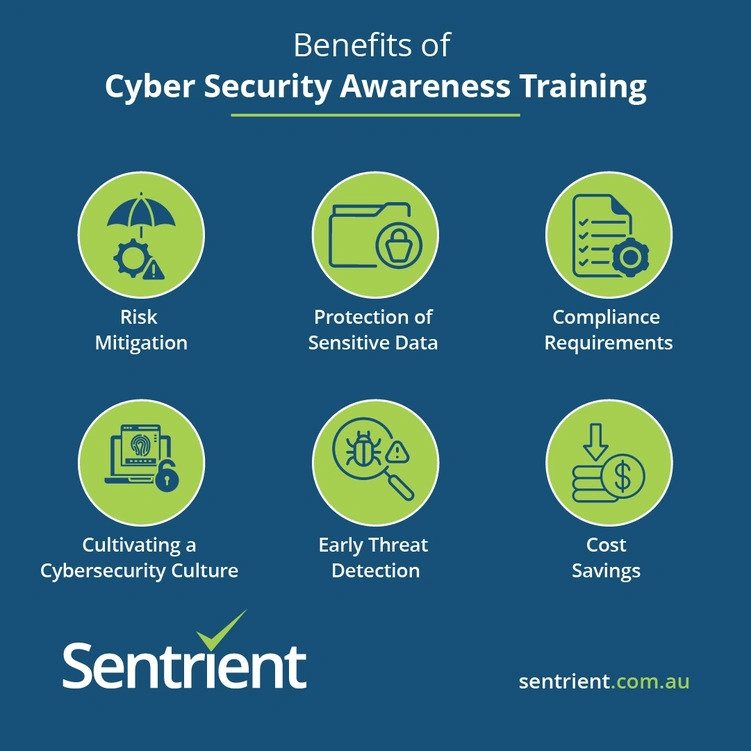
1. Risk Mitigation
One of the primary benefits of providing cybersecurity awareness training to employees is risk mitigation.
By educating staff about potential threats and how to recognise them, businesses can significantly reduce the likelihood of successful cyberattacks.
When employees are aware of the dangers and know how to respond appropriately, the organisation becomes a much more challenging target for cybercriminals.
2. Protection of Sensitive Data
Every organisation handles sensitive data, such as customer information, financial records, and proprietary intellectual property.
A breach of this data can have severe consequences, including legal repercussions and damage to the company’s reputation.
Cybersecurity training helps employees understand the importance of safeguarding this information and know how to do so effectively.
3. Compliance Requirements
Many industries have regulatory requirements regarding data security and privacy.
Failing to comply can lead to significant penalties and legal trouble.
Cybersecurity training helps employees understand these regulations and how to follow them, which supports the organisation’s compliance.
In Australia, organisations covered by the Privacy Act must take reasonable steps to protect the personal information they hold (Australian Privacy Principle 11). The OAIC’s APP 11 guidelines list governance, culture and training among the areas those steps should cover.
4. Cultivating a Cybersecurity Culture
Cybersecurity should not be viewed as a one-time training event but as an ongoing effort.
By consistently providing training and reinforcing the importance of cybersecurity, businesses can cultivate a cybersecurity culture among their employees.
This culture encourages vigilance and responsible behaviour regarding cybersecurity matters.
5. Early Threat Detection
Employees who are well-versed in cybersecurity are more likely to spot unusual activities or potential threats.
This early detection can stop a cyberattack from escalating into a significant breach. Quick identification of threats allows for a rapid response, minimising potential damage. Make reporting simple, so staff know who to tell and feel safe raising a concern.
6. Cost Savings
Investing in cybersecurity awareness training for employees can ultimately result in cost savings.
The financial impact of a successful cyberattack can be severe, including expenses for data recovery, legal fees, and damage control.
By preventing these attacks in the first place, businesses can save a substantial amount of money. As the ASD figures above show, a single incident can cost a small business tens of thousands of dollars.
Cyber Security Awareness Training Benefits at a Glance
| Benefit | What it looks like at work | Sign it is working |
|---|---|---|
| Risk mitigation | Staff pause before clicking links or opening attachments | Fewer clicks in phishing tests over time |
| Protection of sensitive data | Customer and staff records are shared only with the right people | Fewer emails sent to the wrong recipient |
| Compliance | Staff know the privacy and security rules that apply to their role | Training records ready for audits and insurers |
| Security culture | People talk openly about suspicious messages | More staff report concerns, not fewer |
| Early threat detection | Unusual requests are reported straight away | Shorter time from a suspicious email to a report |
| Cost savings | Fewer incidents need clean-up, recovery or legal advice | Fewer incidents and lower recovery costs |
How to Get These Benefits in Practice
The benefits above only arrive when training changes what people do. A few habits make the difference:
- Keep it short and regular: Brief modules through the year work better than one long session. Our guide on how to run cyber security awareness training shows how to fit it around normal work.
- Test with realistic scenarios: Include text message and phone scams, not only email, as these now catch more people.
- Make reporting easy and blame-free: Staff should know exactly who to tell and that raising a concern is always the right call.
- Choose content that fits Australian workplaces: Our guide to choosing the right cyber security awareness training course covers what to look for.
Conclusion: Why the Benefits Make Training a Priority
In conclusion, cyber security awareness training for employees is not just a best practice. It is a necessity for every Australian business.
The benefits of such training are numerous, ranging from risk mitigation and data protection to compliance and cost savings.
Businesses that prioritise cybersecurity education for their staff not only enhance their security posture but also contribute to a safer online environment for everyone.
In the ever-evolving world of cybersecurity, knowledge is power, and investing in employee training is an investment in the future security and success of the organisation. For a closer look at why training matters, read our guide to understanding the importance of cyber security awareness training.
Frequently Asked Questions About the Benefits of Cyber Security Awareness Training
1. What are the benefits of cyber security awareness training for employees?
The main benefits are lower risk of successful attacks, better protection of customer and business data, support for privacy and industry obligations, a stronger security culture, earlier detection and reporting of threats, and lower costs from incidents.
2. What is the purpose of security awareness training?
Its purpose is to change everyday behaviour so staff recognise phishing, scams and risky data handling, and know how to respond and report. Technology blocks many attacks, but people still decide whether to click a link, share a password or approve a payment.
3. Does cyber security awareness training reduce the risk of a data breach?
It reduces the risks that depend on people. Verizon’s 2026 Data Breach Investigations Report found a human element in 62% of breaches, so training targets a large share of the problem. It works best alongside technical controls such as multi-factor authentication, patching and backups, and it cannot remove the risk entirely.
4. Is cyber security awareness training worth it for small businesses?
For most small businesses, yes. The Australian Signals Directorate reported an average self-reported cost of $56,600 per cybercrime report for small businesses in 2024-25. Small teams also rely on each person more, so one mistake can affect the whole business.
5. How does awareness training help if a data breach happens?
Trained staff are more likely to spot and report a possible breach quickly. That gives the business time to contain it, assess whether it is an eligible data breach and, where required, notify the OAIC and affected people under the Notifiable Data Breaches scheme.
Sources
Verizon, 2026 Data Breach Investigations Report: Executive Summary
OAIC, Data breach notifications increase to all-time high in 2025 (6 July 2026)
OAIC, Australian Privacy Principles guidelines, Chapter 11: Security of personal information
Last reviewed: October 2026
This article is general information, not legal advice. Check your specific privacy and security obligations with a qualified adviser.
Read More About Cyber Security:
- The Importance Of Cyber Security Training For IT Professionals
- The Importance Of Cyber Security Awareness Training For Employees
- Cyber Security Awareness Training for Australian Employees: How to Choose the Right Course
- Why Is Cybersecurity Awareness Training Important?
- The Importance Of Cyber Security Training For IT Professionals
- 10 Best Cyber Security Awareness Training Courses For Employees