Quick Answer
Examples of racial discrimination in the workplace include refusing to hire or promote someone because of their race, paying them less, racist jokes or comments, excluding them from work activities, making assumptions about their ability, and policies that unfairly disadvantage people from certain backgrounds. In Australia, racial discrimination at work is unlawful under the Racial Discrimination Act 1975, the Fair Work Act and state and territory laws, and employers must also manage racism as a work health and safety risk.
In this guide
Racial discrimination in the workplace is a serious issue that affects many employees of different ethnicities and races. It can be obvious or subtle, and it can come from managers, co-workers, customers or the way policies are set up. Below are the most common examples, what Australian law says and how employers can prevent it.
5 Common Examples of Racial Discrimination in the Workplace
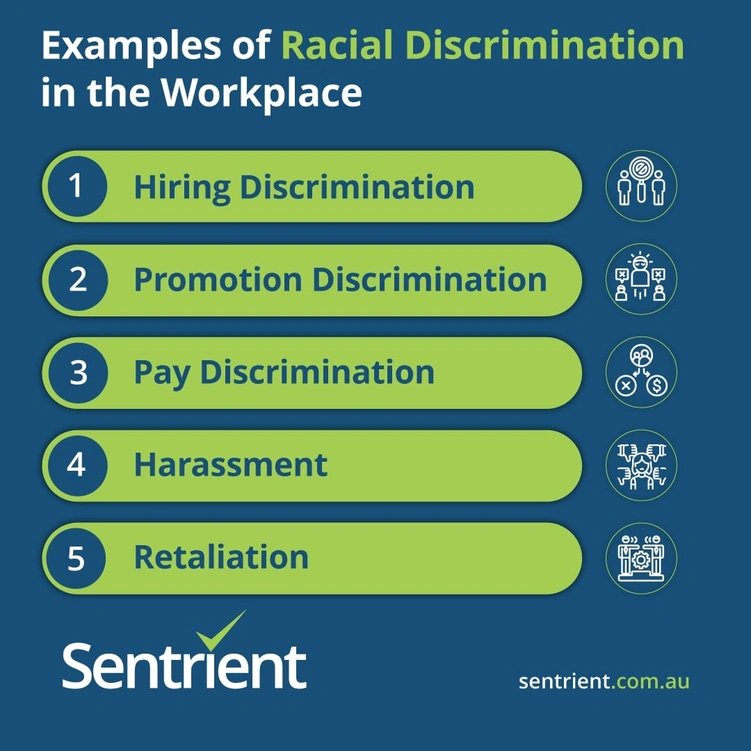
- Hiring Discrimination: This occurs when an employer refuses to hire an individual based on their race or ethnicity. This can happen during the application process, the interview process, or even after the individual has been offered a job.
- Promotion Discrimination: This occurs when an employer denies an employee a promotion based on their race or ethnicity, even though they are qualified for the position.
- Pay Discrimination: This occurs when an employer pays an employee of a certain race or ethnicity less than their colleagues who are of a different race or ethnicity, despite having the same qualifications and job responsibilities.
- Harassment: This occurs when an employee is subjected to derogatory or offensive comments, jokes, or gestures based on their race or ethnicity. This type of discrimination can create a hostile work environment and can lead to mental and emotional distress for the affected employee.
- Retaliation: This occurs when an employee who complains about racial discrimination is subjected to negative consequences, such as being demoted, transferred, or even fired.
7 More Examples of Racial Discrimination at Work
Racial discrimination is not always obvious. Safe Work Australia notes that racism at work can be subtle as well as open, and can come from managers, co-workers, customers or the way an organisation’s policies work. Other common examples include:
- Exclusion: Leaving someone out of meetings, training, work events or informal networks because of their race or ethnicity.
- Comments about appearance or culture: Remarks about a person’s accent, food, clothing or cultural practices.
- Assumptions about ability: Assuming a worker lacks skills or knowledge because of their race, or holding them to different performance standards.
- Stereotyped tasks and rosters: Giving people certain jobs, shifts or customers based on assumptions about their background.
- Unequal access to development: Overlooking someone for training, mentoring or acting roles that others in the same position are offered.
- Name-based screening: Passing over job applications because the applicant’s name does not sound English.
- Rules that disadvantage some groups: Requirements, such as asking for “native English speakers” when the role does not need it, that exclude people of certain backgrounds without a good reason. This is known as indirect discrimination.
Direct and Indirect Racial Discrimination: What Australian Law Says
Under the Racial Discrimination Act 1975 (Cth), it is unlawful to treat someone less favourably at work because of their race, colour, descent, or national or ethnic origin. This is direct discrimination. It is also unlawful to impose a rule or condition that is not reasonable and that disadvantages people of a particular race. This is indirect discrimination. Victimising someone because they made or supported a complaint is unlawful too.
Other laws add further protection. Under the Fair Work Act, employers cannot take adverse action against an employee or job applicant because of race, colour, national extraction or social origin, and every state and territory has its own anti-discrimination laws. Employers also have a work health and safety duty to eliminate or minimise the risk of racism at work, so far as is reasonably practicable.
Racist comments, jokes and abuse can also be racial harassment or vilification. Our guide to racial harassment in the workplace covers those in detail.
Examples of Racial Discrimination at a Glance
| Example | Type | Why it can be unlawful |
|---|---|---|
| Not hiring a qualified applicant because of their ethnicity | Direct discrimination | Less favourable treatment because of race |
| Paying one worker less than colleagues doing the same job because of their background | Direct discrimination | Less favourable treatment because of race |
| Requiring ‘native English speakers’ for a role that does not need it | Indirect discrimination | An unreasonable condition that disadvantages people of certain races |
| Racist jokes or comments that are allowed to continue | Racial harassment | Can breach anti-discrimination and work health and safety laws |
| Demoting someone after they complain about racism | Victimisation | Punishing a person for making a complaint is unlawful |
How Common Is Racial Discrimination at Work in Australia?
Hiring is one of the clearest places to see it. In a Monash University field study of more than 12,000 job applications, applicants with non-English names received 57.4% fewer callbacks for leadership roles than applicants with English names, despite identical resumes. For non-leadership roles, they received 45.3% fewer callbacks. All the candidates were born, schooled and worked in Australia.
Safe Work Australia also notes that First Nations people and people from culturally diverse backgrounds are most at risk of racism at work, and that many workers do not report it because they fear the consequences. A lack of complaints does not mean a workplace is free from racism.
How Employers Can Prevent Racial Discrimination at Work
It’s important for employers to take proactive steps to prevent racial discrimination in the workplace, such as providing training to all employees on the topic, implementing policies and procedures to address discrimination, and conducting regular audits to identify and address any potential issues. Additionally, employees should feel comfortable reporting discrimination if they experience it and should not be afraid of retaliation.
Practical steps that help include:
- Fair recruitment: Use clear selection criteria and consider hiding names in the first screening round, as the Monash researchers recommend.
- Clear policies: Set out what racial discrimination and harassment look like, how to report them and what will happen.
- Training for everyone: Help managers and staff recognise subtle bias as well as open racism.
- Risk management: Treat racism as a psychosocial hazard. Listen to workers, watch for patterns and review controls, including for racism from customers.
- Regular checks: Review pay, promotions and complaints data for gaps between groups.
What to Do If You Experience or Witness Racial Discrimination
Keep a record of what happened, when and who was there, and raise it through your workplace’s complaint process if you feel safe to. If that does not resolve it, you can contact the Australian Human Rights Commission, your state or territory anti-discrimination body, or the Fair Work Ombudsman on 13 13 94. For a step-by-step approach, see our guide on how to deal with racial discrimination in the workplace.
Final Thoughts on Racial Discrimination in the Workplace
It’s important to remember that discrimination of any kind is unacceptable and must be addressed promptly and effectively. By promoting a culture of inclusivity and respect, we can create a workplace where everyone feels valued and respected.
Frequently Asked Questions About Racial Discrimination in the Workplace
1. What are examples of racial discrimination in the workplace?
Common examples include refusing to hire or promote someone because of their race, paying them less than colleagues doing the same work, racist jokes or comments, excluding people from meetings or events, assuming they lack ability, giving them certain tasks based on stereotypes, and rules that unfairly disadvantage people of particular backgrounds.
2. What is the difference between direct and indirect racial discrimination?
Direct discrimination is treating someone less favourably because of their race, such as not hiring them. Indirect discrimination is a rule or condition that applies to everyone but unfairly disadvantages people of a particular race and is not reasonable, such as an unnecessary ‘native English speaker’ requirement.
3. Is an employer responsible for racism from customers?
Employers have a work health and safety duty to eliminate or minimise the risk of racism at work, and Safe Work Australia notes this includes racism from customers, clients and suppliers. That means having clear rules for customer behaviour, supporting staff and acting on incidents.
4. Can asking for ‘native English speakers’ be racial discrimination?
It can be. A requirement for a level of English that the job genuinely needs is usually reasonable. Asking for ‘native’ speakers can exclude people based on national or ethnic origin, which may be indirect discrimination if it is not reasonable for the role.
5. What should I do if I experience racial discrimination at work?
Keep a record of each incident, raise it through your workplace’s complaint process if it is safe to, and seek support. You can also contact the Australian Human Rights Commission, your state or territory anti-discrimination body, or the Fair Work Ombudsman.
Sources
Fair Work Ombudsman, Protection from discrimination at work
Last reviewed: October 2026
This article is general information, not legal advice. For advice about a specific situation, contact a lawyer, your union or the agencies listed above.
Read More About Racial Harassment:
- How To Deal With Racial Discrimination In The Workplace
- How To Identify, Prevent, And Respond To Discriminatory Harassment In The Workplace
- How To Identify, Prevent, And Respond To Racial Harassment In The Workplace
- How To Deal With Unfair Discrimination In The Workplace
- What Are Examples Of Quid Pro Quo Harassment In The Workplace