
Quick Answer
Types of employee records: Australian employers must keep employee records for 7 years. Under the Fair Work Act, these include each employee’s basic employment details, pay and deductions, hours worked (where overtime or penalty rates apply, and for casuals), leave, superannuation contributions and how employment ended. Records must be in English, legible and easy to access. Many businesses also keep personal, contact, job, training and performance records to run HR well.
In this guide
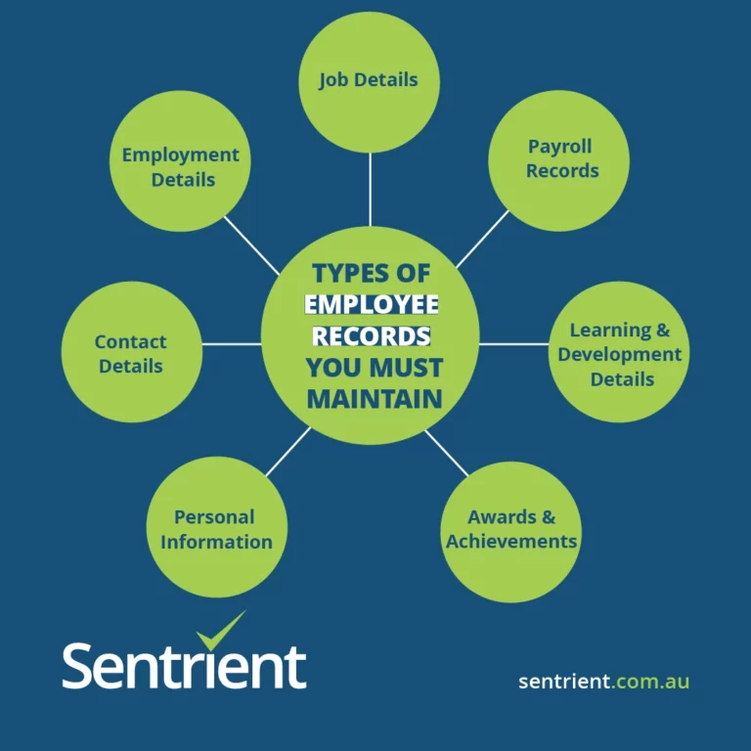
- Types of Employee Records You Must Maintain
- 1. Personal information
- 2. Contact details
- 3. Employment details
- 4. Job details
- 5. Payroll records
- 6. Learning and development details
- 7. Awards and achievements
- What Records Does Fair Work Require Employers to Keep?
- Conclusion
- Frequently Asked Questions About Employee Records
Maintaining employee records and personal information is one of the many administrative tasks performed by the HR department within businesses of all sizes.
With such administrative tasks that involve personal information collection, there are laws around the privacy and protection of personal information for our staff as well as our clients…
The maintenance of records can also vary greatly, for example, Australian business regulations may require some employee records to be kept for 7 years, such as employee details about pay, leave, work hours, reimbursements, insurance, superannuation, etc.
Another example in Australia would be fair work claims for workplace bullying, where some related complaints, such as harassment complaints to the Australian Human Rights Commission, can be made up to 24 months after the conduct, or there may be an investigation of an incident from 12 months ago, and we are now trying to find the previous forklift license for that particular forklift operator.
The list goes on, and all roads lead to good records management for past, present and future staff.
These records must be able to provide full employment history, which may be useful in case of any legal disputes in future.
The task of managing these records might seem overwhelming, and it will continue to do so until you are organised, and by organised, we mean having the right structures in place and the right systems and modes of operation.
But it is not just about the technology, but about embracing the technology to put the hones on the staff to do things, if and when required, and that you have the appropriate workflows in place for validation and reporting on compliance records.
To ease things for you, we have prepared a list of some of the personal information and compliance records that are most commonly maintained in a human resource information system as an employer.
Types of Employee Records You Must Maintain
1. Personal information
This is the basic information about an employee, which gives details of their background, identity proofs, and qualifications.
Collecting this information can also be used to know more about the demographic information of employees that may be used to make their work experience better.
The common details recorded here include (and are not limited to):
- Name
- Age
- Birthdate
- Gender
- Nationality
- Marital status
- Educational qualifications
- Permanent address
- Passport number
- Tax file number (TFN) declaration
- Other identity proofs
Such details also help employers analyse employee demographics when employee diversity is a priority.
Employers must check that every employee who is not an Australian citizen has the right to work in Australia, for example through the government’s free VEVO service, and keep a record of that check. Only collect personal details you need. Health information, such as medical conditions, is sensitive information under privacy law, so collect it only when it is needed, with the employee’s consent, and store it securely.
2. Contact details
Every employer should record up-to-date contact information for their employees.
They must be able to reach the employees via phone, email, or in person for any correspondence.
This must also include the details of an emergency contact person who might be needed to correspond in case of emergency.
One of the most common areas that are lacking for small and medium businesses is not having up-to-date emergency contact details, and this can create great stress in the event of an incident, where they are left with either no contacts or too many contacts.
All of which expose unnecessary risk and create unnecessary strain.
Some of the contact details that are required to be recorded include:
- Contact number
- Email address
- Current residential address
- Emergency contact name and number
- Relationship with the emergency contact person
- Mediclaim details, if any
3. Employment details
One of the primary ways of knowing your employee better is their employment history.
Every new employer can gain insights into the data, such as employee attrition rate or promotion, through these details.
Regulations require employers to document the date of joining, previous experience, and referral details from previous colleagues or managers if available.
Other information might include the bank account details towards which the salaries were drawn, employee identity number, etc.
Some of the common information required to be stored under this record type include:
- Employee identification number
- Employment type
- Employment status
- Date of Joining
- Bank account number
- Bank name
- BSB
- Last working day
4. Job details
Keeping track of what projects your employees are currently working on is not a legal requirement, but it is good practice.
Managing this information tells you how many of your employees have or don’t have projects assigned to them.
Businesses may need to make sure that a certain number of employees are available for a new project before taking up a new project.
This helps maintain a culture of balanced work assignments in your workplace where nobody is being over or underworked.
Some of the information that can be stored here includes:
- Job description
- Skills
- Location
- Current projects
This information is also useful in gathering information related to the role of an employee in your organisation.

5. Payroll records
Businesses might or might not be required to record the details of employee payroll based on their location.
Documenting payroll records also helps employees explain the cause of employee-related decisions whenever required.
These records need to be made readily available.
6. Learning and development details
The best way to make sure that employees are performing their best is to provide them with competent training.
Maintaining learning and development details helps you track which employee has or has not been to which training.
This also helps derive the employees who require particular training to perform their jobs better or which employee’s skills are better suited for which project.
The laws make sure every employee is given an equal opportunity by their employer.
These details can be easily stored with an integrated HRMS that includes a learning management system.
7. Awards and achievements
Recognising employee efforts and rewarding them can go a long way in retaining satisfied employees.
Employers are also required to store such details and encourage their employees to keep performing better in the interest of the growth of both the organisation and the employee.
What Records Does Fair Work Require Employers to Keep?
The categories above are what a well-run HR team keeps. The legal minimum for national system employers is set by the Fair Work Act and Regulations. According to business.gov.au, you must keep these employee records for 7 years:
- Basic employment details: your business name and ABN, the employee’s name, start date, and whether they are full-time, part-time or casual, and permanent or temporary.
- Pay: the rate of pay, gross and net amounts, deductions, and any loadings, allowances, penalty rates, bonuses or incentives.
- Hours worked: including overtime, for employees paid overtime or penalty rates and for casual employees.
- Leave: leave taken and leave balances.
- Superannuation: the amount paid, the fund, the period it covers and the date it was paid.
- End of employment: how the employment ended and who ended it.
Records must be in English, legible and readily accessible to a Fair Work Inspector. Employees can ask to see and copy their own records, and you must give each employee a pay slip within one working day of payday. The Fair Work Ombudsman has templates and more detail.
Conclusion
When regulations specify the need for maintaining employee records, there’s not just the regulatory compliance involved.
The collected information can be used to identify trends and derive conclusions for employee behaviour and growth.
Although this may seem like a herculean task without the right tools, a complete human resource management software can help streamline it for HR personnel.
Capturing, storing, and managing employee information is now simple with the digital HRMS solution provided by Sentrient HR.
It also includes advanced reporting to help decision-makers get the required information with just a few clicks.
Contact Sentrient HR today to know how it can help keep employee records for your business.
Frequently Asked Questions About Employee Records
1. How long must employers keep employee records in Australia?
At least 7 years. This applies to the records the Fair Work Act requires, including pay, hours, leave and superannuation records. Some other laws, such as tax and work health and safety laws, have their own record-keeping rules.
2. Can employees see their own employee records?
Yes. Employees and former employees can ask to inspect and copy the Fair Work records their employer keeps about them, such as pay, hours and leave records.
3. What is the difference between Fair Work records and other HR records?
Fair Work records are the legal minimum: employment details, pay, hours, leave, super and termination. Other HR records, such as training, performance reviews and job details, are not all required by law, but they help you manage your people and respond to disputes or investigations.
4. Should employee records be stored digitally?
They can be. Digital records are fine as long as they are accurate, legible, in English and easy to access when needed. A records management system also makes it easier to control who can see personal information.
Sources
business.gov.au, Employee records
Fair Work Ombudsman, Pay slips and record-keeping
Last reviewed: October 2026
This article is general information, not legal advice.
Read More About Records Management:
- How Sentrient’s Records Management Software Helps Australian Businesses Meet The Privacy Act Requirements
- Why Must A Regulatory Compliance Software Enable Self-Service Records Management?
- How to Keep Your Business Compliance Audit-Ready with Records Management Software
- Why It’s Indispensable to Maintain Accurate Employee Records









