Quick Answer
How to identify money laundering: watch for four types of red flags: suspicious customer behaviour, unusual international transactions, larger than normal transactions and suspicious transaction patterns such as structuring cash below $10,000. One red flag alone may have an innocent explanation, but several together should be escalated. Since 1 July 2026, real estate agents, lawyers, conveyancers and accountants providing designated services also have AML/CTF obligations in Australia.
In this guide
There are a range of indicators to help you identify potential money laundering activity, ranging from suspicious customer behaviour, international transactions, larger than normal transactions and suspicious transactions.
The presence of a single indicator may not necessarily raise suspicion but could warrant further monitoring and examination. Multiple indicators are more likely to result in a suspicion being formed.
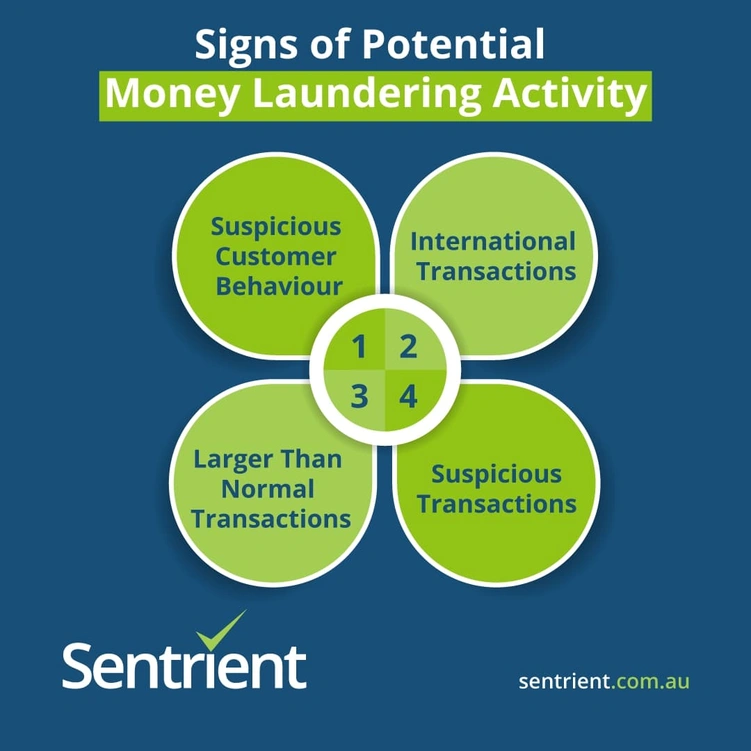
1. Suspicious Customer Behaviour
Suspicious customer behaviour that may be an indicator of money laundering include:
- refusing to show identification.
- unusual business account behaviours such as frequent changes of address, phone numbers, etc.
- the unusual desire for anonymity or discretion in their affairs
- unusual interest in internal controls and processes
- use of false identification to conduct transactions.
2. Unusual International Transactions
International transactions that may be an indicator of money laundering include:
- high-value cash deposits to pay for international funds transfers.
- high-value international funds transfers to/from Australia with no apparent business or other reason
- ordering customers to send international funds transfers to multiple beneficiaries.
- significant volume of international funds transfers conducted in a short period of time.
Recommended reading: Anti-Money Laundering and Counter Terrorism Financing Course
3. Larger Than Normal Transactions
Large transactions that may be an indicator of money laundering include:
- large cash deposits and withdrawals
- new customer attempting large transactions.
- Regular large cash deposits are made into a remitter’s accounts by the same third party, who does not appear to be directly linked to the remittance business.
4. Suspicious Transaction Patterns
Unusual transactions that may be an indicator of money laundering include:
- cash withdrawals conducted at various bank branches and/or ATMs on the same day.
- multiple cash deposits at various banks and branches, and multiple customers sending international funds transfers to the same overseas beneficiary.
- structuring of cash deposits and withdrawals to avoid reporting requirements.
- undertaking transactions that appear inconsistent with their profile and/or transaction history.
- use of third parties to carry cash, deposit, or withdraw funds.
Money Laundering Red Flags in Real Estate and Professional Services
From 1 July 2026, Australia’s AML/CTF laws cover tens of thousands more businesses, including real estate agents, lawyers, conveyancers, accountants, trust and company service providers, and dealers in precious metals and stones. According to AUSTRAC, more than $60 billion in illicit profits is laundered through the Australian economy each year, and criminals often target property and trust or company structures to hide it.
AUSTRAC’s guidance for the real estate sector lists warning signs such as:
- a deposit or purchase paid by an unrelated third party, or third parties used to hide who really owns the property
- a request to put the property in the name of a relative, a minor or a complex company or trust structure with no clear reason
- cash deposited in structured amounts, then sent to a real estate, conveyancer or legal trust account
- buying and reselling properties quickly, or paying well above or below market value without concern
- a sudden change of ownership close to settlement, or a customer who ends the relationship when asked for more information
If your business is newly regulated, our AML/CTF training for real estate and AML/CTF training for professional services courses cover these obligations. You can also check if you are regulated on the AUSTRAC website.
What to Do If You Spot a Money Laundering Red Flag
Knowing how to identify money laundering is only useful if it leads to the right next step. If you work for a reporting entity:
- Do not tip off the customer: it is against the law to tell the customer or anyone else that a suspicion has been formed or reported, unless an exception applies.
- Escalate internally: follow your AML/CTF program and tell your AML/CTF compliance officer straight away.
- Report to AUSTRAC on time: once a suspicion is formed, a suspicious matter report is due within 3 business days, or within 24 hours if it relates to terrorism financing.
- Report large cash transactions: cash transactions of $10,000 or more must be reported as threshold transactions, whether or not they look suspicious.
- Keep records: document what you saw, when and what you did, in line with your record-keeping obligations.
Knowing how laundering works also helps you spot it earlier. Our guide to the 3 stages of the money laundering process explains how illicit funds move through placement, layering and integration.
Find out how you can access online learning on anti-money laundering and counter-terrorism financing now.
Sentrient provides an online AML and CTF course that enables a Reporting Entity to deliver practical training for its staff that covers Australia’s AML/CTF obligations.
For more information, contact us at 1300 040 589 or visit our website at www.sentrient.com.au today.
FAQs: How to Identify Money Laundering
1. How can you identify money laundering?
Look for patterns that do not fit the customer or the business: reluctance to show identification, high-value or rapid international transfers with no clear purpose, unusually large cash transactions, and cash split into amounts below $10,000. One indicator may have an innocent explanation, but several together should be escalated.
2. What are the red flags for money laundering?
Common red flags include false or missing identification, frequent changes to contact details, an unusual desire for anonymity, large cash deposits, transfers to multiple overseas beneficiaries, structured deposits across branches or ATMs, and the use of third parties or complex company and trust structures to hide who owns the money.
3. What should I do if I suspect money laundering at work?
Do not confront or warn the customer. Record what you saw and tell your AML/CTF compliance officer, who will decide whether to submit a suspicious matter report to AUSTRAC. Reporting entities must lodge a report within 3 business days of forming a suspicion, or within 24 hours for terrorism financing.
4. Is splitting cash deposits to avoid reporting illegal in Australia?
Yes. Deliberately breaking up cash transactions to avoid the $10,000 threshold reporting requirement, known as structuring, is an offence under the AML/CTF Act, even if the money comes from a legal source.
5. Who must report suspicious matters to AUSTRAC?
Reporting entities that provide designated services, such as banks, remitters, casinos and digital currency exchanges. Since 1 July 2026 this also includes real estate agents, lawyers, conveyancers, accountants, trust and company service providers, and dealers in precious metals and stones when they provide designated services.
Sources
AUSTRAC, Risk insights and indicators of suspicious activity for the real estate sector
AUSTRAC, Suspicious matter reports
AUSTRAC, Check if you may be regulated
Last reviewed: October 2026
This article is general information, not legal advice. Check your specific AML/CTF obligations with AUSTRAC or a qualified adviser.