Quick Answer:
Risk management is the structured process of identifying what could harm your organisation, rating how likely and how serious it is, putting controls in place, and reviewing whether those controls still work. In Australia it is also a legal duty. The Work Health and Safety Act 2011 requires employers to eliminate risks so far as is reasonably practicable, and to minimise them where elimination is not possible. The process runs in five steps: establish the context, identify the risks, analyse and evaluate them, treat them, then monitor and review. What makes it defensible is not the framework. It is the documentation that proves you followed it.
In this guide
- What risk management is
- What a risk management framework is
- The 6 types of risk Australian businesses face
- The risk management process in 5 steps
- The hierarchy of control
- Risk management strategies compared
- Risk management for small and medium businesses
- Risk management at enterprise scale
- How to implement risk management
- The role of GRC and risk management software
- Psychosocial risk, the one most underestimated
- 5 mistakes Australian organisations make
- A 12-point readiness self-check
- FAQs
Every business faces risk. The question is whether you manage it, or it manages you!
Australian workplaces recorded 146,700 serious workers’ compensation claims in 2023-24, equivalent to more than 400 a day. Mental health condition claims rose 14.7% in a single year and now make up 12% of all serious claims. Over the same period the Fair Work Ombudsman recovered more than $358 million in unpaid wages for over 249,000 workers.
None of those numbers describe organisations that set out to do the wrong thing. They describe organisations that could not show what they had done. That is the gap a risk management framework closes.
This guide covers what HR managers, compliance officers and board members need: the six categories of risk, the five-step risk management process, the hierarchy of control that Australian law actually requires you to apply, the strategies that fit different organisations, and how to implement the lot without a dedicated compliance team.
Whether you are building a first risk register or replacing a siloed system that no longer keeps pace, this is the framework to start from.
Sentrient builds workplace compliance software for Australian and New Zealand organisations, including a risk management system that holds risk registers, assigns ownership and links risks to incidents, controls and training records.
146,700
Serious workers’ compensation claims, Australia 2023-24
$67,400
Median compensation, mental health claims (all claims: $16,300)
35.7 weeks
Median time lost, mental health claims (all claims: 7.4)
$28.6b
Estimated annual GDP gain if work-related injury were eliminated
What Is Risk Management?
Risk management is the structured process of identifying, assessing and controlling threats that could affect your organisation’s people, operations, finances and reputation.
In an Australian context it also intersects directly with legal obligations under the Work Health and Safety Act 2011, the Fair Work Act 2009, the Privacy Act 1988 and relevant state-based legislation.
Under the WHS Act, a person conducting a business or undertaking has a primary duty of care to ensure, so far as is reasonably practicable, the health and safety of workers. Risk management is how that duty is discharged in practice.
Effective risk management is not reactive. It creates a proactive, documented system so that when something goes wrong, and eventually something will, your organisation can demonstrate it took every reasonable precaution.
Why this matters to HR and compliance leaders
If a workplace claim reaches Fair Work or a WHS regulator, the question is not whether your intentions were good. The question is what you can demonstrate.
Training records, policy acknowledgements, risk assessments and audit trails are the defence. A risk management system turns good intentions into documented evidence.
What Is A Risk Management Framework?
A risk management framework is the structure that makes the process repeatable. The process tells you what to do. The framework says who does it, on what cycle, with what authority, and where the record lives.
Most organisations that say they “do risk management” have a process and no framework.
That is why the same hazard gets reassessed by three people, why the register goes stale between audits, and why nobody can say who signed off on accepting a risk.
A workable framework for an Australian mid-market organisation has six components:
| Component | What it settles | Where it usually fails |
|---|---|---|
| Governance and accountability | Who owns risk overall, who owns each risk, and what the board sees | Ownership sits with a job title that has no authority to act |
| Risk appetite | How much risk the organisation will accept, and where it will not | Written in adjectives, so no manager can apply it to a decision |
| Process | The five steps: context, identify, analyse, treat, review | Runs once at implementation and never again |
| Risk register | The single record of risks, ratings, controls and owners | Lives in a spreadsheet only one person maintains |
| Controls and assurance | What reduces each risk, and evidence it is working | Controls listed but never tested, so effectiveness is assumed |
| Reporting and review | What leadership sees, how often, and what triggers a re-rate | Annual cycle only, ignoring the regulation 38 triggers below |
ISO 31000 describes the same idea as leadership commitment, integration, design, implementation, evaluation and improvement.
The table above is that expressed in the language of an organisation with an HR manager rather than a chief risk officer.
Building one is a separate exercise from describing it. How to build a risk assessment framework walks through each of the six components in order.
Where safety, HR and operations already run frameworks of their own, integrated risk management covers bringing them together without starting again.
Types of Risk Australian Businesses Face
Understanding the risk landscape is the first step. Australian organisations typically face six interconnected categories of risk, each requiring a different management approach.
Treating them in isolation is where most frameworks break down.
1. Operational risk
What it is: Operational risk arises from failures in your internal processes, people or systems, or from external events outside your control.
It is the broadest category and the one most consistently underestimated by growing organisations.
What it looks like in practice:
- An onboarding process that exists in someone’s head but is never documented, creating inconsistency and gaps every time a new hire joins
- Manual records management across spreadsheets and shared drives that no one can audit under pressure
- Key-person dependency, where critical compliance knowledge sits with one employee who then leaves
- System failures during audits or inspections because records were never centralised
Why it matters: Operational failures do not always trigger an immediate crisis. They quietly accumulate.
By the time a workers’ compensation claim, a Fair Work audit or a board-level review surfaces the gaps, the cost of fixing them is significantly higher than the cost of preventing them.
2. Compliance and regulatory risk
What it is: Compliance risk is the exposure that arises from failing to meet obligations under applicable laws, regulations and industry standards.
For Australian businesses this spans the Work Health and Safety Act 2011, the Fair Work Act 2009, the Privacy Act 1988, anti-discrimination legislation, anti-money laundering obligations, and sector-specific requirements in healthcare, aged care, financial services and education.
What it looks like in practice:
- Staff not trained on sexual harassment, bullying or manual handling policies, with no completion records to prove otherwise
- Policy acknowledgements not documented, so employees say they were never informed and there is no signed evidence to dispute it
- Pay slip and record-keeping breaches. The Fair Work Ombudsman recovered $358 million in unpaid wages for more than 249,000 workers in 2024-25, and issued compliance notices recovering a further $8.2 million for 3,428 workers
- Regulatory changes the business did not track, leaving outdated policies and procedures in active use
Why it matters: Regulatory consequences range from financial penalties and licence conditions through to prosecution.
More immediately, poor record keeping removes the organisation’s ability to defend itself, not because the risk was unmanaged, but because there is no documented evidence that it was managed.
The seven steps good businesses take to mitigate the risk of non-compliance cover this exposure across pay, privacy and conduct together.
3. People and workplace risk
What it is: People risk covers the full spectrum of harm that can occur in the employment relationship.
Physical injuries, psychosocial hazards, discrimination, harassment, performance failures and poor workforce governance. It is the risk type most directly linked to regulatory enforcement activity in Australia.
What it looks like in practice:
- Physical injuries from inadequate manual handling training or site hazards without documented risk assessments
- Workplace bullying or harassment incidents where no training or policy acknowledgement exists, making it impossible to demonstrate due diligence
- Poor onboarding that leaves new employees unaware of safety procedures, complaint processes or their rights
- Psychosocial hazards such as high workload, management conflict and isolation that go unassessed and escalate into workers’ compensation claims
The numbers: There were 146,700 serious workers’ compensation claims in 2023-24. Mental health condition claims increased 14.7% in a single year and now represent 12% of all serious claims.
For those claims the median compensation paid was $67,400 and the median time lost was 35.7 working weeks, against $16,300 and 7.4 weeks across all serious claims.
Those medians are the most recent published by Safe Work Australia and relate to 2022-23 claims, which have had time to be finalised.
HR risk management covers the employment side of this in detail, and the 11 types of workplace harassment sets out the conduct exposure and where employer liability attaches.
4. Reputational risk
What it is: Reputational risk is damage to your organisation’s standing in the eyes of clients, employees, regulators and the public.
It is almost always a downstream consequence of another risk category. A compliance failure, a people incident, a data breach or a governance breakdown.
What it looks like in practice:
- A Fair Work investigation that becomes public. Even where the outcome is favourable, the process itself signals weak governance to prospective clients and employees
- A notifiable data breach under the Privacy Act that requires you to contact affected individuals, damaging trust well before any regulatory outcome
- Workers’ compensation claims or workplace injury incidents that attract industry or media attention
- Negative Glassdoor or LinkedIn commentary from former employees signalling a disorganised or unsafe culture, which affects talent acquisition directly
Why it matters: Reputational damage tends to cost more than the original penalty, and it lasts longer. It also compounds.
A compliance failure that becomes public makes the next tender harder to win and the next hire harder to attract, neither of which appears on any penalty notice.
Most frameworks treat reputation as a secondary concern when it is one of the strongest arguments for getting the underlying controls right.
Reputational damage usually starts with culture rather than with an incident. Cultural risk management covers the conditions that produce the events in the first place.
5. Data privacy and cybersecurity risk
What it is: Data privacy and cybersecurity risk covers exposure arising from unauthorised access to, loss of, or misuse of personal or organisational data.
Under the Privacy Act 1988 and the Notifiable Data Breaches scheme, Australian organisations have mandatory reporting obligations when a breach is likely to result in serious harm.
What it looks like in practice:
- Employee records, performance data and health information stored across unprotected shared drives or personal email accounts
- Phishing attacks targeting staff who have received no cybersecurity awareness training
- Third-party vendor or contractor access to sensitive HR or compliance data without governance controls
- No documented incident response process, so when a breach occurs the response is disorganised and the notification window is at risk
The numbers: The OAIC received 532 notifiable data breach notifications between January and June 2025.
Malicious or criminal attack remained the largest source at 59%, but the share caused by human error rose to 37% from 29% in the previous six months.
The most common human error was personal information emailed to the wrong recipient, at 44% of those breaches. The health sector reported the most breaches at 18%, followed by finance at 14%.
That shift matters for the way you treat the risk. A rising share of human-error breaches is a training and process problem before it is a technology problem, and cyber security awareness training with tracked completions is a control you can actually evidence.
For scale, IBM’s Cost of a Data Breach Report 2025 put the global average breach cost at $4.44 million, down from $4.88 million the year before.
For most Australian mid-market organisations the reputational and compliance consequences will outweigh the direct financial cost.
6. Strategic and financial risk
What it is: Strategic and financial risk refers to threats arising from poor decision-making, misaligned priorities, inadequate governance structures, or external market and economic forces.
For mid-market Australian organisations this risk is often invisible until a major decision exposes the absence of a structured framework at board level.
What it looks like in practice:
- Rapid staff growth without corresponding compliance infrastructure. New roles, new obligations, and no system to track them
- Board members without visibility into the organisation’s true compliance posture, making decisions on the assumption that policies and training are in place when they are not
- Entering new verticals such as NDIS, aged care or financial services without understanding the additional regulatory obligations they carry
- No risk register at enterprise level, so leadership allocates resources without a clear picture of where risk sits
Why it matters: Financial and strategic risk are not separate from compliance risk. They are compounded by it.
Organisations that scale without building compliance infrastructure alongside headcount are deferring risk costs rather than avoiding them, and those costs surface as claims, investigations and remediation at the point when the organisation is least equipped to absorb them.
The enterprise risk management framework guide covers how to lift this to board level.
Disclosure is now part of this picture for a widening group of organisations. ESG reporting covers what is required and when it reaches mid-sized businesses.
The Risk Management Process: 5 Essential Steps
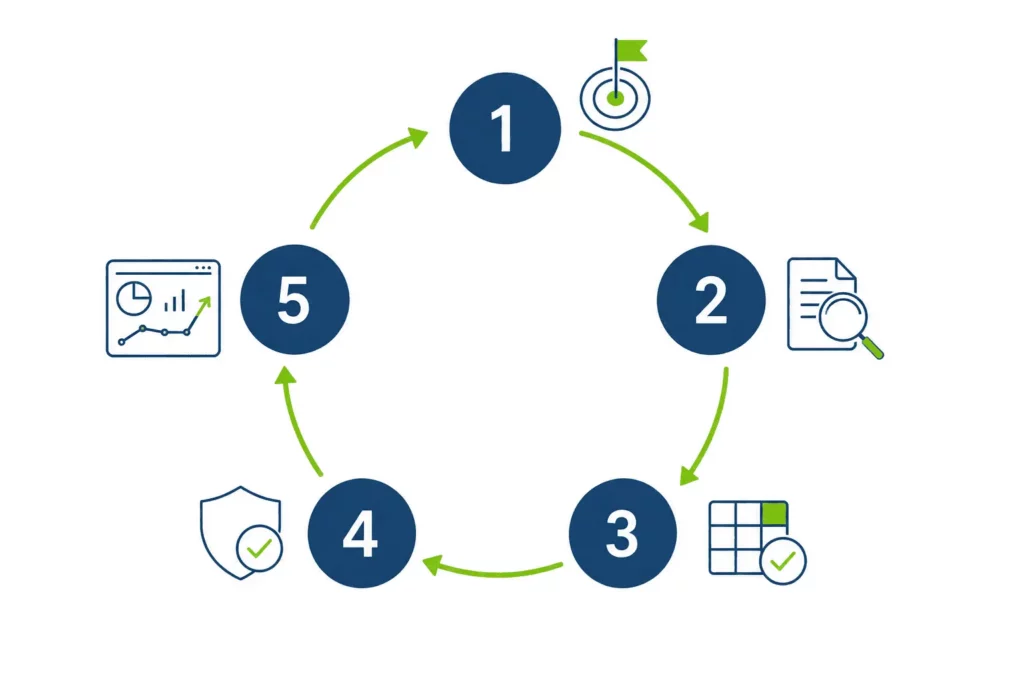
ISO 31000, the internationally recognised risk management standard adopted by many Australian organisations, describes risk management as a continuous cycle rather than a one-off exercise.
The same logic sits behind the WHS regulations. These are the five core steps.
Step 1: Establish the context
Define the scope, objectives and internal and external environment of your risk management effort. This includes your legal obligations, industry requirements, organisational structure, and the risk appetite set by your board or leadership.
Skipping this step is why so many registers contain risks the organisation does not actually face. Context is what makes the rest specific. A documented risk appetite statement gives managers a decision rule rather than a set of adjectives.
Step 2: Risk identification
Systematically identify what could go wrong across every operational area. Common inputs include risk workshops, interviews with department heads, inspection reports, incident logs, hazard reports and regulatory change tracking. Document every identified risk in a centralised risk register.
The pain point for HR and compliance teams
“We know the risks exist, we just cannot find the records when we need them.” This is the most common failure mode. Risks are identified informally in conversations and corridor conversations, then never documented in a searchable, auditable system. When a regulator asks, the knowledge exists but the evidence does not.
How to run a workplace risk assessment covers the method itself, including how to use the matrix without inflating the ratings.
Step 3: Risk analysis and evaluation
Assess each identified risk by likelihood and consequence. A risk matrix helps prioritise where to focus resources.
Risks are typically rated low, medium, high or extreme, which guides response urgency and resource allocation.
Rate each risk twice. The inherent rating is the risk before controls. The residual rating is what remains after the controls you actually have in place are working as intended.
The gap between them is the value your controls deliver, and residual risk is the number leadership should be making decisions against.
Step 4: Risk treatment and control
For each risk, decide how to respond. The four standard treatment options are:
- Avoid: eliminate the activity or condition that creates the risk
- Reduce: implement controls that lower the likelihood or the impact
- Transfer: shift responsibility through contracts, insurance or outsourcing
- Accept: acknowledge and monitor risks that fall below your risk appetite threshold
Treatment actions must be assigned to named individuals with clear timelines. Without accountability, risk registers become static documents rather than live tools.
The risk owner needs the authority to act on the risk, not just the job of reporting on it.
One caution on transfer. Insurance moves the financial consequence, it does not move the duty.
Under WHS law a business cannot contract out of its primary duty of care, and outsourcing an activity does not outsource the obligation to consult, cooperate and coordinate with the other duty holders involved.
Step 5: Monitor, review and report
Risk management is only effective when it is ongoing. Regular audits, inspections and compliance reviews confirm that controls are working, that new risks are captured, and that the board receives accurate reporting.
This is not just good practice. Regulation 38 of the model Work Health and Safety Regulations requires a duty holder to review and, as necessary, revise control measures.
It sets out specific triggers, including when the control measure does not control the risk so far as is reasonably practicable, before a change at the workplace that is likely to give rise to a new or different risk, when a new hazard or risk is identified, when consultation indicates a review is necessary, or when a health and safety representative requests one.
Matrix-level reporting, showing compliance status across the entire organisation, is what gives leadership genuine visibility.
Real-time GRC dashboards cover what that pack should contain, and continuous risk monitoring covers why the cycle cannot be annual.
The Hierarchy Of Control: What The Law Actually Requires
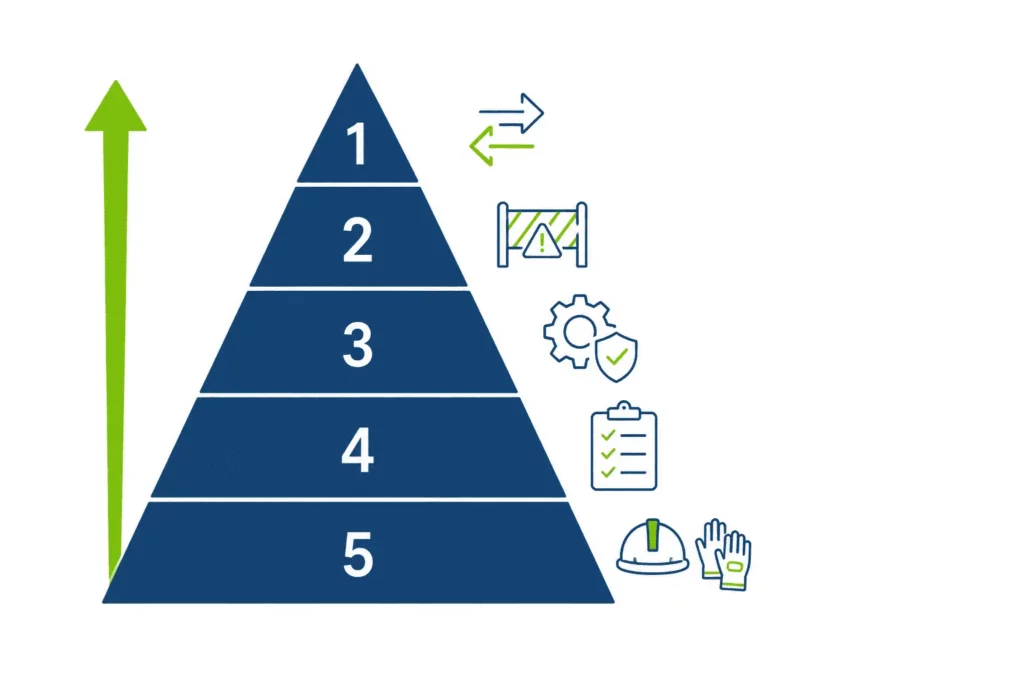
Step 4 above says reduce the risk. Australian WHS law is more specific than that about how.
Regulation 36 of the model Work Health and Safety Regulations sets out a ranked order of control measures, and it must be worked through in order rather than picked from.
The duty is first to eliminate the risk so far as is reasonably practicable. Where that is not reasonably practicable, the risk must be minimised, so far as is reasonably practicable, by one or more of the following, in this order:
| Rank | Control type | What it means in practice |
|---|---|---|
| 1 | Substitution | Substitute, wholly or partly, the hazard giving rise to the risk with something that gives rise to a lesser risk |
| 2 | Isolation | Isolate the hazard from any person exposed to it |
| 3 | Engineering controls | Implement a physical or mechanical control that reduces the risk |
| 4 | Administrative controls | Where risk remains, minimise it by administrative controls such as procedures, rosters, supervision and training |
| 5 | Personal protective equipment | Where risk still remains, minimise it with suitable PPE |
Two points worth holding onto. Administrative controls and PPE sit at the bottom because they rely on people behaving as intended every time, which makes them the least reliable.
And a register full of controls that are all training and procedures is a register that has skipped the top of the hierarchy.
This matters for evidence as much as for safety. A regulator reviewing your risk assessment will look at whether higher-order controls were considered and why they were ruled out.
“We trained everyone” is a weaker answer than a documented assessment showing elimination and substitution were examined first.
Lone and isolated work is the clearest worked example, because elimination is available far more often than employers assume.
The risks when working alone applies all six levels to a single hazard, the working alone risk assessment checklist sets out the assessment that comes first, and occupational violence and aggression covers the hazard where administrative controls are most often over-relied on.
The hierarchy is only as good as the record behind it
A regulator will ask what higher-order controls you considered and why they were ruled out. Sentrient keeps the register, the controls, the decisions and the evidence in one place, so that answer already exists.
Explore the risk management system | Book a free demonstration
Risk Management Strategies: Which Approach Fits Your Organisation?
No single strategy fits every business. Effective risk management draws on a combination of approaches matched to your organisation’s size, industry and risk profile.
Most organisations need all four, weighted differently.
| Strategy | What it looks like in practice | Best suited to |
|---|---|---|
| Preventive | Training staff before incidents occur. Legally endorsed compliance courses on sexual harassment, manual handling and workplace bullying address exposure before it arises. | Every organisation, as the baseline layer |
| Detective | Inspections, audits and surveys that identify emerging risks before they escalate. Regular WHS audits catch hazards that have not yet caused harm. | Multi-site operations and higher-hazard industries |
| Corrective | Incident management processes and corrective action plans triggered when something goes wrong, so lessons are captured and systems updated. | Organisations with meaningful incident volume |
| Integrated GRC | Unifying compliance training, policy management, risk registers, inspections and HR records in one system, so no risk sits undocumented across disconnected platforms. | Organisations past roughly 50 staff, or in regulated sectors |
The four are sequential in maturity as well as in function. Organisations tend to start corrective, reacting to what has already happened, then build detective capability, then preventive, and only then integrate. Risk management maturity sets out what each stage looks like.
Risk Management For Small And Medium Businesses
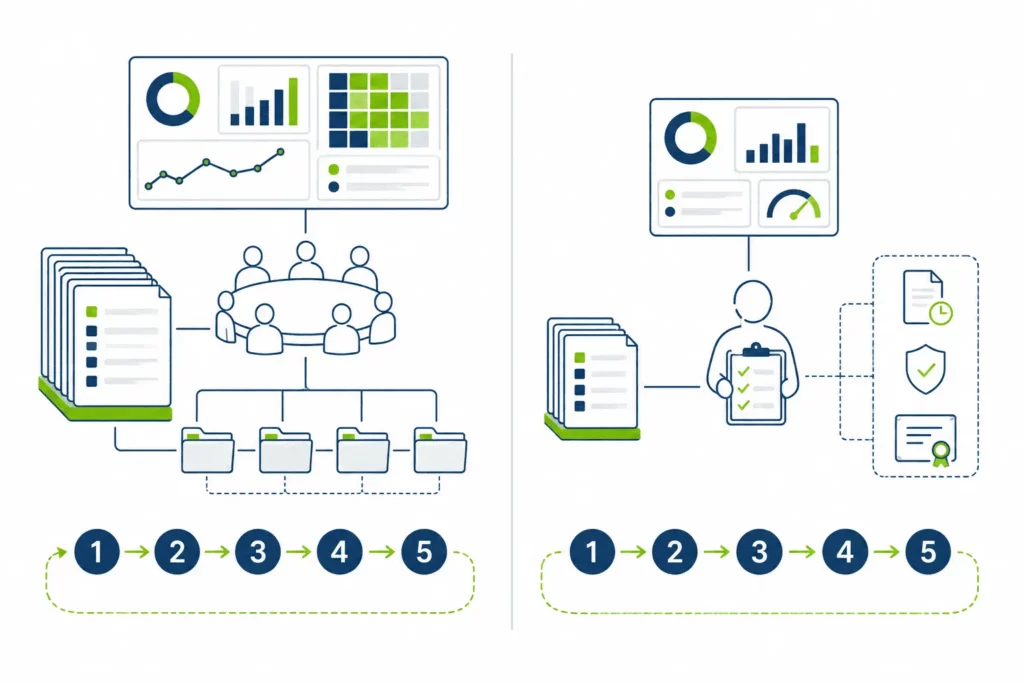
Most risk management guidance is written for organisations with a chief risk officer and a dedicated team.
If you have neither, the advice reads as a description of a job you cannot do, so it gets shelved.
The obligations do not scale down. There is no small-business exemption from the primary duty of care under the Work Health and Safety Act.
What changes is the amount of machinery a proportionate response needs.
What actually changes at smaller scale:
| Practice | At 500+ staff | At 20 to 200 staff |
|---|---|---|
| Risk register size | 150 to 400 entries across divisions | 15 to 40 entries. If it is longer, it is a hazard list, not a register |
| Ownership | Dedicated risk function | One named owner with executive backing, usually HR or operations |
| Review cycle | Quarterly by committee, and on event triggers | Twice yearly, and on event triggers. The triggers matter more than the cycle |
| Risk workshops | Formal facilitated sessions per division | One session with the leadership team, then walk the floor and ask people what nearly went wrong |
| Reporting | Board pack with heat maps and appetite dashboards | One page: the top risks, what moved, what is overdue |
| Evidence | Integrated GRC platform | A system that timestamps training, policy acknowledgements and incidents. This is the part not worth doing on paper |
The mistake smaller organisations make is not doing too little. It is copying a large-organisation register, ending up with 200 entries nobody reviews, and concluding that risk management does not work here.
Fifteen risks you actually review beats two hundred you do not. Start with the exposures you have already had, name an owner for each, and only add a risk when it would change a decision.
The one place not to economise is the evidence trail. A regulator or an insurer will ask what training the worker had completed before the incident and when the policy was acknowledged.
That question has a good answer or it does not, and the size of the organisation does not soften it.
Risk Management At Enterprise Scale
Above roughly 500 staff, or across multiple entities, sites or jurisdictions, the constraint stops being whether risks are identified and becomes whether they can be compared.
Three things change:
- Aggregation: A risk rated high in one division and medium in another may be the same risk. Without a common rating scale and shared definitions, the board sees a list rather than a picture
- Appetite cascading: Board-level appetite has to translate into thresholds a site manager can apply on a Tuesday, or it stays a document
- Assurance layering: Management controls, oversight functions and internal audit each test different things, and someone has to make sure they are not all testing the same thing
That is enterprise risk management, and it is a bigger subject than this page should try to cover.
The enterprise risk management framework guide sets out the structure, the three lines model and how appetite cascades.
Real-time GRC dashboards cover what the pack should contain, and integrated risk management covers the aggregation problem above.
Worth saying plainly: enterprise frameworks fail for the same reason small ones do. Controls that were never tested, registers that went stale, and appetite statements nobody could apply. Scale changes the cost of the failure, not its cause.
How To Implement Risk Management In Your Organisation
Implementation is where most organisations stall. The framework makes sense on paper.
The challenge is embedding it into day-to-day operations without a dedicated compliance team and without months of disruption.
Here is a practical pathway for Australian businesses with 50 to 500 staff.
1. Appoint clear ownership
Assign a named owner for risk management, typically an HR manager, compliance officer or operations lead. Without executive-level accountability, risk frameworks drift back toward informality within a quarter.
Ownership at the top is only half of it. What supervisors and managers must consider covers the layer where frameworks actually hold or fail.
2. Build your risk register from existing records
Start with what you already know. Incident reports, insurance claims, prior audit findings and near-miss logs. A risk register does not require a blank-sheet exercise.
It starts with the exposures your organisation has already encountered. Why manual risk registers fail is worth reading before you commit the register to a spreadsheet.
3. Deploy legally endorsed compliance training
Staff training is both a risk prevention measure and a compliance record.
Courses ratified by lawyers and acknowledged by staff, with timestamps and completion certificates tracked in a system, create defensible documentation.
Good intentions are not evidence. Timestamped records are.
Records show the training happened. Building a risk-aware culture covers what determines whether it changed anything.
4. Establish a regular inspection and audit cadence
Inspections and audits run through a compliance system rather than a spreadsheet create an ongoing, searchable audit trail.
When a WHS regulator or Fair Work inspector asks for evidence, the answer assembles itself instead of triggering a week of searching.
Set the cadence against regulation 38 triggers rather than against the calendar alone. A yearly review that ignores a change to how work is done is not a review.
5. Report to leadership with matrix-level visibility
Board members and executives need a consolidated view of compliance status across the organisation, not a collection of spreadsheets.
Matrix reporting showing training completion, policy acknowledgements and open risk items by department gives leadership the visibility to act.
6. Connect the register to your incident data
This step is the one most often skipped and the one that pays back fastest.
If incidents are recorded in one place and risks in another, a risk can stay rated as well controlled while events keep occurring against it.
Linking the two means the register is corrected by reality rather than by opinion. What incidents should be reported covers what belongs in that data set.
The Role Of Technology: GRC Software And Risk Management Systems
Manual risk management breaks under regulatory complexity rather than under volume. An organisation with 80 staff can track training in a spreadsheet.
The same organisation cannot track training, policy acknowledgements, inspections, incidents, corrective actions and risk ratings in six spreadsheets and still answer a regulator inside a notice period.
That is the practical case for a system, and it is worth being precise about what a system does and does not do.
| Without a GRC system | With a GRC system |
|---|---|
| Training records scattered across email threads and folders | All training, completions and certifications in one searchable system |
| Policy acknowledgements not tracked, or expired without notice | Policy management with timestamped acknowledgements and reminders |
| Risk registers in spreadsheets, updated irregularly | Live risk registers with owner accountability, status tracking and reporting |
| Inspections and audits on paper or in siloed apps | Digital inspections and audits with corrective actions recorded against them |
| No consolidated view for leadership reporting | Matrix reporting showing compliance status by department, site or role |
| HR records disconnected from compliance data | Onboarding, performance and compliance in one integrated platform |
If you are weighing options, the risk management software buyer’s checklist sets out what to test during a trial, and implementing risk management software covers the rollout itself.
How Sentrient addresses these pain points
Sentrient is a Melbourne-based GRC and HR compliance platform built specifically for Australian and New Zealand organisations with 50 to 500 or more staff.
It consolidates compliance training with legally endorsed course content, policy management, records management, inspections and audits, risk management, HR onboarding and offboarding, and performance management into a single system.
What separates Sentrient from larger enterprise platforms:
- Compliance-only clients can be live within seven days, without a months-long implementation project
- Phone support answered directly by the Melbourne team, with no ticketing system and no queue
- Legally endorsed compliance courses ratified by lawyers and aligned to Australian workplace law
- Matrix reporting that gives HR managers, compliance officers and boards a consolidated view of organisational risk and training gaps
- HR and compliance data in one system, so the question “was this worker trained before this incident?” has an answer
A necessary caveat
No software platform eliminates compliance or WHS risk, and no platform can make an organisation compliant on its own. A GRC system is a governance and documentation tool. It supports professional legal and safety advice rather than replacing it, and it records the decisions your people make rather than making them.
See what your evidence trail actually looks like
Most organisations only discover the gaps when a regulator asks. A short walkthrough shows you where your training records, policy acknowledgements, risk register and incident data sit today, and what a single system would change.
Software removes some problems and exposes others. The five most common governance, risk and compliance challenges cover what usually gets in the way of a system landing.
The Risk You Are Most Likely Underestimating: Psychosocial Risk
Physical hazards have been on every Australian employer’s radar for decades. Psychosocial risk, meaning the organisational conditions that affect employees’ psychological health, is now a formal WHS obligation rather than an HR preference.
The data is stark. Mental health condition claims increased 14.7% in a single year and now account for 12% of all serious compensation claims. Median compensation for those claims was $67,400, more than four times the $16,300 median across all serious claims, and median time lost was 35.7 working weeks against 7.4 weeks overall. Women carry a much higher share, with mental health conditions accounting for 17.2% of their work-related injury or illness compared with 8.2% for men.
Under the model WHS laws, employers must identify, assess and manage psychosocial hazards using the same risk management framework applied to physical hazards, and the same hierarchy of control. Relevant hazards include:
- High job demands with insufficient control or support
- Poor management practices and low procedural fairness
- Workplace conflict, bullying and harassment
- Isolation, role ambiguity and inadequate change management
- Exposure to traumatic content or events
This is not a wellness program. It is a risk management obligation with enforcement consequences. Documented risk assessments, manager-level training records and policy acknowledgements are the evidence trail that matters.
The most common mistake here is a control set made entirely of support measures.
An employee assistance program, a wellbeing survey and resilience training all help people cope with pressure.
None of them reduce the demand creating it, which means the residual rating should not move. Apply the hierarchy honestly and the gap becomes visible.
Psychosocial hazards at work covers each hazard and the duty attached to it, including the controls that do move a residual rating.
5 Risk Management Mistakes Australian Organisations Make
1. Treating risk management as a one-off project
Risk management is a continuous cycle. A register built once and never updated is a liability rather than a protection, because it shows you identified the risks and then did nothing about them.
Audit-ready risk management covers what the record needs to look like for that not to be the conclusion.
2. Storing compliance records across disconnected systems
Training records in email, policies in a shared drive, incidents in a spreadsheet. When a regulator asks for evidence, the search takes longer than the response window allows.
3. Confusing culture with compliance
“We have a good culture” is not a defensible position at Fair Work. Policy acknowledgements, training completions and inspection records are. Culture is what makes the records honest, not a substitute for them.
4. Ignoring psychosocial hazards
Psychological injury claims are among the most expensive and complex claims employers face. Treating them as an HR program rather than a WHS obligation leaves the duty unmet and the exposure undocumented.
5. Providing general training instead of legally endorsed content
Training that is not ratified by lawyers and aligned to Australian workplace law may not meet your due diligence obligations, particularly for sexual harassment, bullying and manual handling.
Risk Management Readiness: A 12-Point Self-Check
Work through these as they stand today, not as they are meant to work. Anything you cannot answer in under a minute is the honest answer.
| # | Check | You can answer yes if |
|---|---|---|
| 1 | There is one named person accountable for risk management | They have the authority to spend or stop work, not just to report |
| 2 | A single risk register exists | One file or system, not a register per department |
| 3 | Every risk has a named owner | A person, not a team or a job family |
| 4 | Risks are rated before and after controls | You can state the residual rating for your top five |
| 5 | Controls have been tested, not just listed | Someone checked in the last 12 months that each one works |
| 6 | The hierarchy of control was applied in order | You can show why elimination or substitution was ruled out |
| 7 | Psychosocial hazards are in the register | Rated with the same method as physical hazards |
| 8 | Training completions are timestamped and searchable | You can produce one worker’s full record in under 5 minutes |
| 9 | Policy acknowledgements are recorded | With a date, against a named person and a policy version |
| 10 | Incidents are linked to register entries | An incident triggers a re-rate of the related risk |
| 11 | Review is triggered by events, not only the calendar | The regulation 38 triggers are written into your procedure |
| 12 | Leadership sees risk on a set cycle | With movement shown, not just a static list |
Under 6 is common and it is not a crisis. It usually means the work is being done and the record is not.
That is the cheaper problem to fix, and it is the one that determines what you can demonstrate when it matters.
The Bottom Line
Risk management is not a compliance formality. It is the operational foundation that determines whether your organisation can defend itself, keep operating and grow without accumulating exposure it cannot see.
The organisations getting this right are not the ones with the largest compliance teams or the biggest budgets.
They are the ones that treated risk management as a continuous, documented, system-supported practice, and built the evidence trail to prove it.
If your current approach relies on spreadsheets, informal records and the assumption that nothing will go wrong, that is the position worth reconsidering first.
For what regulators look for specifically, audit-ready risk management covers the evidence side, and risk management and regulatory shifts covers what is changing.
Take the next step with Sentrient
Sentrient gives Australian and New Zealand businesses the GRC and HR compliance infrastructure to manage risk seriously, without the implementation burden of large enterprise software.
Compliance training, policy management, risk registers, inspections, audits and HR records in one system. Live within seven days for compliance-only implementations, with phone support from a Melbourne team.
To see how it works in practice, book a free demonstration with the team. Our compliance outlook webinar is also a useful starting point for what is ahead.
Frequently Asked Questions
Pain-point questions from HR managers, compliance officers and board members.
1. What are the 5 steps of the risk management process?
Establish the context, identify the risks, analyse and evaluate them, treat them, then monitor and review. The cycle is continuous rather than sequential, because treatment changes the risk and monitoring feeds new risks back into identification. Under Australian WHS law, treatment must follow the hierarchy of control in regulation 36, and the review step is a specific legal requirement under regulation 38.
2. What is the difference between risk management and compliance?
Compliance means meeting regulatory obligations. Risk management is the broader framework for identifying, assessing and controlling all threats, including those no specific rule covers. Compliance is a subset of risk management. An organisation can meet every rule that applies to it and still carry serious unmanaged risk.
3. How do I build a risk register without a dedicated compliance team?
Start with existing incident reports, insurance claims, near-miss logs and audit findings, since those describe exposures you have already encountered. Assign a named owner to each risk. Keep the register to the risks that would change a decision rather than trying to be exhaustive. A GRC platform automates tracking, reminders and escalation, which is what makes a register maintainable by a small team.
4. Are we legally required to have a risk management framework in Australia?
The Work Health and Safety Act 2011 requires employers to eliminate risks to health and safety so far as is reasonably practicable, and to minimise them where elimination is not reasonably practicable. Meeting that duty in practice requires identifying, assessing and controlling foreseeable hazards, which is a risk management obligation in all but name. There is no exemption based on organisation size. Specific documentation requirements vary by jurisdiction and by hazard type, so confirm what applies to you.
5. What is the hierarchy of control?
The ranked order of control measures set out in regulation 36 of the model WHS Regulations. Eliminate the risk first. If that is not reasonably practicable, minimise it through substitution, isolation or engineering controls, then administrative controls, then personal protective equipment. The order matters legally, not just practically. Administrative controls and PPE sit last because they depend on people acting as intended every time.
6. How often should risk assessments be reviewed?
Regulation 38 sets the triggers rather than a fixed interval. Review control measures when they are not controlling the risk so far as is reasonably practicable, before a workplace change likely to create a new or different risk, when a new hazard is identified, when consultation indicates a review is needed, or when a health and safety representative requests one. Many organisations also set a baseline cycle, commonly quarterly for high risks and yearly for low ones, on top of those triggers.
7. What is the cost of getting risk management wrong?
Direct costs include penalties, compensation payments and legal fees. Safe Work Australia’s most recent published medians show $16,300 compensation and 7.4 working weeks lost across all serious claims, rising to $67,400 and 35.7 weeks for mental health condition claims. Indirect costs include reputational damage, staff turnover and lost client confidence, which are harder to quantify and usually larger.
8. Can a GRC system make us fully compliant?
No platform can guarantee compliance, and any vendor claiming otherwise should be treated with caution. GRC software creates documented, auditable evidence of your risk management activities, which is what regulators and courts examine when a claim arises. It supports compliance rather than delivering it, and it does not replace professional legal advice.
9. How long does it take to implement a risk management system?
For compliance-focused implementations, organisations using platforms such as Sentrient can be operational within seven days. Full GRC and HR implementations covering all modules typically take four to six weeks. The variable is rarely the software. It is how long it takes to agree ownership, gather existing records and decide what the register should contain.
10. What risks should HR managers prioritise first?
Psychosocial hazards, workplace harassment and bullying, manual handling, and onboarding gaps. Those carry high claim frequency and cost, and they are also the areas where documented training records provide the clearest evidence of due diligence. Prioritise by residual rating rather than inherent rating, since that reflects what is actually left after your current controls.
11. What is the difference between ISO 31000 and WHS risk management?
ISO 31000 is a broad international standard covering all organisational risk, and it is guidance rather than a certifiable requirement. WHS risk management is a legal obligation under Australian safety law with specific control and review duties. Effective frameworks apply ISO 31000 principles across the whole organisation while meeting WHS Act and Regulations requirements for health and safety risk specifically.
12. What are the 6 types of risk a business faces?
Operational, compliance and regulatory, people and workplace, reputational, data privacy and cybersecurity, and strategic and financial. They interconnect rather than sitting in separate columns. Reputational risk in particular is almost always the downstream consequence of one of the others, which is why treating categories in isolation is where most frameworks break down.
13. What is risk management in simple terms?
Working out what could go wrong, how bad it would be, doing something about it, and checking that what you did worked. Everything else is structure around those four things. The formal version runs in five steps and is documented so it can be reviewed and evidenced rather than remembered.
14. How does risk management work for a small business?
The same obligations apply, but the machinery should be proportionate. One named owner with real authority, a register of 15 to 40 entries rather than 200, review twice yearly as well as on event triggers, and one page of reporting to leadership. The part not worth economising on is the evidence trail, because timestamped training and policy records are what you produce when a regulator or insurer asks.
15. What is the difference between risk management and enterprise risk management?
Risk management handles risks as they are identified. Enterprise risk management aggregates them across an entire organisation using shared definitions and a common rating scale, so exposure can be compared between divisions and rolled up to the board. ERM adds appetite cascading and layered assurance. Both use the same underlying five-step process.
16. What is a risk management framework?
The structure that makes the process repeatable. It sets who owns risk, how much risk the organisation will accept, the process itself, where the register lives, how controls are assured, and what leadership sees and when. A process without a framework runs once at implementation and then decays.
Sources
- Safe Work Australia, Key Work Health and Safety Statistics Australia 2025, October 2025
- Safe Work Australia, Key Work Health and Safety Statistics Australia 2025 now available
- Work Health and Safety Regulations 2011, regulation 36, Hierarchy of control measures
- Work Health and Safety Regulations 2011, regulation 38, Review of control measures
- Safe Work Australia, Identify, assess and control hazards
- Fair Work Ombudsman, $358 million back-paid to Australian workers, Annual Report 2024-25, October 2025
- OAIC, Notifiable Data Breaches statistics, January to June 2025
- IBM, Cost of a Data Breach Report 2025
- Deloitte Access Economics for Safe Work Australia, Safer, healthier, wealthier, October 2022
- ISO 31000 Risk Management, International Organization for Standardization
- Work Health and Safety Act 2011 (Cth)
You May Also Like To Explore About Risk Management
- 9 Steps to Develop an Effective Risk Management Strategy: Key Steps and Best Practices
- Implementing Risk Management Software In 5 Essential Steps
- Enterprise Risk Management Framework: A Complete Guide For Australian Organisations
- Audit-Ready Risk Management: What Regulators Expect To See (And What They Don’t)
- Risk Management In Australia: Preparing For 2026 Regulatory And Workforce Shifts
- How To Choose Risk Management Software In Australia: Buyer’s Checklist
Disclaimer: This guide is general information current at the date of publication and is not legal advice. Work health and safety duties differ between jurisdictions and change over time. Confirm your obligations with your work health and safety regulator or a qualified adviser.