Let’s be honest, if you’ve ever worked in an office, on a building site, or even in a remote team scattered across different time zones, you’ve experienced workplace conflict.
Maybe it was the colleague who kept ‘borrowing’ your coffee mug, or perhaps it was something more serious, like disagreements over project direction or workload distribution.
Whatever the case, conflict is as much a part of working life as Monday morning meetings and dodgy office coffee.
Here’s the thing that might surprise you: conflict isn’t inherently bad.
In fact, when appropriately managed, it can spark innovation, expose hidden problems, and strengthen team dynamics.
The real issue isn’t the conflict itself; it’s how we handle it.
Workplace conflict costs Australian businesses between $6 billion and $12 billion annually, with managers spending roughly 30% of their time resolving disputes.
That’s more than a full working day each week just managing disagreements.
If that doesn’t make you sit up and pay attention, I don’t know what will.
In this comprehensive guide, we’ll explore the five stages of conflict and, more importantly, share practical strategies for resolving workplace disputes before they spiral out of control.
Whether you’re a team leader, HR professional, or simply someone who wants to navigate workplace relationships more effectively, understanding these stages can be your roadmap to a healthier work environment.
Understanding Louis Pondy’s Five-Stage Conflict Model
In 1967, Louis Pondy from the University of Pittsburgh developed the Five-Stage Model of Conflict, which remains the gold standard for understanding how workplace disagreements develop and evolve.
Think of it like a weather system; conflicts don’t just appear out of nowhere. They build, intensify, and eventually either dissipate or turn into full-blown storms.
What’s particularly useful about Pondy’s model is that it recognises conflict as a dynamic process, not just a single event.
Each stage presents an opportunity to intervene, redirect, and resolve issues before they cause lasting damage to working relationships and productivity.
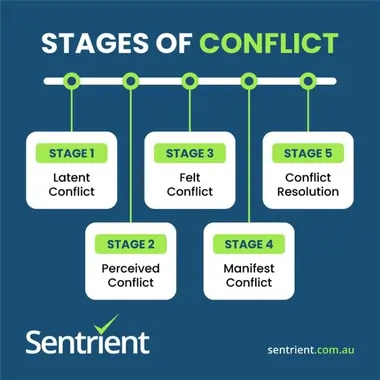
Let’s break down each stage and explore what they mean for your workplace.
Stage 1: Latent Conflict (The Quiet Before the Storm)
Latent conflict is the hidden stage where conditions exist for conflict to emerge, but it is not yet apparent.
It’s like having a gas leak in your house, dangerous, but you can’t see or smell it yet.
Pondy identified four common conditions that create latent potential for conflicts in companies: competition for scarce resources, drives for autonomy, subunit objective variation, and interdependence between parties.
Here’s what this looks like in practice:
- Competition for scarce resources: Your marketing team and product development team both need access to the same limited budget. Neither knows the other has submitted a proposal for the same funds. Conflict is brewing, but it has not yet surfaced.
- Drives for autonomy: A senior manager wants control over a project that another department believes falls under their jurisdiction. Both are going about their business, unaware they’re on a collision course.
- Subunit objective variation: Sales targets clash with customer service quality metrics. The sales team is incentivised to close deals quickly, while customer service is measured on satisfaction scores. Their goals are fundamentally misaligned.
- Interdependence: When two teams rely on each other to complete their work, delays or miscommunication from one can create friction with the other, even if neither party initially recognises the problem.
The challenge with latent conflict is its invisibility. You can’t resolve what you don’t know exists.
This is why creating transparent communication channels and regularly reviewing organisational structures is essential.
Sometimes the best conflict resolution happens before the conflict even begins.
Stage 2: Perceived Conflict (Houston, We Have a Problem)
Now we’re getting somewhere. In the perceived stage, at least one party becomes aware that a problem exists. Someone’s finally noticed the gas leak, so to speak.
This awareness may result from miscommunication, misunderstandings, or observing unfair practices.
People start recognising that something’s not quite right, even if they haven’t yet worked out precisely what’s causing the tension.
Here’s where things get interesting and potentially tricky. Not everyone perceives conflict in the same way or at the same time.
You might be aware that your colleague is frustrated about project responsibilities, whilst your colleague might not even realise there’s an issue yet.
Or worse, you might perceive a conflict that doesn’t exist due to miscommunication. This stage is quite valuable if handled correctly.
It’s your early warning system, the point at which you can still resolve issues through improved communication before emotions become involved. The key is to check your perceptions.
Are you interpreting the situation correctly? Have you got all the facts? Sometimes, what appears to be intentional obstruction is a misunderstanding about priorities or deadlines.
A quick conversation can often clear the air at this stage: “Hey, I’ve noticed some tension around the project timeline. Can we have a chat about how we’re approaching this?”
Simple, direct, and potentially problem-solving before we move to the next stage.
Stage 3: Felt Conflict (When It Gets Personal)
Welcome to the emotional stage. In the felt stage, feelings of tension, stress, and anxiety come into play for affected parties.
This is where disagreements cease to be merely intellectual and begin to affect people on a personal level.
Frustration mounts. Resentment builds. That colleague who has been missing deadlines isn’t just causing project delays; they’re also disrespecting your time and effort.
Or at least, that’s how it feels. Whether these feelings are justified or not becomes almost irrelevant because they’re real to the people experiencing them.
According to research, workplace conflict makes employees feel distracted (21%), frustrated (18%), anxious (9%), and stressed (9%).
These aren’t just fleeting emotions; they’re persistent feelings that can impact job satisfaction, mental health, and overall well-being.
What makes the felt stage particularly challenging is that emotions can distort our perception of the situation.
A minor disagreement might feel like a significant personal attack. A genuine mistake might seem like deliberate sabotage.
This emotional escalation can make resolution more difficult because logic and reason take a backseat to feelings.
This is where emotional intelligence becomes crucial.
Leaders and team members who can recognise their own emotional responses and manage them effectively have a much better chance of preventing escalation.
Creating a safe space where people can acknowledge their feelings without judgment is essential.
It’s perfectly acceptable to say: “I’m feeling frustrated about this situation, and I need to take some time to process it before we discuss solutions”.
That’s not weakness, that’s self-awareness, and it’s far more productive than letting emotions drive the conversation.
Stage 4: Manifest Conflict (The Storm Hits)
Manifest conflict is where disagreements become visible through actions and behaviour.
This is the stage everyone thinks of when they hear the word “conflict”: the arguments, the cold shoulders, the passive-aggressive emails, the outright confrontations.
People might argue openly, refuse to cooperate, avoid communication altogether, or engage in behaviours designed to obstruct the other party’s goals.
Teamwork suffers. Productivity drops. The conflict that was once hidden or merely felt is now out in the open for everyone to see and, unfortunately, to take sides on.
Research indicates that interpersonal conflicts consume approximately 2.8 hours per employee per week, resulting in significant productivity losses.
But it’s not just about lost time, it’s about the collateral damage.
When conflicts reach the manifest stage, they rarely stay contained between the original parties.
Other team members get drawn in, projects get delayed, and the overall work environment becomes toxic.
Here’s the reality check: by the time conflict reaches this stage, it requires intervention.
Hoping it will resolve itself is wishful thinking at best and negligent at worst. This is where conflict resolution strategies, mediation, and potentially HR involvement become necessary.
The good news? Even at this visible, disruptive stage, conflicts can still be resolved constructively.
It requires commitment from all parties, skilled facilitation, and a structured approach to finding solutions. But it’s possible to turn things around.
Stage 5: Conflict Aftermath (What Happens Next)
The aftermath stage represents the outcome of how the conflict was managed, and this is where the long-term consequences play out.
If handled constructively, relationships can improve, trust can grow, and teams can work together more effectively.
However, if the conflict was poorly managed, resentment, mistrust, and unresolved issues may remain, leading to future problems.
Think of the aftermath as setting the stage for future interactions.
A well-resolved conflict can strengthen relationships because parties have demonstrated they can work through difficulties together.
They’ve built resilience, improved communication skills, and perhaps even developed a deeper understanding of each other’s perspectives.
On the other hand, a poorly handled conflict can create a toxic legacy. Resentment simmers beneath the surface.
Trust is damaged, sometimes irreparably. And here’s the kicker: unresolved conflict from the aftermath stage often becomes the latent conflict for the next episode. It’s a vicious cycle.
Currently, 47% of affected employees choose to let conflicts go without any formal resolution, which may seem like the easy option but often leads to worse outcomes in the long run.
Ignoring problems doesn’t make them disappear; it postpones them.
The aftermath stage is also when organisations should reflect on what they can learn from the conflict.
What systemic issues contributed to the problem? How can processes be improved? What early warning signs were missed?
This reflective practice turns negative experiences into opportunities for organisational growth.
Practical Conflict Resolution Strategies
Understanding the stages is useful, but let’s move on to practical applications. How do you resolve workplace conflicts when they arise?
Here are evidence-based strategies that work:
Open and Honest Communication
It’s remarkable how often communication breakdowns fuel conflicts.
Encouraging individuals to express their perspectives and concerns whilst actively listening to others fosters understanding and helps identify common ground.
Active listening means genuinely trying to understand the other person’s viewpoint, not just waiting for your turn to speak.
It means asking clarifying questions, reflecting on what you’ve heard, and suspending judgment long enough to grasp their perspective fully.
Mediation by a Neutral Third Party
Sometimes, parties are too emotionally invested to resolve conflicts on their own.
A neutral third party can facilitate discussions and guide parties towards resolution, providing an objective perspective and helping both sides move beyond entrenched positions.
Professional mediators are trained to identify underlying interests, reframe discussions constructively, and help parties find mutually acceptable solutions.
Even informal mediation by a respected colleague or manager can be effective if they can remain genuinely neutral.
Collaboration and Joint Problem-Solving
Collaboration promotes a sense of ownership and commitment to the resolution process.
Rather than approaching conflict as a win-lose situation, collaboration frames it as a shared problem requiring a shared solution.
This might involve brainstorming sessions where all parties contribute ideas, identifying shared goals that transcend individual interests, or developing new processes that address everyone’s concerns.
The key is focusing on interests rather than positions.
Empathy and Perspective-Taking
Understanding the emotions and viewpoints of others is vital. Empathy creates a supportive environment where individuals feel heard and valued.
Empathy doesn’t mean agreeing with someone it means understanding their perspective and acknowledging their feelings as legitimate, even if you see things differently.
This emotional validation can de-escalate tensions and open pathways to resolution.
Negotiation and Compromise
Not every conflict has a perfect solution where everyone gets exactly what they want.
Finding a middle ground through negotiation allows parties to reach compromises that satisfy their needs and interests.
Effective negotiation requires identifying what’s negotiable and what’s non-negotiable, understanding the relative importance of different issues, and being willing to give ground on lower-priority items to secure wins on higher-priority ones.
The Cost of Unresolved Conflict
Still not convinced that addressing workplace conflict matters? Let’s talk numbers.
Research indicates that 85% of employees experience some form of conflict, with 29% experiencing it nearly constantly.
That’s not occasional disagreements; that’s endemic conflict affecting most workplaces. The financial impact is staggering.
Beyond the direct costs of lost productivity, there are indirect costs like increased turnover, recruitment expenses, reduced innovation, and damaged customer relationships.
Approximately 56% of employees who experienced conflict reported being diagnosed with stress, anxiety and/or depression, whilst 40% reported being less motivated.
Think about that for a moment. More than half the people experiencing workplace conflict develop mental health issues as a result.
This isn’t just about business efficiency; it’s about people’s well-being.
Creating a Conflict-Resilient Culture
The best approach to workplace conflict isn’t just resolving it when it occurs; it’s creating a culture that handles conflict constructively from the start.
- Establish clear communication channels: Make it easy for people to raise concerns before they escalate. Regular check-ins, open-door policies, and anonymous feedback mechanisms can all help surface issues early.
- Train everyone in conflict resolution: Don’t just train managers, equip all employees with basic conflict resolution skills. Understanding the five stages, practising active listening, and developing emotional intelligence should be part of everyone’s professional development.
- Address systemic issues: If conflicts persist in the same areas, identify the underlying causes. Are competing incentive structures creating tension? Are unclear role boundaries causing friction? Fix the system, not just the symptoms.
- Model healthy conflict resolution: Leadership sets the tone. When senior managers handle their own disagreements constructively, it signals to everyone else that healthy conflict resolution is valued and expected.
- Act quickly: The earlier you intervene in the conflict cycle, the easier the resolution becomes. Don’t wait until conflicts reach the manifest stage to pay attention.
Moving Forward
Workplace conflict is inevitable, but destructive conflict isn’t.
By understanding the five stages of conflict from latent tensions through to aftermath, you can identify issues earlier, intervene more effectively, and create outcomes that strengthen rather than damage working relationships.
By understanding the five stages of conflict and implementing effective conflict resolution strategies, organisations can transform conflicts into opportunities for growth, collaboration, and improved relationships.
The goal isn’t to eliminate conflict, that would be impossible in any organisation with diverse people, competing priorities, and limited resources.
The goal is to handle conflict skilfully, turning potential disasters into opportunities for learning, innovation, and fostering stronger relationships.
Whether you’re dealing with a minor misunderstanding in its early stages or a full-blown, manifest conflict disrupting your entire team, the principles remain the same: communicate openly, listen actively, focus on interests rather than positions, and seek solutions that respect everyone’s legitimate needs.
Workplace conflict doesn’t have to be the workplace nightmare that costs billions and drives talented people away.
With the proper knowledge, skills, and commitment to constructive resolution, it can become a catalyst for positive change.
So, the next time you notice tension building with a colleague or spot the early signs of latent conflict in your team, remember that you’re at a choice point.
You can let it escalate through the stages, or you can intervene early with empathy, communication, and collaborative problem-solving.
The difference between these choices could mean the difference between a toxic workplace and a thriving one.
And really, when you think about it, that choice is what leadership at any level is all about.