Quick Answer:
Enterprise risk management is a single, organisation-wide view of risk, replacing the separate registers that HR, finance, operations and IT each keep on their own. The framework has nine components: governance, identification, assessment, response, monitoring, culture, compliance integration, technology and continuous improvement. For an Australian organisation of 50 to 500 staff it can be working in four to six weeks, and it does not require a dedicated risk function. What it does require is one common rating scale, named owners, and a way for incident data to reach the register.
In this guide
Enterprise risk management is one of the most important and least well executed disciplines in Australian organisations today.
The regulatory environment is tightening. The consequences of a compliance failure, whether a Fair Work claim, a WorkCover investigation or an APRA review, are more serious and more visible than they have ever been.
Australian workplaces recorded 146,700 serious workers’ compensation claims in 2023-24, and the Fair Work Ombudsman recovered more than $358 million in unpaid wages for over 249,000 workers in 2024-25.
Most organisations still manage risk the way they did a decade ago. In spreadsheets, siloed by department, reviewed once a year.
This guide is written for the Australian context, and specifically for organisations that carry enterprise-scale obligations without an enterprise-scale risk function.
Most ERM guidance assumes a chief risk officer and a team. If you have an HR manager, a compliance officer and a board that meets quarterly, the standard advice describes a job you cannot staff.
What follows is the enterprise risk management framework, right-sized. What each component actually needs to contain, what can be dropped at your scale, and what cannot.
Sentrient builds workplace compliance software for Australian and New Zealand organisations, including a risk management system that holds the register, assigns ownership and connects risks to incidents, policies and training records.
New to the subject, or need the underlying process first? Our complete guide to risk management covers the five-step process, the six risk types and the hierarchy of control.
This guide assumes that groundwork and builds the enterprise layer on top of it.
What Is Enterprise Risk Management?
Enterprise risk management is a structured, organisation-wide approach to identifying, assessing, responding to and monitoring the full range of risks that could affect an organisation’s ability to achieve its objectives.
The defining characteristic, and the thing that separates it from traditional risk management, is scope.
Traditional risk management is fragmented. HR manages people risks, finance manages financial risks, IT manages cyber risks.
Enterprise risk management integrates these into a single coherent framework that gives leadership a complete view of exposure across the organisation.
For Australian organisations operating under the Fair Work Act, the Work Health and Safety Act 2011, the Privacy Act 1988 and a growing web of industry-specific regulation, enterprise-wide risk thinking is not optional.
Regulators including Safe Work Australia, the Fair Work Ombudsman, ASIC and APRA look for evidence of systematic risk identification and management, not a risk register that has not been updated since the last financial year.
| ERM element | What it means for Australian organisations |
|---|---|
| Enterprise-wide scope | Risk is managed across all functions, including HR, compliance, operations and finance, rather than in silos |
| Strategic alignment | Risk appetite is set by the board and connected to business objectives |
| Proactive identification | Risks are identified before they materialise, not after a claim or incident |
| Continuous monitoring | Risk registers and controls are live and updated, not static annual documents |
| Regulatory defensibility | The organisation can demonstrate its risk management approach to a regulator |
The word doing the work in that table is aggregation. A risk rated high in one division and medium in another may well be the same risk described by two people using different scales.
Until the scales match and the definitions are shared, the board is looking at a list rather than a picture.
What Right-Sized Enterprise Risk Management Looks Like
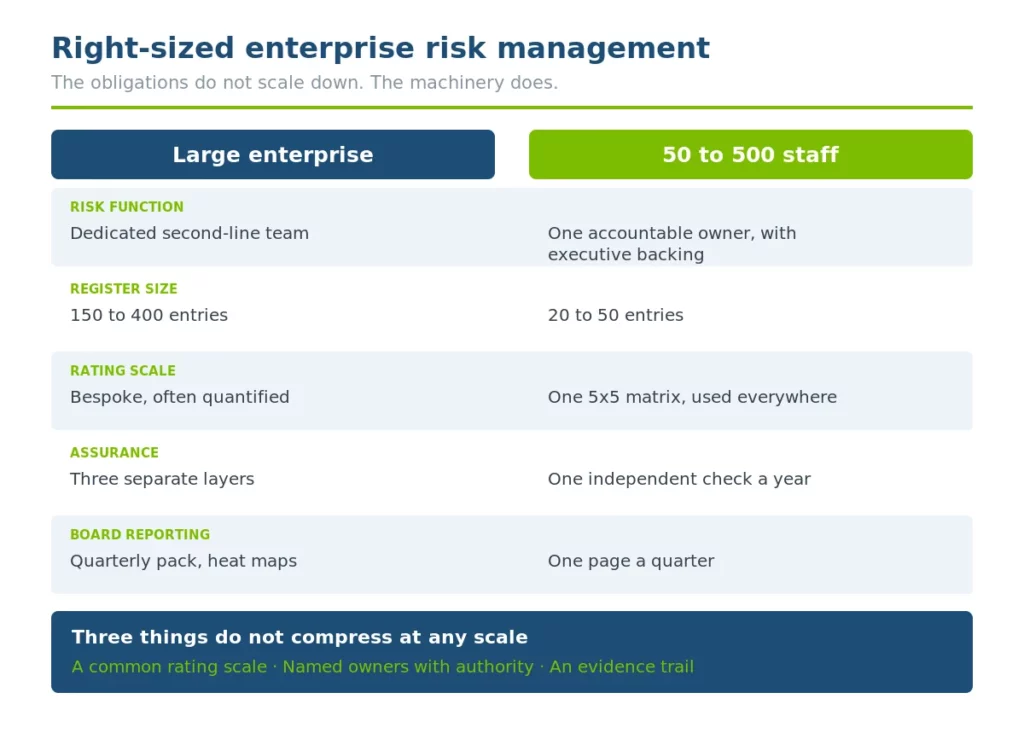
Most ERM literature is written for organisations with a chief risk officer, a second-line risk function and an internal audit team.
Applied unchanged to a 300-person aged care provider or an NGO, it produces a framework nobody has the capacity to run, which is abandoned within a year and then cited as evidence that ERM does not work here.
The obligations do not scale down. An organisation of 200 staff faces the same WHS Act, the same Fair Work Act and, in many sectors, the same industry standards as one of 5,000. What scales is the machinery.
| Component | Large enterprise | 50 to 500 staff |
|---|---|---|
| Risk function | Dedicated second-line team | One accountable owner, usually HR, compliance or operations, with executive backing |
| Register size | 150 to 400 entries across divisions | 20 to 50 entries. Longer than that and it stops being reviewed |
| Rating scale | Bespoke, often quantified | One 5×5 matrix used identically everywhere. The consistency matters more than the sophistication |
| Risk appetite | Full statement per risk category | One page, four or five categories, written so a manager can apply it to a decision |
| Assurance | Three separate layers | Management review, and one independent check a year. It does not have to be an internal audit function |
| Board reporting | Quarterly pack with heat maps and appetite dashboards | One page each quarter: top risks, what moved, what is overdue |
| Technology | Integrated GRC suite with configuration | A system that timestamps training, policy acknowledgements and incidents against the register. This is the part not worth doing on paper |
Three things do not compress at any scale.
- A common rating scale: Without it, nothing aggregates and the whole exercise collapses back into separate registers with a cover sheet
- Named owners with authority: An owner who can report on a risk but cannot act on it is a reporting line, not an owner
- An evidence trail: A regulator or insurer will ask what training a worker had completed before an incident and when the relevant policy was acknowledged. Organisation size does not soften that question
Everything else in this guide can be dialled up or down. Those three cannot.
The Frameworks Behind Effective ERM: ISO 31000 And The Three Lines Model
ISO 31000: risk management guidelines
ISO 31000 is the internationally recognised standard for risk management principles and guidelines, adopted in Australia as AS ISO 31000.
It sets out how a risk management framework should be structured, integrated and continuously improved in any organisation, regardless of size or industry.
It is guidance rather than a certifiable requirement, which is worth knowing before anyone claims to be “ISO 31000 certified”. You align to it. You are not audited against it.
The principles that matter most in the Australian context:
- Risk management should be integrated into governance, strategy, planning and operations, rather than treated as a separate function
- It should be structured and comprehensive, covering all significant sources of risk across the organisation
- It should be dynamic, updated continuously as the organisation and its context change
- It should be based on the best available information, both quantitative and qualitative
- It should account for human and cultural factors, which is directly relevant to psychosocial risk under Australian WHS legislation
The Three Lines Model, and why the name changed
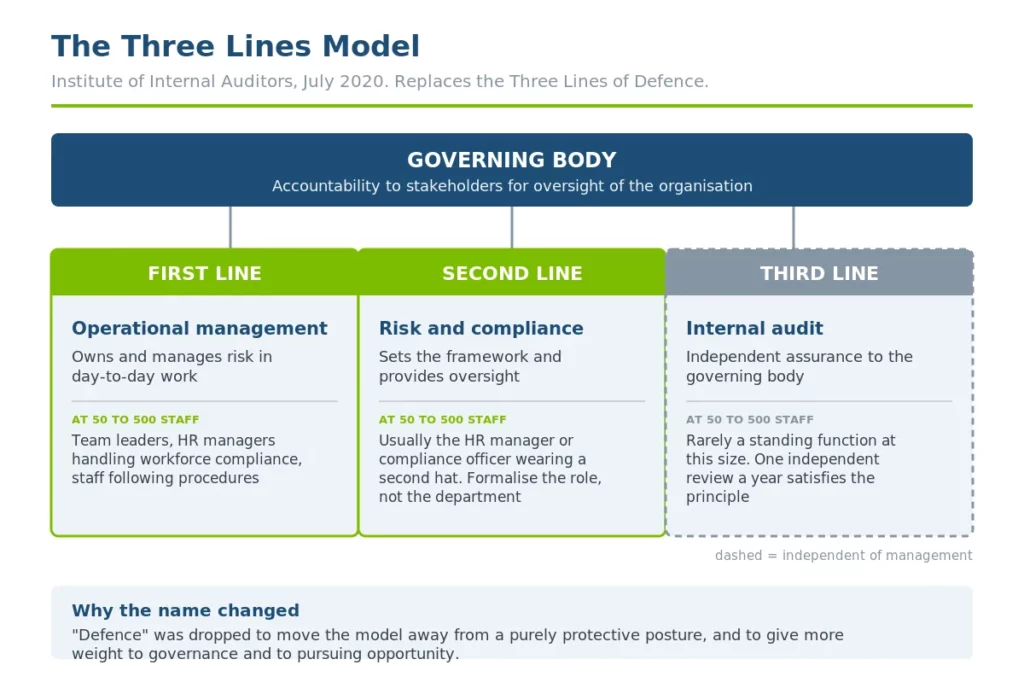
Many Australian organisations still call this the Three Lines of Defence. The Institute of Internal Auditors retired that name in July 2020 and replaced it with the Three Lines Model.
The change was deliberate rather than cosmetic. Dropping “defence” was meant to move the model away from a purely protective posture and toward one where risk-based decisions are as much about pursuing opportunity as about preventing loss.
The updated model also puts more weight on governance and on the relationship between the governing body, management and internal audit.
The older term remains in wide use, including in Australian practice and in some regulatory commentary, so you will hear both.
Using the current name in board papers is a small signal that the framework was built from the source rather than from a template.
| Line | Who | What they do | At 50 to 500 staff |
|---|---|---|---|
| First | Operational management and frontline staff | Own and manage risk in day-to-day work | Team leaders, HR managers handling workforce compliance, staff following procedures |
| Second | Risk and compliance functions | Set the framework, provide oversight, check the first line is managing risk properly | Usually the HR manager or compliance officer wearing a second hat. Formalise the role, not the department |
| Third | Internal audit | Independent assurance to the governing body | Rarely a standing function. One independent review a year, external if needed, satisfies the principle |
For most Australian businesses of this size the second and third lines are not fully formalised, and that is acceptable.
The principle still holds. Someone sets the framework, and someone independent checks that it is being followed.
What is not acceptable is the same person doing both, because that is the arrangement where problems stop being reported.
Australian regulatory relevance
APRA’s prudential standards and Safe Work Australia’s guidance on managing psychosocial risk both assume structured risk ownership with independent oversight. Demonstrating that ownership exists across all three lines, in whatever form fits your size, is closer to a baseline expectation than a stretch goal. Note that APRA requirements apply to APRA-regulated entities specifically, so confirm what applies to your organisation.
The 9 Components Of An Effective ERM Framework
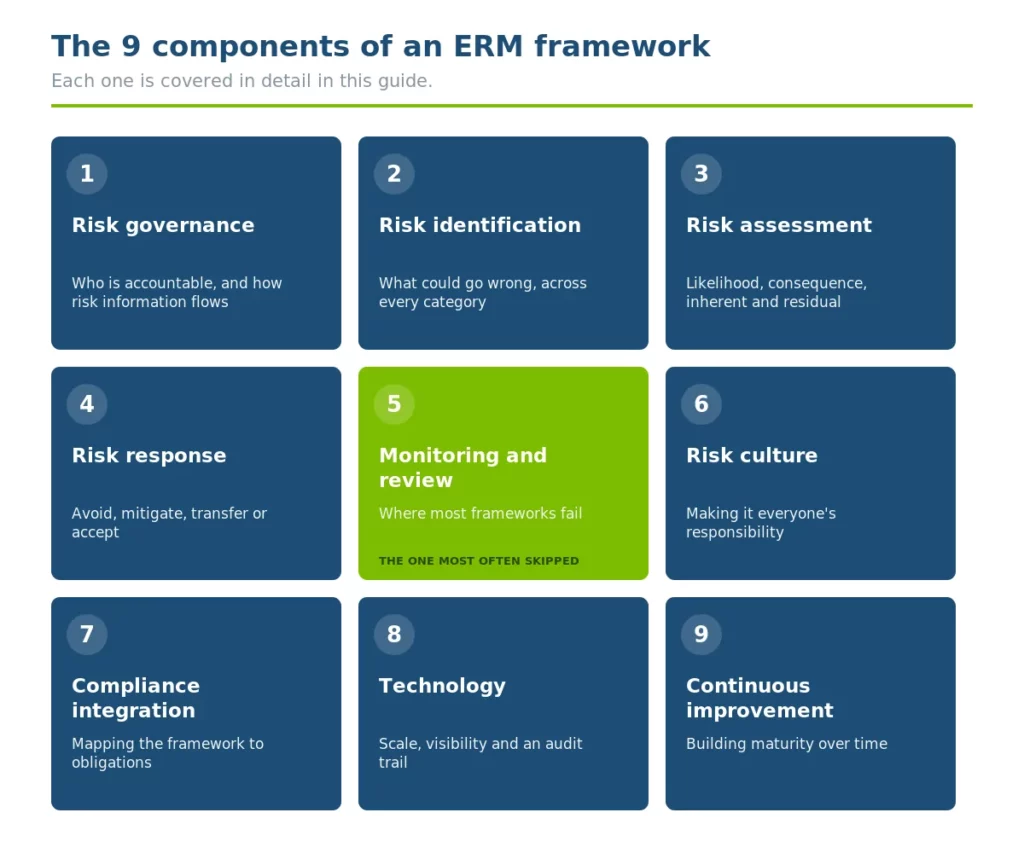
An enterprise risk management framework is only as strong as its components.
These nine components separate organisations that genuinely manage enterprise risk from those that produce compliance documentation and call it a risk program.
1. Risk governance: setting the rules and accountability
Risk governance is the foundation of the enterprise risk management framework. It defines who is accountable for risk at every level, from the board to the frontline, and how risk information moves between those levels.
In practice this means:
- A board-approved risk appetite statement that sets out the level and type of risk the organisation will accept in pursuit of its objectives
- Clear risk ownership. Every identified risk has a named owner responsible for managing it
- A defined escalation path, so that when a risk exceeds acceptable thresholds there is a documented route to the right level
- Regular board and executive reporting on risk status, not only at audit time
The most common failure is treating governance as a documentation exercise. An appetite statement that sits in a policy document but never shapes an operational decision is not governance. It is paperwork.
2. Risk identification: knowing what you are up against
You cannot manage a risk you have not identified. That sounds obvious, but most compliance failures in Australian workplaces happen where risks were present and visible yet never formally identified or documented.
Identification should cover:
- Strategic risks: changes in regulation, market conditions or operating environment that could affect objectives
- Operational risks: failures in processes, systems or people that could disrupt operations or create liability
- Compliance risks: gaps against the WHS Act, Fair Work Act, Privacy Act or industry-specific legislation
- People risks: workplace misconduct, psychosocial hazards, skills gaps and turnover
- Reputational risks: events that damage stakeholder trust, including media exposure, regulatory sanction or public incidents
Practical inputs include SWOT analysis, incident data review, regulatory obligation mapping, staff surveys and structured workshops.
The point is to make identification continuous rather than an annual event.
The single richest source is usually your own incident and near-miss history, which is discussed under what incidents should be reported.
Psychosocial risk is the category most often missed
Under Australian WHS regulations, employers must identify, assess and control psychosocial hazards including high job demands, poor management practices, workplace bullying and exposure to traumatic content. Most enterprise registers do not reflect this. The exposure is not theoretical: mental health condition claims rose 14.7% in a single year and now account for 12% of all serious claims, with median compensation of $67,400 against $16,300 across all serious claims.
3. Risk assessment: measuring what you have found
Risk assessment analyses each identified risk for likelihood and potential impact, so effort can be prioritised.
The most widely used tool is the risk matrix, a grid rating risk on two dimensions:
- Likelihood: rare, unlikely, possible, likely, almost certain
- Consequence: insignificant, minor, moderate, major, catastrophic
The intersection produces a rating, typically low, medium, high or extreme, which guides prioritisation and response.
Assessment should also account for:
- Inherent risk: the level before any controls are applied
- Residual risk: the level after existing controls are considered
- Control effectiveness: how well your controls are actually working, rather than how well they should work on paper
Control effectiveness is the column most often left blank and the one that carries the most information.
A risk with three impressive-sounding controls and no evidence any of them has been tested should not be rated as well managed.
At enterprise scale the assessment must be consistent, not just present. Results have to roll up into a single risk profile the board can act on, and that only works if every division is using the same scale to mean the same thing.
4. Risk response: deciding what to do
Once risks are assessed, decide how to respond. There are four standard strategies:
- Avoid: eliminate the activity or condition creating the risk. Appropriate where likelihood is high and consequences catastrophic with no acceptable mitigation
- Mitigate: implement controls that reduce likelihood or consequence. The most common response for operational and compliance risk
- Transfer: shift the financial consequence to a third party through insurance or contract. Does not eliminate the underlying risk
- Accept: acknowledge and monitor without active intervention. Appropriate only for low-rated risks inside the defined appetite
Two cautions on transfer. Insurance moves the cost, not the duty.
Under Australian WHS law a business cannot contract out of its primary duty of care, and where duties overlap the law requires duty holders to consult, cooperate and coordinate.
A register entry reading “transferred to contractor” records a commercial arrangement, not a control.
For WHS risks specifically, “mitigate” is not open-ended. Regulation 36 of the model WHS Regulations sets a ranked hierarchy of control that must be worked through in order, starting with elimination.
A response plan built entirely from training and procedures has skipped the top of it.
The discipline that makes response real is follow-through. Decisions documented, controls assigned to named owners, effectiveness reviewed.
A response decision without follow-through is indistinguishable from a risk nobody addressed.
5. Risk monitoring and review: keeping the framework live
This is where most enterprise risk management frameworks fail. Risks are identified, assessed and responded to, and then the framework sits untouched until the next annual review.
In a regulatory environment that moves as quickly as Australia’s, that produces an illusion of compliance rather than the thing itself.
Effective monitoring requires:
- A live register, updated as risks emerge, change and are controlled
- Key risk indicators, measurable metrics that give early warning when a risk trends the wrong way
- Regular control testing, with documented evidence that controls operate as intended
- Incident data integration, so every near miss, complaint and breach feeds back into the register
- Periodic formal review, at least quarterly for high-rated risks and annually for the full register
Australian WHS law is more specific than “periodically”.
Regulation 38 requires control measures to be reviewed, and revised if necessary, when the control is not working, before a workplace change likely to create a new risk, when a new hazard is identified, when consultation indicates a review is needed, or when a health and safety representative requests one.
Those triggers sit alongside your cycle, not instead of it.
6. Risk culture: making ERM everyone’s responsibility
An enterprise risk management framework that lives only in documents and dashboards is not a program.
Risk awareness has to be embedded in how people work, and that takes deliberate investment.
In Australian workplaces, risk culture connects directly to compliance outcomes.
Where staff understand their obligations, feel safe raising concerns and are supported to do the right thing, outcomes are better than where policy documents carry the whole load.
In practice:
- Integrate risk awareness into induction and onboarding, so obligations are understood from day one
- Provide ongoing, role-specific compliance training rather than a generic annual module
- Create conditions where staff can report risks and near misses without fear of blame
- Recognise risk ownership, so proactive management is visibly valued
- Lead by example. Boards and executives who engage with risk signal its importance to everyone else
One caution worth holding. Culture is what makes the records honest. It is not a substitute for them. “We have a good culture” is not a defensible position in front of a regulator.
7. Compliance integration: connecting ERM to regulatory obligations
In Australia, enterprise risk management and regulatory compliance are interdependent.
A framework that does not map to obligations under the WHS Act, Fair Work Act, Privacy Act, the NDIS Quality and Safeguarding Framework, the Aged Care Quality Standards or other applicable legislation is incomplete.
Integration means:
- A documented obligation register, recording every regulatory requirement that applies to the organisation
- Linkage between obligations and risks, so a regulatory change flags the affected risks for review
- Policy management inside the risk framework, because policies are controls rather than documents
- Training completion tracked as a control, since staff who have not completed required training represent an open risk
This is one of the largest gaps in Australian practice. Most organisations maintain separate systems for risk, compliance training and policy.
The data never connects, so the risk picture is permanently incomplete.
8. Technology and ERM systems: enabling scale and visibility
Manual risk management has a ceiling. Spreadsheets, shared drives and email trails cannot scale, cannot give real-time visibility and cannot produce audit-ready reporting.
Why manual risk registers fail goes into the detail.
A purpose-built system should deliver:
- A centralised, live risk register accessible to everyone who needs it
- KRI monitoring and alerting, so emerging risks surface before they become incidents
- Policy distribution and acknowledgement tracking, with documented evidence staff have read what applies to them
- Compliance training delivery and completion tracking, integrated with the framework rather than siloed
- Incident reporting that feeds directly back into risk assessment
- Matrix reporting across teams, sites and roles in a single view
- A complete, timestamped audit trail of risk management activity
When evaluating options, the question is not which platform has the most features.
It is which one integrates the specific risk, compliance and training functions you need, and can be adopted by your team without a six-month project. The buyer’s checklist for risk management software sets out what to test during a trial.
9. Continuous improvement: building maturity over time
A framework is not a one-time implementation. It is a capability that develops as the organisation learns from experience, responds to regulatory change and builds knowledge of its own risk profile.
Risk management maturity sets out what each stage looks like.
Measuring effectiveness means tracking:
- Risk reduction rate; Are high-rated risks trending down as controls strengthen?
- Control effectiveness: Are controls working as designed, or being bypassed?
- Compliance rates:Are staff completing training, acknowledging policies and following procedures?
- Incident trends: Are incidents falling, or do the same categories keep recurring?
- Cost of risk: Is the investment producing a measurable reduction in the cost of incidents, claims and penalties?
Organisations that use this data actively, to find patterns and improve controls, get more from the framework than those treating ERM as a compliance exercise.
How To Implement An ERM Framework In Australia: A 9-Step Roadmap
Implementation does not need to be a six-month transformation.
For most Australian organisations with 50 to 500 staff, a working framework can be in place within four to six weeks.
- Get leadership alignment: The board and executive agree the risk appetite statement and commit to the governance structure. Without this, ERM becomes a compliance exercise owned by one person.
- Map your regulatory obligations: Document every requirement that applies, by jurisdiction, industry standard and legislation. This is your compliance baseline.
- Run an initial identification workshop: Bring representatives from each function together to identify significant risks and document them in a structured risk register.
- Assess and rate what you found: Apply the matrix to each risk: likelihood, consequence, inherent rating, current controls, residual rating. Prioritise on residual risk.
- Assign owners and response plans: Every high and extreme risk needs a named owner and a documented plan with actions, timelines and success measures.
- Implement your system: Deploy a platform that integrates the risk register, compliance training, policy management and incident reporting.
- Train your team: Make sure staff understand their obligations, how to report risks and incidents, and how to use the system. Role-specific beats generic.
- Establish the monitoring cycle: Define review frequency, who receives KRI reports, and when the full risk register is formally updated. Build it into the governance calendar, and write the regulation 38 triggers into the procedure.
- Measure and improve: Track metrics from day one to establish a baseline. Review annually and update in response to regulatory change, incidents and business change.
If you are doing this without a risk function, steps 1 and 5 are the ones to protect. Everything else can be simplified. Those two are what stop the framework becoming one person’s spreadsheet.
5 Common ERM Mistakes In Australian Organisations
Even well-intentioned programs fail. These are the mistakes that consistently undermine enterprise risk management in Australian workplaces.
1. Treating ERM as an annual event
A register reviewed once a year is a historical document. Risks change, regulations change, business contexts change.
ERM needs continuous monitoring and regular review, driven by triggers rather than only by the calendar.
2. Siloed risk management
When HR manages people risks, IT manages cyber risks and finance manages financial risks with no integration, the organisation has no complete picture of its exposure.
Breaking down those silos is the entire purpose of ERM. Integrated risk management covers how the pieces join up.
3. Confusing documentation with risk management
A well-formatted risk register nobody uses is not a risk management program. Policies staff have not read are not controls.
Out-of-date training records are not evidence of compliance. Documentation has value only when it reflects actual behaviour.
4. Neglecting psychosocial risk
Under Australian WHS legislation, psychosocial hazards including bullying, sexual harassment, high job demands and poor management practices are risks organisations must identify, assess and control.
Most enterprise registers either omit them or treat them superficially. Psychosocial risk management covers the obligation in detail.
The common version of this mistake is subtler than omission. The risk is on the register, and the controls listed against it are an employee assistance program, a wellbeing survey and resilience training.
All three help people cope with pressure. None reduce the pressure. So the residual rating should not have moved, and usually it has.
5. Choosing the wrong technology
A platform designed for a large financial services organisation with a dedicated risk function is not the right choice for an aged care provider, an NGO or a 200-person healthcare business.
The right system fits your actual size, regulatory context and operational capability, rather than requiring a three-month implementation and a specialist consultant to configure.
The organisations that get ERM right are not the ones with the biggest risk teams or the most sophisticated platforms.
They are the ones that have embedded risk thinking into how the organisation operates, supported by a system that makes the right thing easy to do consistently.
How Sentrient Supports Enterprise Risk Management
Sentrient is an Australian-owned GRC system built for the regulatory and operational context of Australian workplaces.
It is designed for organisations with 50 to 500 or more staff, which face the same regulatory obligations as large corporates without a dedicated risk department to manage them.
Integrated risk, compliance and training in one system
The most significant limitation of most ERM attempts in Australian businesses is fragmentation.
The risk register sits in a spreadsheet, training in a learning management system, policy in a shared drive, incidents in an email folder. None of it connects, so the risk picture is permanently incomplete.
Sentrient brings these into a single platform, so the risk register is informed by incident data, training completion is visible as a control, and policy acknowledgements are traceable evidence.
Legally endorsed compliance content
Sentrient’s compliance training library is reviewed and endorsed by Australian workplace lawyers to align with current Australian workplace law.
That is directly relevant to ERM, because legally endorsed training addresses the compliance risk attached to workforce education in a way generic content does not.
Risk management module
The risk management module supports risk identification and categorisation, likelihood and consequence assessment, control assignment, residual rating, risk owner management and ongoing monitoring.
Incident reporting that feeds risk intelligence
Incidents, near misses and breaches captured in Sentrient’s incident management software module are available alongside the register, so patterns become visible and ratings that need revisiting can be identified.
Inspection and audit capability
Structured inspections and audits with documented checklists, findings, actions and sign-offs.
This is the evidence layer that makes a framework defensible: not only that risks were identified and responded to, but that controls were tested.
Matrix risk reporting for boards and executives
Reporting that gives boards and executives visibility of staff compliance status, risk ratings, training completion and incident trends in a format supporting genuine oversight rather than a once-a-year summary.
Fast implementation of your ERM system
For compliance-focused implementations Sentrient can be live within seven days. Full GRC and risk implementations typically take four to six weeks. Over 1,000 Australian organisations use Sentrient.
A necessary caveat
No platform eliminates compliance or WHS risk, and no system makes an organisation compliant on its own. A GRC system is a governance and documentation tool. It records the decisions your people make rather than making them, and it supports professional legal and safety advice rather than replacing it.
See Sentrient’s ERM System In Action
If your organisation manages enterprise risk in spreadsheets, runs compliance training that is not linked to the register, or relies on a framework reviewed only at audit time, there is a more workable approach.
Book a no-obligation demonstration. Our Melbourne-based team will walk through the platform and show how it works for your industry and your size.
A real conversation with someone who understands Australian compliance.
Frequently Asked Questions: Enterprise Risk Management In Australia
1. What is enterprise risk management?
An organisation-wide framework for identifying, assessing, responding to and monitoring the full range of risks that could affect an organisation’s ability to achieve its strategic objectives. Unlike traditional risk management, which is typically fragmented by department, ERM provides an integrated view of risk across the whole organisation using a shared rating scale and shared definitions.
2. What is the difference between enterprise risk management and traditional risk management?
Traditional risk management is siloed. HR manages people risks, IT manages cyber risks, finance manages financial risks. Enterprise risk management integrates all of them into a single framework aligned to strategic objectives and risk appetite. The practical difference is aggregation: ERM lets you compare and roll up exposure between divisions, which separate registers cannot do.
3. What are the 9 components of an ERM framework?
Risk governance, risk identification, risk assessment, risk response, monitoring and review, risk culture, compliance integration, technology, and continuous improvement. Each is covered in detail above. At smaller scale several can be simplified, but a common rating scale, named owners with authority, and an evidence trail cannot be.
4. What framework should Australian organisations use for enterprise risk management?
ISO 31000, adopted in Australia as AS ISO 31000, provides the principles and guidelines. The Three Lines Model provides the governance structure for risk ownership and oversight. Both are referenced in Australian regulatory guidance. ISO 31000 is guidance rather than a certifiable standard, so organisations align to it rather than being audited against it.
5. Is it the Three Lines of Defence or the Three Lines Model?
The Three Lines Model. The Institute of Internal Auditors retired the Three Lines of Defence name in July 2020 and replaced it with the Three Lines Model, deliberately dropping “defence” to move away from a purely protective framing and give more weight to governance and to pursuing opportunity. The older term is still widely used in Australian practice, so you will hear both.
6. Can you do enterprise risk management without a dedicated risk function?
Yes, and most Australian organisations of 50 to 500 staff do. What you need is one accountable owner with executive backing rather than a second-line department, a register of 20 to 50 entries rather than several hundred, one rating scale used identically everywhere, and one independent check a year rather than a standing internal audit function. What does not compress is the evidence trail.
7. How does enterprise risk management connect to workplace compliance in Australia?
They are inseparable. The risks Australian organisations face under the WHS Act, Fair Work Act, Privacy Act and industry-specific legislation are core enterprise risks rather than compliance administration. An ERM framework that does not integrate regulatory obligations, and track training and policy acknowledgement as controls, is incomplete.
8. What is psychosocial risk, and how does it fit into enterprise risk management?
Psychosocial risk refers to the organisational conditions and work design factors, including high job demands, bullying, poor management practices and lack of support, that can harm workers’ mental health. Australian WHS legislation requires employers to identify, assess and control these hazards using the same framework and the same hierarchy of control as physical hazards. They belong on the enterprise register with documented controls, and support measures alone should not move the residual rating.
9. What does an enterprise risk management system need to do for Australian businesses?
Provide a live centralised register, risk assessment aligned to Australian regulatory requirements, incident reporting that feeds risk intelligence, compliance training delivery and completion tracking, policy management and acknowledgement records, inspection and audit capability, and board-level reporting. The integration matters more than the feature count.
10. How long does it take to implement an enterprise risk management framework?
Most Australian organisations with 50 to 500 staff can have a working framework operational within four to six weeks. Compliance-focused implementations can be live within seven days. The constraint is rarely technology. It is the organisational decisions about risk appetite, ownership and governance structure, which take as long as they take.
11. How often should an enterprise risk register be reviewed?
At least quarterly for high-rated risks and annually for the full register, with event triggers on top. Regulation 38 of the model WHS Regulations sets specific triggers for reviewing control measures, including a workplace change likely to create a new risk, a newly identified hazard, a control that is not working, and a request from a health and safety representative. A review cycle without those triggers will miss the changes that matter most.
12. How is Sentrient different from other enterprise risk management software in Australia?
Sentrient is built specifically for Australian workplace compliance and GRC requirements. Unlike platforms designed for large financial services organisations, it integrates risk management with legally endorsed compliance training, policy management, incident reporting and HR in a single system, for the regulatory context Australian businesses operate in. It can be implemented in days rather than months and is supported by a Melbourne-based team.
Sources
- Institute of Internal Auditors, The IIA’s Three Lines Model: An Update of the Three Lines of Defense, July 2020
- ISO 31000 Risk Management, International Organization for Standardization
- AS ISO 31000:2018 Risk Management Guidelines, Standards Australia
- Work Health and Safety Regulations 2011, regulation 36, Hierarchy of control measures
- Work Health and Safety Regulations 2011, regulation 38, Review of control measures
- Safe Work Australia, Key Work Health and Safety Statistics Australia 2025, October 2025
- Safe Work Australia, Psychosocial hazards
- Fair Work Ombudsman, Annual Report 2024-25, October 2025
- APRA Prudential Standards
- Work Health and Safety Act 2011 (Cth)
Disclaimer: This guide is general information current at the date of publication and is not legal advice. Work health and safety and other regulatory duties differ between jurisdictions and change over time. APRA requirements apply to APRA-regulated entities. Confirm your obligations with the relevant regulator or a qualified adviser.
Read More About Risk Management:
- Risk Management: The Complete Australian Guide 2026 [Risk Management 101]
- 9 Steps to Develop an Effective Risk Management Strategy: Key Steps and Best Practices
- Mastering Risk Management: Essential Strategies For HR Managers And Business Owners
- How to Implement a GRC System in Your Business
- Top 10 Questions to Ask Before Choosing Risk Management Software
- Top 10 Risk Management Systems Every Australian Business Should Consider
- How Can a Risk Management System Improve Compliance and Security
- 5 Common GRC Challenges and How to Overcome Them