Quick Answer
Examples of retaliation in the workplace include being put on a performance plan soon after you complain, having your shifts or hours cut, being left out of meetings, being passed over for promotion, closer monitoring, demotion, threats and bad references. In Australia, punishing someone for making a complaint or using a workplace right can breach the Fair Work Act, anti-discrimination laws and WHS laws. For how employers should prevent and respond to it, see our guide to identifying, preventing and responding to retaliation harassment.
Have you ever voiced a concern at work, only to feel like you suddenly have a target on your back? One day you’re part of the team, and the next, you’re getting the “cold shoulder” or “randomly” lose your best shifts.
In Australia, we value a “fair go.” However, unfortunately, retaliation and harassment in the workplace occur more frequently than they should. If you’ve suffered negative consequences after making a complaint, you aren’t just dealing with a “grumpy boss”. You might be experiencing illegal retaliation.
Let’s break down what this looks like, the logic behind it, and the facts you need to know.
In this guide
What Exactly is Retaliation Harassment?
In simple terms, retaliation harassment is when an employer or colleague punishes an employee for engaging in a “protected activity.”
A protected activity includes things like:
- Reporting sexual harassment.
- Filing a claim for unfair dismissal.
- Inquiring about unpaid wages.
- Participating in an internal investigation.
According to the Fair Work Commission, it is illegal for an employer to take “adverse action” against you because you exercised a workplace right.
8 Common Examples of Retaliation After Reporting Harassment
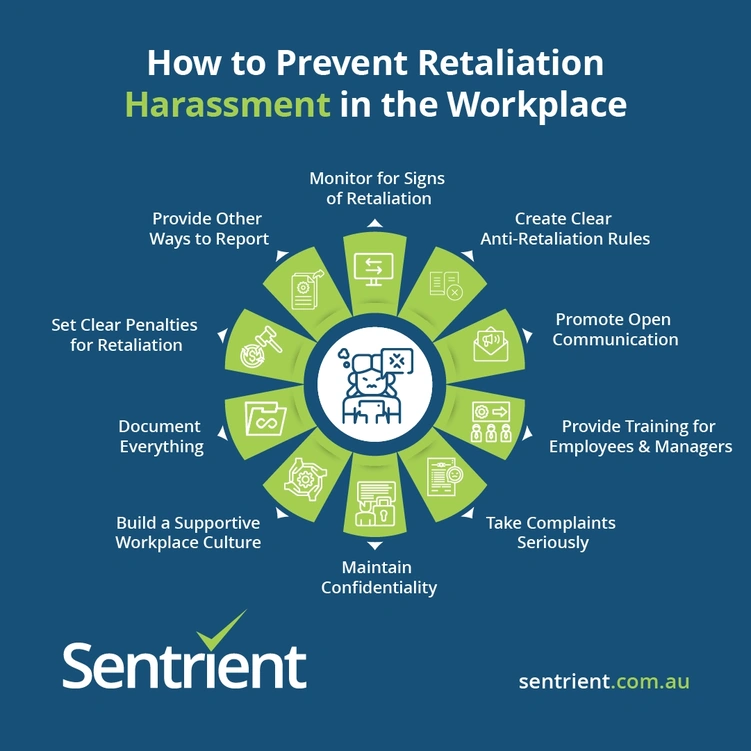
Retaliation isn’t always a dramatic “You’re fired!” moment. Often, it’s a slow burn designed to make you quit. Here are the most common ways workplace harassment retaliation shows up:
1. The Sudden “Performance Issue”
You’ve had glowing reviews for three years. Suddenly, two weeks after you reported workplace harassment, your manager puts you on a Performance Improvement Plan (PIP). If the “faults” are vague or newly invented, it’s a massive red flag.
2. The “Social Freeze”
This is the “high school” version of workplace bullying. Managers might stop inviting you to key meetings, or colleagues might suddenly stop eating lunch with you because they were told you’re “Trouble.” This isolation is a classic form of harassment and retaliation.
3. The Roster From Hell
In industries such as retail or hospitality, retaliation can often result in financial loss. If your boss moves you from the lucrative Saturday shift to the quiet Tuesday morning slot or cuts your hours entirely after you speak up, that is likely retaliation for a claim of harassment.
4. The “Ghost” Promotion
You were the top candidate for the next step. Then, you reported a senior staff member for inappropriate behaviour. Suddenly, the promotion goes to “Dave,” who has half your experience and spends most of his day watching cricket highlights.
5. Increased Supervision (Micromanagement)
If your supervisor starts tracking your bathroom breaks or breathing down your neck about every comma in an email only after a complaint, they are likely looking for an excuse to push you out.
6. Being Moved, Demoted or Stripped of Duties
You come back from an HR meeting to find your key accounts handed to someone else, or you are moved to another team, site or role with less responsibility. If nobody can give a clear business reason, and the timing lines up with your complaint, treat it as a warning sign.
7. Warnings, Threats or a Bad Reference
A sudden written warning over something that was fine last month, a comment like “people who rock the boat don’t last here”, or a poor reference once you have left. Threats can be retaliation even if they are never carried out.
8. Losing Training, Overtime or Flexibility
Your training course is cancelled, your overtime dries up or your flexible working arrangement is withdrawn. Each change on its own can look minor. Together, and straight after a complaint, they form a pattern.
Retaliation or Reasonable Management Action?
Not every change after a complaint is retaliation. Employers can still manage performance and run the business, as long as they do it fairly and not because you complained. These examples of retaliation in the workplace sit next to what fair management usually looks like.
| Situation | Usually legitimate | Possible retaliation |
|---|---|---|
| Performance management | Concerns raised before your complaint, specific, with support and time to improve | A performance plan that appears soon after your complaint, with vague or new faults |
| Roster and hours | Changes applied to the whole team for a clear business reason | Only your shifts or hours cut, straight after you speak up |
| Supervision | Normal check-ins that apply to everyone in the role | Closer monitoring that only started after your complaint |
| Promotion | A documented, fair selection process | Passed over despite being the strongest candidate, with no clear reason |
| Team inclusion | Meeting invites based on role and project | Left out of meetings or communication you used to be part of |
The Legal Reality: Discrimination, Harassment, and Retaliation
Under the Fair Work Act 2009, these actions fall under “General Protections.” They make it unlawful for an employer to take adverse action against you, such as dismissing you, demoting you or changing your job to your disadvantage, because you made a complaint or enquiry about your employment or used another workplace right.
Other laws protect you too:
- Anti-discrimination laws make victimisation unlawful. That covers punishing someone because they made, or helped with, a discrimination or sexual harassment complaint.
- Under the positive duty in the Sex Discrimination Act, employers must take reasonable and proportionate steps to prevent victimisation linked to sexual harassment and sex discrimination.
- WHS laws prohibit discriminatory conduct against workers who raise health and safety concerns.
- Whistleblower laws protect eligible people who report certain types of misconduct from being victimised.
The Australian Human Rights Commission treats victimisation, meaning punishing someone for making or supporting a complaint, as unlawful under federal discrimination law. Retaliation also discourages others from speaking up. Only 18% of workplace sexual harassment incidents are formally reported, according to the Commission’s 2022 Time for Respect survey. It creates a “culture of silence” that protects bullies and hurts productivity.
Logic Check: If an employer’s first instinct after a report is to punish the whistleblower rather than fix the problem, they aren’t just being “tough”. They are exposing the company to serious legal risk.
How to Prove Retaliation Harassment in the Workplace
Proving intent can be tricky, but it is not impossible. If you feel you are experiencing retaliation harassment, do these four things:
- Keep a Paper Trail: Document every unusual interaction, change in shift, or snarky comment. Include dates, times, and witnesses.
- Compare the “Before and After”: Highlight the contrast in your work life before the report and after the report.
- Check the Policy: Most Australian companies have a “Whistleblower” or “Grievance” policy. Check if they are adhering to their own rules.
- Get Advice Early: If you have been dismissed, you have only 21 days to lodge a general protections claim with the Fair Work Commission. The Fair Work Ombudsman (13 13 94), your union or an employment lawyer can help you work out your options.
Summary: Your Rights Matter
No one should have to choose between their dignity and their paycheck. Retaliation after reporting harassment is a serious breach of employment law. If you feel you are being squeezed out, you don’t have to “take it” or “toughen up.”
Australia has strong legal protections against retaliation. Whether it’s through the Fair Work Commission or a legal representative, help is available.
FAQs About Retaliation in the Workplace
1. What are three examples of retaliation at work?
Three common examples are being put on a performance improvement plan soon after making a complaint, having your shifts or hours cut, and being left out of meetings and team communication. Others include demotion, losing a promotion, warnings, threats and bad references.
2. What is silent retaliation?
Silent or quiet retaliation is punishment that is hard to prove because nothing is said out loud. Examples are the cold shoulder, being left off emails and meetings, slower approvals, worse shifts and losing interesting work. It is still retaliation if it happens because you complained.
3. Is workplace retaliation illegal in Australia?
In many situations, yes. The Fair Work Act’s general protections make it unlawful to take adverse action against someone because they made a complaint or enquiry about their employment. Anti-discrimination laws make victimisation unlawful, WHS laws protect workers who raise safety concerns, and whistleblower laws protect eligible whistleblowers.
4. How long do I have to make a retaliation claim?
If you were dismissed, you must lodge a general protections claim with the Fair Work Commission within 21 days of the dismissal taking effect. Other claims have different time limits. For example, the Australian Human Rights Commission can decline complaints made more than 24 months after the incident. Get advice early.
5. Can my employer still manage my performance after I make a complaint?
Yes. Making a complaint does not stop your employer from managing genuine performance issues. What it cannot do is take action against you because you complained. Timing, evidence and whether the concerns existed before your complaint all matter.
Sources
Fair Work Ombudsman, Protections at work
Australian Human Rights Commission, What is the positive duty?
Last reviewed: October 2026
This article is general information, not legal advice. For advice about a specific situation, speak to a lawyer, your union or the Fair Work Ombudsman.
Related Blogs: