Quick Answer
What is AI awareness? AI awareness is a working understanding of what artificial intelligence is, how it is used at work, what it does well and where it fails. For employees, it means using approved AI tools well, checking AI outputs, protecting personal and confidential information and spotting bias or misuse. It does not need technical or coding skills.
In this guide
- What Exactly Is AI Awareness?
- Why Has AI Awareness Become Critical?
- How Is AI Currently Being Used in Workplaces?
- What Benefits Does AI Bring to Today’s Workplace?
- Why Is AI Awareness Important for Every Employee?
- How Can AI Help Address Common Workplace Challenges?
- AI Risks Every Employee Should Understand
- How Organisations Can Build AI Awareness
- How Sentrient Supports AI Awareness in the Workplace
- Conclusion
- Ready to build AI awareness in your organisation?
- FAQs
Artificial Intelligence (AI) has moved beyond being a futuristic concept to becoming an integral part of everyday workplace operations.
From streamlining administrative tasks to enhancing strategic decision making, AI is transforming how we work across every industry.
Understanding AI’s role and potential is no longer optional, it’s a necessity for employees at all levels.
As organisations continue to adopt AI technologies, those with AI awareness will thrive, while those without may find themselves increasingly left behind.
This blog explores why developing AI awareness is important for every employee in modern workplaces and how organisations can foster this critical knowledge.
What Exactly Is AI Awareness?
AI awareness encompasses understanding what artificial intelligence is, how it functions in workplace settings, and recognising its potential applications and limitations.
It’s about being familiar with AI concepts without necessarily requiring technical expertise.
For employees, this means:
- Knowing how to interact with AI tools effectively
- Understanding their benefits and capabilities
- Recognising potential pitfalls and limitations
- Identifying ethical considerations in AI implementation
Why Has AI Awareness Become Critical?
The rapid acceleration of AI adoption across industries has created an urgent need for AI-aware workforces.
Many businesses in Australia and New Zealand are now using or exploring AI technologies in some capacity. Use is growing faster than skills. In a 2025 global study by KPMG and the University of Melbourne, half of Australians surveyed said they use AI regularly, yet only 24% had received any AI training, compared with 39% globally.
This widespread integration means employees without basic AI awareness may struggle to:
- Utilise workplace tools efficiently
- Participate fully in AI-enhanced processes
- Contribute to discussions about AI implementation
- Adapt to changing job requirements
As AI continues to reshape industries, fostering a culture of AI awareness makes sure that both employees and organisations remain competitive in a rapidly changing work environment.
How Is AI Currently Being Used in Workplaces?
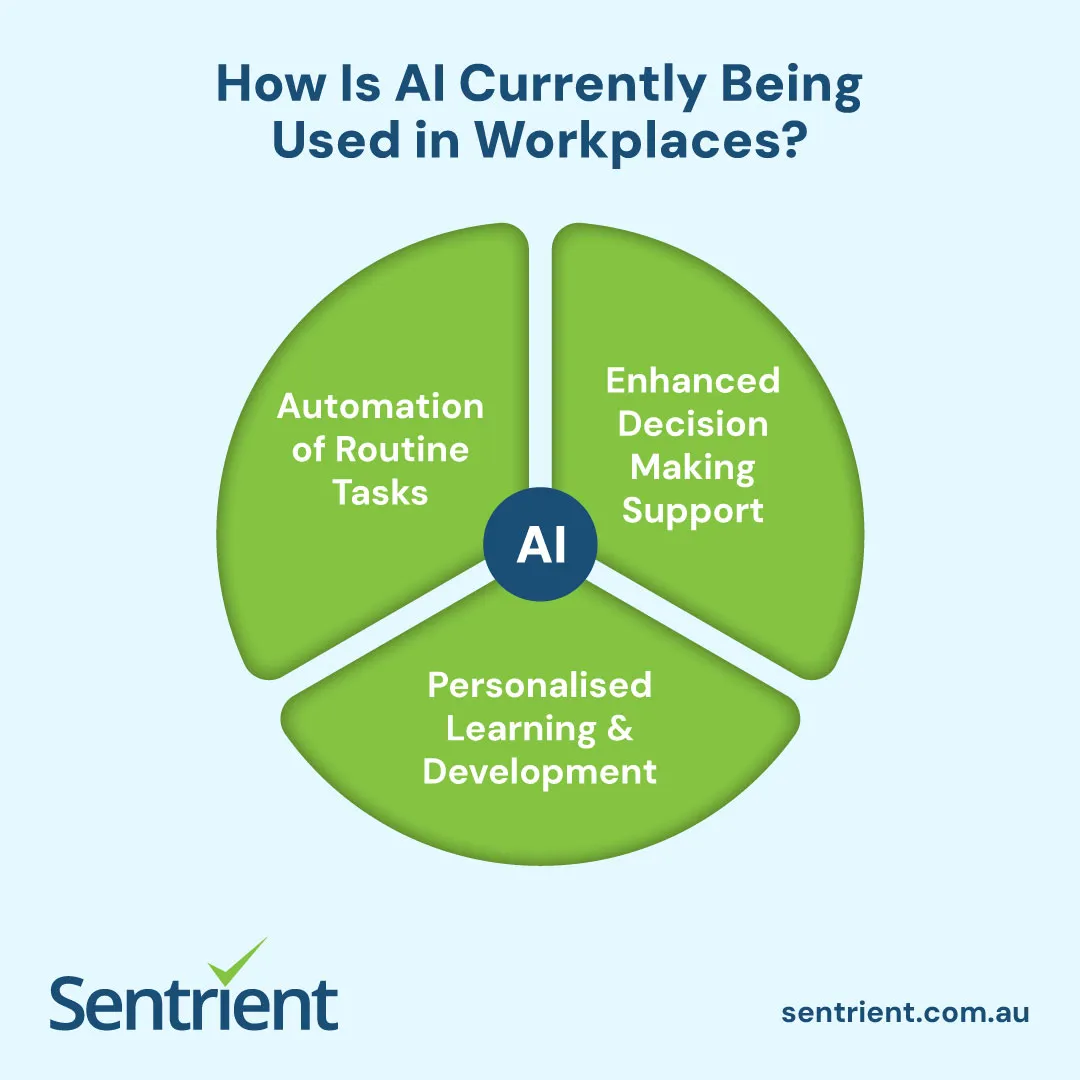
Automation of Routine Tasks
AI systems now handle numerous repetitive tasks across organisations, freeing employees to focus on more complex and creative work.
These include:
- Processing invoices and expense reports
- Scheduling meetings and managing calendars
- Responding to basic customer inquiries
- Sorting and categorising information
By understanding how these systems work, employees can better collaborate with AI tools rather than resist them.
Enhanced Decision-Making Support
AI excels at analysing vast amounts of data to support informed business decisions. Modern workplaces are using AI to:
- Identify market trends and customer preferences
- Predict maintenance needs for equipment
- Analyse performance metrics and suggest improvements
- Assess risks in various business operations
Employees with AI awareness can better interpret and apply these insights in their roles.
Personalised Learning and Development
AI-powered learning platforms are changing employee training by:
- Creating customised learning paths based on individual needs
- Recommending relevant training resources and courses
- Tracking progress and adapting content accordingly
- Providing on-demand learning opportunities
Understanding these tools helps employees take full advantage of development opportunities.
What Benefits Does AI Bring to Today’s Workplace?
Increased Productivity and Efficiency
When properly implemented, AI systems can dramatically improve workplace productivity:
| Traditional Approach | AI-Enhanced Approach | Potential Benefit |
|---|---|---|
| Manual data entry taking several hours weekly | Automated data capture and processing | Significant time reduction |
| Manual report generation (multiple days) | AI-assisted report creation | Faster completion times |
| Standard customer response time (24+ hours) | AI-powered response systems | Quicker responses |
| Manual scheduling and coordination | AI scheduling assistants | Fewer scheduling conflicts |
Employees who understand these capabilities can identify opportunities for AI implementation in their own workflows.
Enhanced Workplace Wellbeing
AI tools are increasingly being used to support employee wellbeing by:
- Monitoring workloads and suggesting breaks
- Identifying early signs of stress or burnout
- Providing personalised wellness recommendations
- Supporting flexible working arrangements
With proper awareness, employees can use these tools to maintain a better work-life balance.
Improved Decision Quality
AI-augmented decision-making leads to better outcomes through:
- Reduced human bias in data analysis
- Consideration of more variables than humanly possible
- Consistent application of decision criteria
- Real-time updates based on changing conditions
Employees with AI awareness can better collaborate with these systems rather than simply following their recommendations blindly.
Why Is AI Awareness Important for Every Employee?
Adapting to Changing Job Responsibilities
As AI takes over routine tasks, job roles are evolving to focus more on:
- Creative problem-solving
- Strategic thinking
- Emotional intelligence
- Interpersonal communication
- AI system oversight
Understanding this shift helps employees develop relevant skills for their evolving roles.
Ethical Use and Oversight
AI systems are powerful but require human oversight to make sure ethical use. Employees with AI awareness can:
- Identify potential biases in AI systems
- Recognise inappropriate applications of AI
- Question AI-generated recommendations when necessary
- Advocate for responsible AI practices
This ethical dimension of AI awareness is particularly important as organisations navigate complex implications of AI adoption.
Competitive Advantage in Career Development
Employees with strong AI awareness position themselves advantageously in the job market by:
- Demonstrating valuable contemporary knowledge
- Identifying opportunities to implement AI in their work
- Speaking confidently about AI applications in interviews
- Adapting more quickly to new workplace technologies
As AI becomes more ubiquitous, this awareness increasingly becomes a baseline expectation rather than a differentiator.
How Can AI Help Address Common Workplace Challenges?
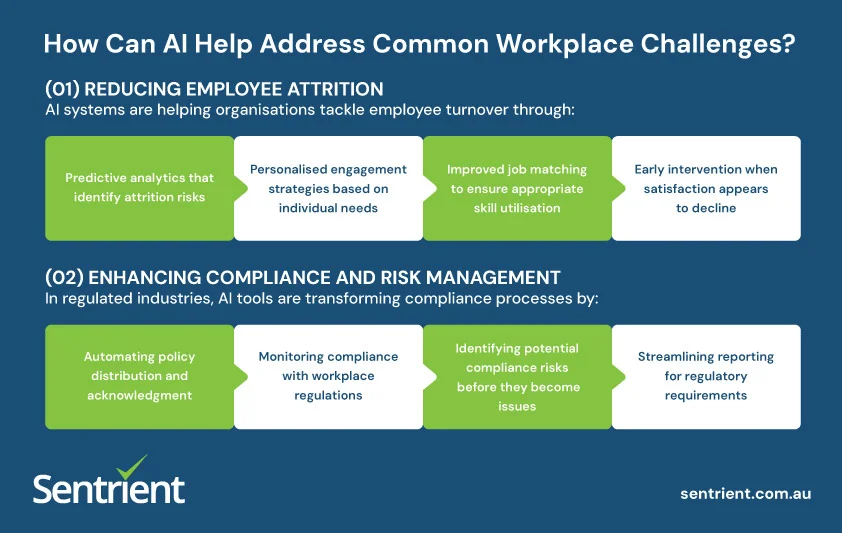
Reducing Employee Attrition
AI systems are helping organisations tackle employee turnover through:
- Predictive analytics that identify attrition risks
- Personalised engagement strategies based on individual needs
- Improved job matching to make sure appropriate skill utilisation
- Early intervention when satisfaction appears to decline
With proper AI awareness, HR teams can implement these solutions effectively while maintaining appropriate human oversight.
Enhancing Compliance and Risk Management
In regulated industries, AI tools are transforming compliance processes by:
- Automating policy distribution and acknowledgment
- Monitoring compliance with workplace regulations
- Identifying potential compliance risks before they become issues
- Streamlining reporting for regulatory requirements
Understanding these capabilities helps compliance officers and employees alike maintain higher standards with less administrative burden.
AI Risks Every Employee Should Understand
AI awareness is as much about knowing the limits as knowing the benefits. These are the risks staff most often meet in day-to-day work.
| Risk | What it looks like at work | What an AI-aware employee does |
|---|---|---|
| Wrong or made-up answers | A chatbot gives a confident answer, figure or citation that is false | Checks facts and sources before using or sharing the output |
| Privacy breaches | Customer or staff details pasted into a public AI tool | Keeps personal and sensitive information out of public tools |
| Confidential data leaks | Contracts, code or strategy uploaded to an unapproved tool | Uses only tools the organisation has approved |
| Bias | AI screening or scoring that disadvantages a group | Questions results and raises concerns early |
| Over-reliance | Decisions made on AI output with no human review | Keeps a person accountable for the final decision |
The Office of the Australian Information Commissioner (OAIC) recommends, as best practice, that organisations do not enter personal information, and particularly sensitive information, into publicly available AI chatbots and generative AI tools.
How Organisations Can Build AI Awareness
The National AI Centre’s Guidance for AI Adoption, released in October 2025, sets out six practices for responsible AI use: decide who is accountable, understand impacts and plan for them, measure and manage risks, share key information, test and monitor, and keep human control. For most employers, building awareness around those practices comes down to five steps.
- Write an AI use policy: List approved tools, banned uses and what information must never be entered.
- Train every role: Give all staff a short foundation course, such as an AI awareness training course, then add role-specific modules.
- Name an owner: Make one person or team accountable for AI tools, risks and questions.
- Keep a register: Record which AI tools are in use, by whom and for what.
- Review regularly: Update the policy and training as tools, laws and guidance change.
How Sentrient Supports AI Awareness in the Workplace
Sentrient’s complete workplace compliance and HR solutions help organisations foster AI awareness through customisable learning modules designed for the modern workplace, with particular focus on Australian and New Zealand business needs.
Our learning management system features engaging courses covering:
- AI fundamentals and applications
- Practical implementation scenarios
- Ethical considerations and compliance requirements
- Best practices for AI-human collaboration
These courses avoid overwhelming technical details, making sure accessibility for employees at all levels.
Our policy management system enables organisations to create clear AI usage policies that establish appropriate boundaries and expectations for all employees.
The distribution framework makes sure these policies reach everyone efficiently while tracking acknowledgment and comprehension.
Sentrient’s governance and risk management tools provide structured frameworks for evaluating AI implementations, identifying potential risks, and maintaining ongoing compliance.
These assessment tools address:
- Privacy implications
- Security vulnerabilities
- Ethical considerations
- Documentation requirements
This approach helps organisations implement AI technologies responsibly while meeting regulatory requirements.
Conclusion
AI awareness is rapidly becoming as fundamental to workplace success as digital literacy was a decade ago.
By understanding AI’s capabilities, limitations, and implications, employees can:
- Adapt more effectively to changing workplace technologies
- Contribute meaningfully to AI implementation discussions
- Maintain relevant skills in an evolving job market
- Participate in making sure ethical AI application
For organisations across Australia and New Zealand, fostering AI awareness isn’t just about technological adoption, it’s about creating a workforce prepared for the future of work.
As AI continues to transform workplaces, those who embrace AI awareness will find themselves better positioned to thrive in an increasingly AI-augmented work environment.
Ready to build AI awareness in your organisation?
Explore how Sentrient’s compliance and HR management tools can help your team develop AI awareness while making sure compliance.
Our solutions are tailored to meet the unique needs of businesses in Australia and New Zealand.
Contact us today to start your organisation’s AI awareness journey.
FAQs
1. How quickly do employees need to develop AI awareness?
While immediate mastery isn’t necessary, employees should begin developing basic AI awareness now. The pace of AI adoption is accelerating and establishing foundational knowledge sooner rather than later will make adaptation easier.
2. Do all employees need the same level of AI awareness?
No. While everyone benefits from basic awareness, the depth of knowledge required varies by role. Technical teams may need deeper understanding, while others may focus more on practical applications and ethical considerations.
3. How can I measure AI awareness in my organisation?
Consider assessments that evaluate understanding of basic AI concepts, comfort with AI tools, awareness of ethical considerations, and ability to identify appropriate AI applications for specific challenges.
4. What if employees are resistant to developing AI awareness?
Address concerns directly by emphasising how AI awareness benefits individual careers, demonstrating practical applications, providing adequate training resources, and making sure proper support during transitions.
5. Does AI awareness require technical expertise?
No. Effective AI awareness focuses on concepts, applications, benefits, and limitations rather than technical implementation details. Non-technical employees can develop valuable AI awareness without coding or data science expertise.
6. What is the difference between AI awareness and AI literacy?
AI awareness is the baseline: knowing what AI is, where it is used and what the risks are. AI literacy goes further, covering the skills to use AI tools well, write good prompts and judge outputs. Most organisations start with awareness for everyone and build literacy by role.
7. Should employees use public AI tools like ChatGPT at work?
Only if your AI use policy allows it, and never with personal, sensitive or confidential information. The OAIC recommends, as best practice, that organisations keep personal information out of publicly available generative AI tools. Approved business versions with the right privacy settings lower the risk.
8. What should an AI use policy include?
Approved and banned tools, information that must never be entered, rules for checking and labelling AI output, who is accountable, how to report problems and how often the policy is reviewed. Pair the policy with training so staff know how to apply it.
Sources
KPMG and University of Melbourne: Trust, attitudes and use of AI, a global study 2025
Department of Industry, Science and Resources: Guidance for AI Adoption
OAIC: Guidance on privacy and the use of commercially available AI products
Last reviewed: October 2026
Read More About Artificial Intelligence:
- New Online Artificial Intelligence Awareness Training Course Now Available
- The Future of AI in Governance, Risk and Compliance (GRC): A Detailed Guide
- Workplace Compliance 101: Best Practices for Small and Medium Businesses
- The Benefits of AI Training for Employees: Boosting Productivity and Efficiency
- Why AI Awareness Is Essential for Every Employee in Today’s Workplace