Which Performance Management System Is Best For Australian Businesses In 2026?
Quick Answer
The best performance management system for your business comes down to two things: your team size, and whether you want performance to stand alone or sit alongside the rest of your HR. Sentrient performance management software is our top pick for Australian teams that want performance, compliance and training in one platform, built locally and trusted by more than 1,000 organisations across Australia and New Zealand. Lattice and Culture Amp lead the specialist field, and Workday and SAP SuccessFactors suit large enterprises.
The performance management systems are the complete platforms that run your performance cycle from end to end, covering goal setting, continuous feedback, structured reviews, recognition and analytics.
Unlike a single point tool, a system is built to standardise performance across the whole organisation and usually connects to the rest of your HR.
This guide compares ten systems used in Australia, with current pricing, the size of organisation each suits, and what each does best.
Looking for a lighter, standalone option instead? See our companion guide: Best Performance Management Tools in Australia (2026).
Comparison At Glance
| System | Best for | Starting price | Full cycle | Org size | AU-built | Rating |
|---|---|---|---|---|---|---|
| Sentrient | Performance with compliance + training | Custom quote (after demo) | Yes | SME-Mid | Yes | 4.6 (Capterra) |
| 15Five | Continuous feedback and managers | From ~US$4 (Engage); Perform ~US$11 | Yes | SME-Mid | No | 4.6 (G2) |
| Culture Amp | Engagement and people analytics | Custom (~US$5-8/user) | Yes | Mid-Ent | AU-born | 4.5 (G2) |
| ELMO | AU/NZ HR suite with performance | Custom quote | Yes | Mid-Ent | Yes | 4.5 (Capterra) |
| Employment Hero | Performance with HR and payroll | HR from ~A$20/emp/mo | Yes | SME-Mid | Yes | 4.3 G2 / 4.5 Cap |
| HiBob | Modern mid-market HRIS | Custom quote | Yes | Mid | No | 4.5 (G2) |
| Lattice | Unified performance and growth | From ~US$11/user/mo | Yes | SME-Ent | No | 4.7 (G2) |
| Leapsome | Performance joined with learning | ~US$8 for a performance setup | Yes | SME-Ent | No | 4.8 (G2) |
| SAP SuccessFactors | Large, complex enterprises | Custom (enterprise) | Yes | Enterprise | No | 4.1 (G2) |
| Workday | Enterprise HCM with performance | Custom (enterprise) | Yes | Enterprise | No | 4.2 (G2) |
Our Top Picks By Organisation Type
- Best Australian-built system for performance with compliance and training: Sentrient
- Best specialist system for mid-market: Lattice
- Best for engagement-led organisations: Culture Amp
- Best for continuous feedback: 15Five
- Best for performance joined with learning: Leapsome
- Best for large enterprises: Workday or SAP SuccessFactors
What Is A Performance Management System?
A performance management system is software that runs the full cycle of managing employee performance, from setting goals to reviewing results.
It brings goal setting, continuous feedback, performance reviews, recognition and reporting into one place, so managers and employees can track progress through the year rather than at a single annual review.
Unlike a standalone tool that covers one task, a system applies a consistent process across the whole organisation and connects with your wider HR.
Types Of Performance Management Systems
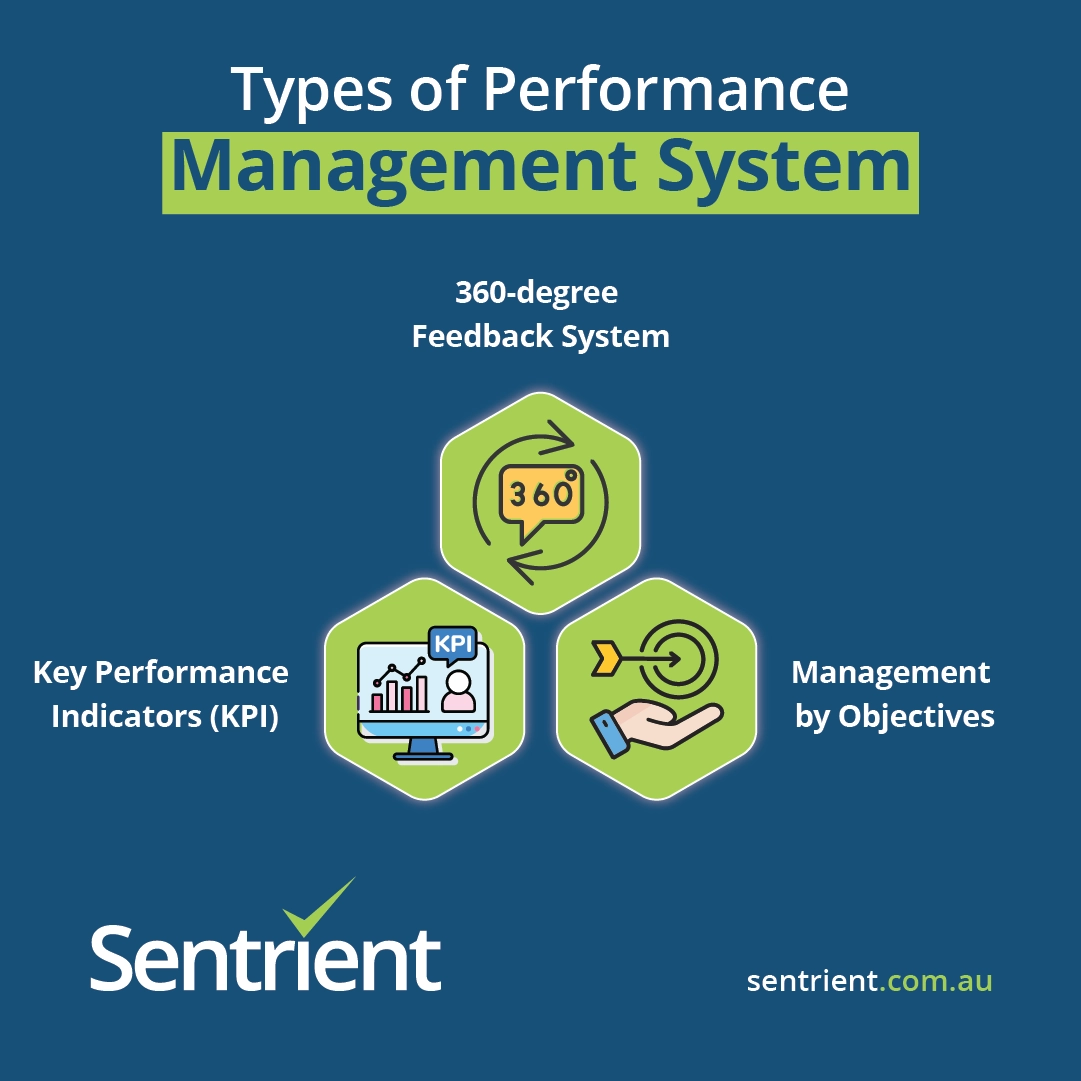
Most systems support more than one way of measuring performance. The three approaches you will see most often in Australia are:
1. 360-degree Feedback
360-degree feedback gathers input on an employee from their manager, peers, direct reports and sometimes customers.
It gives a rounded view of performance and works best for development conversations rather than pay decisions alone.
2. Management My Objectives (MBO)
Management by objectives sets clear, shared goals between a manager and employee, then reviews performance against them.
It suits roles with specific, measurable objectives and underpins the goal and OKR features in most systems.
3. Key Performance Indicators (KPIs)
KPIs measure performance against defined targets, such as sales, response times or quality scores.
They suit roles with clear, quantifiable outcomes and are often combined with the other two approaches. The strongest systems let you blend all three, so you can match the method to each role.
What A Complete Performance Management System Includes
The strongest systems cover the whole performance cycle rather than one slice of it.
When you compare options, look for these five components working together:
- Goal setting and alignment, including OKRs and KPIs, so individual goals ladder up to company objectives.
- Continuous feedback and check-ins, so performance is an ongoing conversation rather than an annual event.
- Structured reviews, including 360-degree feedback, with templates that keep evaluations fair and consistent.
- Recognition and development, linking performance to growth, learning and career progression.
- Analytics and reporting, so leaders can see trends, spot risk and make informed decisions.
Why Invest In A Performance Management System?
A good system does more than tidy up the annual review. Used well, it changes how a team works through the year.
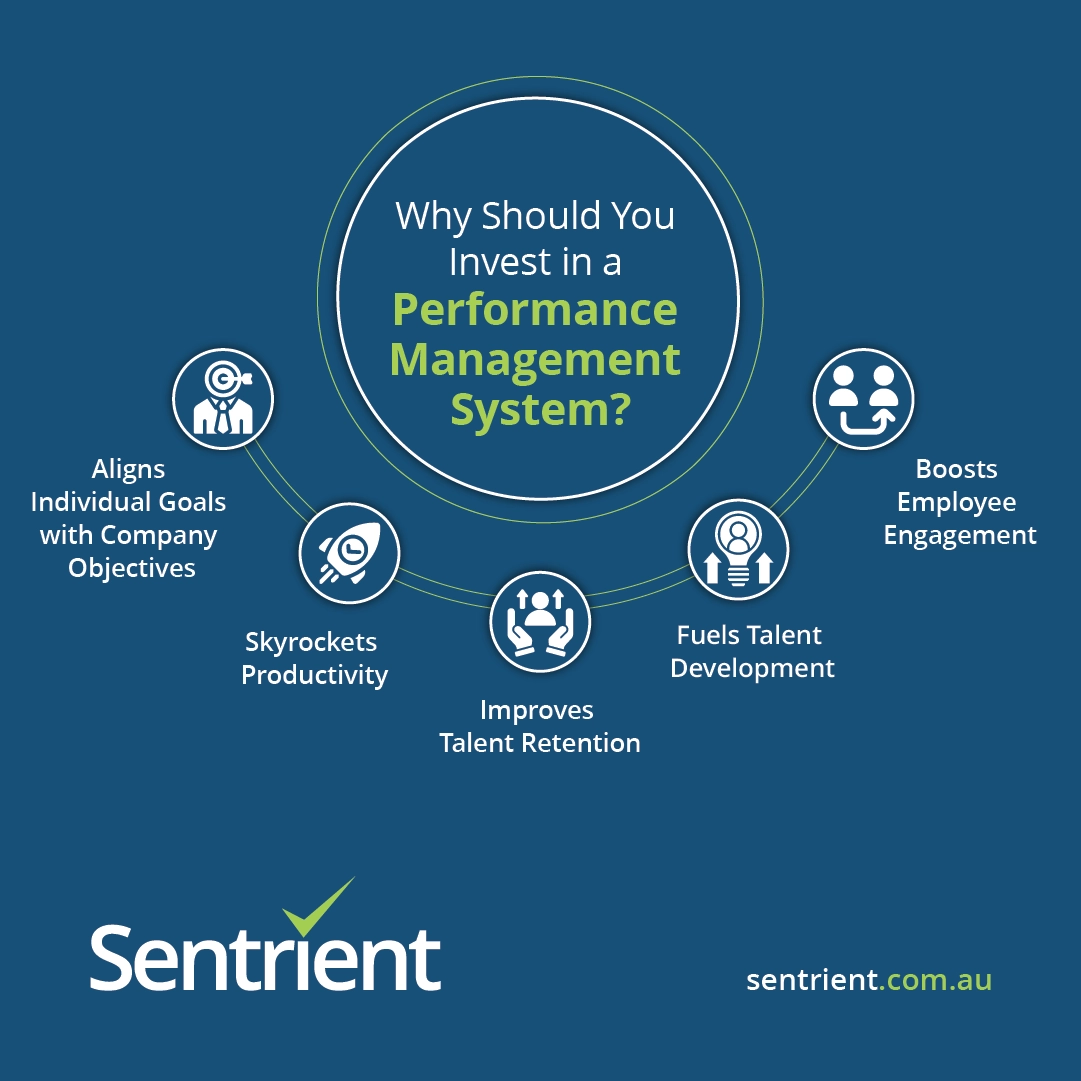
The main benefits are:
- Stronger engagement: Regular feedback and clear goals help people see how their work matters, which lifts motivation and involvement.
- Better development: Linking performance to learning and growth helps employees build skills and progress, rather than only being judged.
- Improved retention: Ongoing conversations surface concerns early, so issues can be addressed before good people decide to leave.
- Higher productivity: Clear goals and regular check-ins keep work aligned and on track, which reduces wasted effort.
- Goal alignment: Individual goals ladder up to team and company objectives, so everyone is pulling in the same direction.
Clear goals and regular feedback also support a fair process if you ever need to manage underperformance, as set out in the Fair Work Ombudsman’s managing underperformance best practice guide.
How Do We Choose?
We assessed each system against the full performance cycle: goal and OKR tracking, continuous feedback, structured reviews, engagement, analytics, integrations, ease of use, scalability, local support and price.
Pricing is taken from each vendor’s published rates and partner listings, and ratings are drawn from review sites including Capterra, G2 and SoftwareSuggest, verified in June 2026.
Both are dated, since vendors change pricing often, and we review this guide each quarter.
As an Australian-built system, Sentrient is our recommended choice for teams that want performance alongside compliance and training, and we are clear about where a specialist or enterprise system is the better fit.
Top 10 Best Performance Management Systems In Detail
1. Sentrient – 4.6 on Capterra (support and value rated 10/10)
Sentrient is our top pick for Australian businesses that want a performance management system joined with compliance and training.
Built in Australia, it runs the full performance cycle, goal setting, performance reviews, engagement surveys, meetings and performance improvement plans, inside the same platform you use for policy sign-off and workplace compliance.
It is used by more than 1,000 organisations across Australia and New Zealand.
Best for: Australian SMEs and mid-sized teams wanting performance, compliance and training in one system.
Key features: Goal setting and management, performance reviews, 360-style feedback, engagement surveys, meetings, performance improvement plans, plus compliance and learning in one Australian platform.
Strengths
- Built in Australia, with local Melbourne-based support
- Full performance cycle joined with compliance and training
- Rated 4.6 on Capterra, with standout scores for support and value
- Connects performance to policies, training and records
- Trusted by more than 1,000 organisations across Australia and New Zealand
Watch-outs
- Part of a broader HR and compliance platform, not a standalone performance-only system
- Pricing is tailored to your modules and team size, so a demo is needed for a quote
- Best suited to teams that also value compliance and training
2. 15Five – 4.6 (G2)
15Five is a specialist system built around continuous performance and manager enablement, combining regular check-ins, engagement surveys and AI insights that flag emerging performance and retention risks.
It suits teams that want an ongoing performance rhythm.
Best for: SME and mid-sized teams wanting continuous feedback and stronger managers.
Key features: Weekly check-ins, OKRs and goals, engagement surveys, 360 reviews and AI-driven insights.
Strengths
- Strong continuous-feedback model
- Useful manager coaching tools
- AI insights on engagement and risk
Watch-outs
- No local Australian base
- Priced per module
- Less suited to compliance-heavy needs
3. Culture Amp – 4.5 (G2)
Culture Amp is an Australian-born system best known for employee engagement and people analytics, with performance and development built around that core.
It is a strong choice for organisations that lead with culture and want rich data behind performance.
Best for: Mid-sized to enterprise organisations leading with engagement and analytics.
Key features: Engagement and pulse surveys, performance reviews, goal tracking, development and benchmarking analytics.
Strengths
- Market-leading engagement and analytics
- Australian-born, globally established
- Strong benchmarking data
Watch-outs
- Custom, quote-based pricing
- Performance is secondary to engagement
- Can be more than small teams need
4. ELMO Software – 4.5 (Capterra)
ELMO is an Australian and New Zealand HR suite where performance sits alongside recruitment, onboarding, learning and payroll.
It suits mid-sized and larger organisations that want performance as one part of a broad, locally compliant system.
Best for: Mid-to-large AU/NZ organisations wanting a full HR suite.
Key features: Performance reviews, goals, learning and analytics within a full HR suite, with Australian support.
Strengths
- Broad, modular suite
- Established AU/NZ presence
- Strong reporting
Watch-outs
- Custom pricing, not published
- Can be heavy for small teams
- Module-based cost adds up
5. Employment Hero – 4.3 (G2) / ~4.5 (Capterra)
Employment Hero includes performance within its widely used Australian all-in-one HR and payroll platform.
It suits SMEs that want reviews, goals and feedback to sit with onboarding, HR and pay in one place.
Best for: Australian SMEs wanting performance with HR and payroll together.
Key features: Performance reviews, goals, feedback and engagement within an all-in-one HR and payroll platform.
Strengths
- Performance sits with HR and payroll
- Strong Australian compliance
- Local support hours
Watch-outs
- Performance is one module among many
- Per-month minimums on smaller plans
- Less depth than specialist systems
6. HiBob – 4.5 (G2)
HiBob’s platform, Bob, is a modern HRIS aimed at mid-market companies, with performance and engagement built on a strong people-experience core.
It suits growing organisations that want a polished system covering HR and performance together.
Best for: Mid-market companies wanting a modern HRIS with performance.
Key features: Performance reviews, goals, engagement, people analytics and core HR, with wide integrations.
Strengths
- Modern, intuitive interface
- Strong engagement and analytics
- Good for distributed teams
Watch-outs
- No native Australian payroll
- Premium price point
- Less depth for complex enterprise needs
7. Lattice – 4.7 (G2)
Lattice is a leading specialist system that brings performance reviews, goals and OKRs, engagement and growth into one polished platform.
It is a popular choice for people teams that want a unified performance and development experience.
Best for: SME to enterprise people teams wanting unified performance and growth.
Key features: Performance reviews, OKRs and goals, engagement surveys, growth plans and analytics.
Strengths
- Polished, unified platform
- Strong goals and growth tools
- High review scores
Watch-outs
- No local Australian base
- Annual minimum commitment
- Cost rises as you add modules
8. Leapsome – 4.8 (G2)
Leapsome joins performance, learning and engagement in one system and holds some of the highest review scores in the category.
It suits organisations that want development and performance to work together.
Best for: SME to enterprise teams wanting performance and learning combined.
Key features: Performance reviews, goals and OKRs, learning paths, engagement surveys and analytics.
Strengths
- Very high user ratings
- Performance and learning together
- Flexible, modular design
Watch-outs
- No local Australian base
- Modular pricing adds up
- Takes time to configure fully
9. SAP SuccessFactors – 4.1 (G2)
SAP SuccessFactors is an enterprise human capital management system with deep performance, goals and succession tools.
It suits large, complex organisations that want performance to run inside a global HCM with extensive configuration.
Best for: Large, complex enterprises wanting deep configuration.
Key features: Performance and goals, calibration, succession and analytics within the SAP HCM suite.
Strengths
- Enterprise-grade depth
- Strong succession and calibration
- Global scale
Watch-outs
- Heavy and costly for smaller teams
- Long, complex implementation
- Custom enterprise pricing only
10. Workday – 4.2 (G2)
Workday delivers performance as part of its enterprise HCM suite, suiting large organisations that want performance to run inside a single system covering HR, finance and workforce planning.
Best for: Large enterprises wanting performance within a full HCM.
Key features: Performance reviews, goals, talent and succession, with deep analytics inside the Workday HCM suite.
Strengths
- Enterprise-grade depth
- One system across HR and finance
- Strong analytics and planning
Watch-outs
- Heavy and costly for smaller teams
- Long implementation
- Custom enterprise pricing only
What To Look For When Choosing
Beyond the headline features, weigh these practical factors when you compare systems:
- Ease of use. Managers and employees should be able to run reviews and check-ins without heavy training.
- Customisation. Look for review templates, rating scales and workflows you can shape to your own process.
- Integrations. The system should connect to your HRIS, payroll and the productivity tools your team already uses.
- Scalability. Choose a system that still fits as your headcount and complexity grow.
- Analytics and reporting. Clear dashboards help leaders spot trends and act on them.
- Local support and compliance. For Australian teams, local support hours and a fit with Australian obligations matter.
- Total cost. Factor in setup, per-user fees, add-on modules and any annual minimum, not just the headline price.
How To Choose A Performance Management System
By Organisation Size
Small and medium Australian teams are well served by Sentrient or Employment Hero.
Mid-market organisations may prefer Lattice, Leapsome, HiBob or Culture Amp, while large enterprises tend towards Workday or SAP SuccessFactors. ELMO spans mid-to-large AU and NZ organisations.
By How Joined-up You Want It
If you want performance to sit with the rest of your people processes, an Australian platform such as Sentrient, Employment Hero or ELMO keeps reviews, compliance, training and records together.
If you want the deepest specialist features, Lattice, Leapsome, 15Five or Culture Amp focus on performance and engagement.
By Australian Support And Compliance
If local support, Australian compliance and a fit with your wider HR matter, prioritise the Australian-built systems.
That is where Sentrient, with the full performance cycle inside a local compliance and training platform, stands out.
Why Australian Businesses Choose Sentrient
Sentrient is built in Australia and runs the full performance cycle, goals, reviews, engagement surveys and performance improvement plans, alongside compliance and training in one reliable system. More than 1,000 organisations across Australia and New Zealand use it, and it holds a 4.6 rating on Capterra with standout scores for support and value. It connects performance to your policies, training and records rather than running as a separate tool.
Frequently Asked Questions
1. What is a performance management system?
A performance management system is a complete platform that runs the performance cycle end to end, covering goal setting, continuous feedback, structured reviews, recognition and analytics. It is built to standardise performance across an organisation, and usually connects to the rest of your HR.
2. What is the difference between a performance management system and a performance management tool?
A system runs the full performance cycle and is built to scale across an organisation, often as part of an HR platform. A standalone tool focuses on one or two areas, such as continuous feedback or surveys. If you want a lighter option, see our guide to the best performance management tools.
3. What are the three types of performance management systems?
The three common approaches are 360-degree feedback, which gathers input from managers, peers and reports; management by objectives (MBO), which sets and reviews shared goals; and key performance indicators (KPIs), which measure performance against defined targets. Many systems support all three.
4. What are the benefits of a performance management system?
Used well, a system lifts engagement, supports employee development, improves retention, raises productivity and aligns individual goals with company objectives. It does this by replacing the once-a-year review with clear goals and regular feedback through the year.
5. Does Sentrient offer a performance management system?
Yes. Sentrient includes a full performance management system covering goals, reviews, engagement surveys, meetings and performance improvement plans, all inside its Australian compliance and learning platform.
6. How much does a performance management system cost in Australia?
Specialist systems commonly start around US$4 to US$16 per user per month depending on the modules. Australian platforms such as Sentrient and ELMO, and enterprise systems such as Workday and SAP SuccessFactors, use a tailored quote based on your size and needs. Always confirm current pricing with the vendor.
7. How long does it take to implement a performance management system?
Smaller systems can be live in a few weeks. Enterprise systems can take several months, depending on configuration, data migration and training. Most vendors offer onboarding support to guide the rollout.
8. How is a performance management system different from an HRIS?
An HRIS manages core people data such as records, leave and onboarding. A performance management system focuses on goals, feedback and reviews. Some platforms, including Sentrient, combine performance with wider HR, compliance and training, so the two sit together.
Explore More On Performance Management:
- What Is A Performance Management System?
- What Are The 6 Most Powerful Employee Performance Management Tools
- 8 Key Reasons to Implement A 360 Degree Feedback System
- The Top 10 Performance Management Software in Australia
- Top Performance Management Tools That Integrate With HR Platforms and Productivity Apps for 2026
- Stop Wasting Time on Performance Reviews: Revolutionise Your Performance Management
- Performance Reviews Explained: A Guide for Employees and Employers
- Performance Management Secrets: What Top Companies Don’t Want You to Know