Quick Answer
A performance review is a structured conversation about how someone is doing at work, what needs to change, and what support they will get. In Australia the record of that conversation matters legally, because if performance ever leads to dismissal, the Fair Work Commission will ask whether the person was warned and given a real chance to respond.
In this blog
- What A Performance Review Is, And What It Is Actually For
- 7 Types Of Performance Reviews
- How Often Should Reviews Happen?
- The Australian Legal Layer
- Running The Review Meeting: Before, During, After
- Performance Review Templates
- What To Say, And What Not To Say
- Linking Reviews To Pay And Promotion
- Setting Standards That Mean The Same Thing To Everyone
- Bias: The Five That Do The Most Damage
- Common Problems And What Actually Fixes Them
- For Employees: How To Prepare, And What To Do If You Disagree
- Connecting Reviews To Development And Career
- Is Your Review System Actually Working?
- Special Situations
- What A System Can And Cannot Do
- Where Sentrient Fits
- Frequently Asked Questions
This guide covers the types of review and how often to run them, four templates you can copy, the Australian legal rules that decide whether a performance dismissal holds up, what to say and what never to say, and the biases that quietly wreck the whole exercise.
What A Performance Review Is, And What It Is Actually For
A performance review is a structured conversation about how someone is doing, what needs to change, and what support they will get.
It has two purposes and most organisations only think about the first.
The obvious one is to help someone improve. The second, which people remember only when it is too late, is that the review is the evidence.
If performance ever leads to dismissal, the Fair Work Commission will look at what the person was told, when, and whether they had a real chance to fix it.
The performance review is where that record either exists or does not.
This is why performance reviews are a compliance topic in Australia, and not just an HR ritual.
7 Types Of Performance Reviews
| Type | What it is | Best used for | Watch out for |
|---|---|---|---|
| 1. Manager to employee | The traditional review. The manager assesses the employee | The default. Clear accountability | One person’s view, one person’s bias |
| 2. Self-evaluation | The employee assesses themselves first | Surfacing gaps between how someone sees themselves and how they are seen | Confident people over-rate. Diligent people under-rate. Do not treat the score as data |
| 3. 360-degree feedback | Input from manager, peers, direct reports, sometimes clients | Development. Seeing the person the way the organisation sees them | Do not tie it to pay. The moment feedback affects money, honesty leaves the room |
| 4. Team review | Assessing the team’s performance as a unit | Interdependent work where individual attribution is artificial | Hiding an individual problem inside a team result |
| 5. 9-box grid | Rating performance against potential on a 3×3 grid | Succession and development planning | It is a planning tool, not a judgement of a person. Do not show people their box |
| 6. Goal-based (MBO) | Assessing against agreed measurable objectives | Roles with clear outputs | Goals set in January that were irrelevant by March |
| 7. Skills-based | Assessing against the capabilities the role requires | Identifying training needs, and technical or trade roles | Ticking a competency without observing it |
How Often Should Reviews Happen?
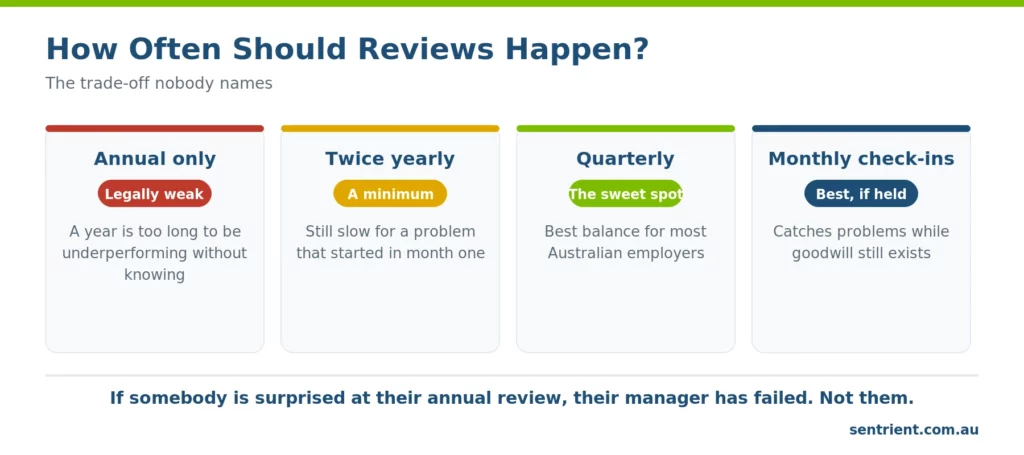
The pattern most Australian employers land on is a light check-in monthly or quarterly, plus one formal annual review that carries the pay and development decisions.
The point is not the calendar. Feedback that arrives eleven months after the event is not feedback, it is an ambush. If somebody is surprised at their annual review, their manager has failed, not them.
| Frequency | What it is good for | The honest problem with it |
|---|---|---|
| Annual only | A formal record, pay and promotion decisions | A year is far too long for someone to be underperforming without knowing. It is also legally weak, because nobody was warned in time to fix anything |
| Twice yearly | A workable minimum for smaller teams | Still slow for a problem that started in month one |
| Quarterly | The best balance for most Australian employers | Requires managers to actually do it, four times a year |
| Monthly or weekly check-ins | Catching problems while they are still small, and while goodwill still exists | They quietly become status updates unless someone protects the purpose |
The Australian Legal Layer
This is what most performance review guides leave out, and it is the part that costs employers money.
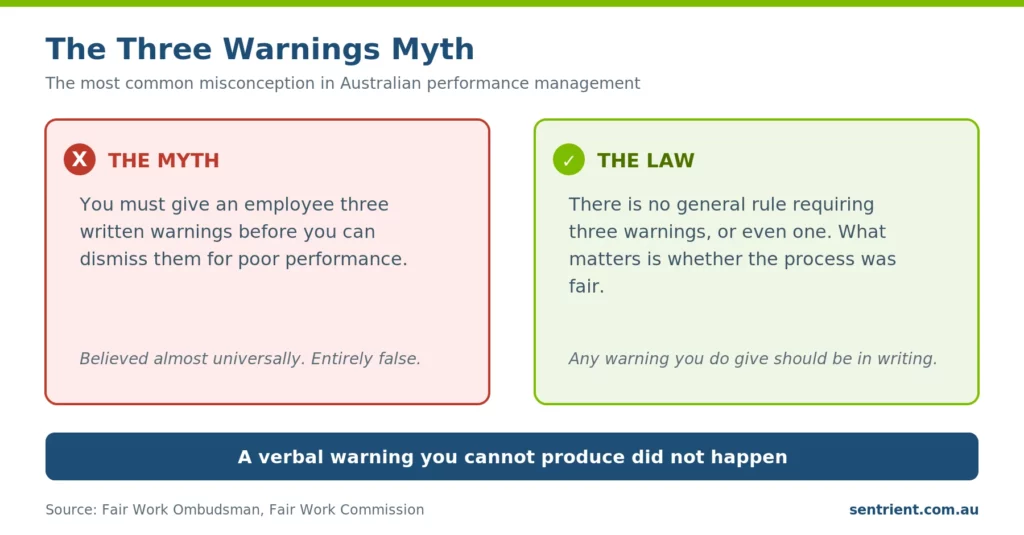
The three warnings myth. There is no general legal rule in Australia requiring three warnings, or even one, before dismissing someone for performance. That belief is everywhere and it is wrong. What matters is whether the process was fair.
If a dismissal is challenged as unfair, the Fair Work Commission must consider whether the dismissal was harsh, unjust or unreasonable, taking into account matters including:
- Whether there was a valid reason relating to the person’s capacity or conduct
- Whether the person was notified of that reason
- Whether they were given an opportunity to respond
- Any unreasonable refusal to allow a support person at discussions relating to the dismissal
- If the dismissal related to unsatisfactory performance, whether the person had been warned about it beforehand
- The size of the business, and whether it had dedicated HR expertise
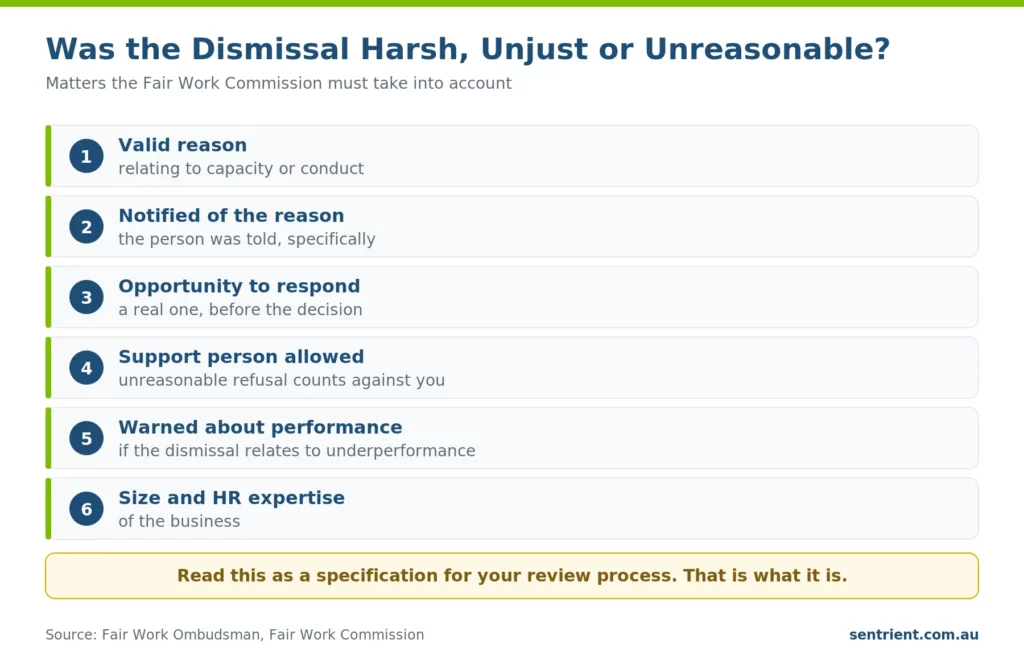
Read that list as a specification for your review process, because that is what it is.
Every one of those points is either evidenced in your performance records or it is not.
- Warnings should be in writing: A verbal warning you cannot produce did not happen
- Be specific: Improve your attitude is not a performance standard. Nobody can pass it, and no tribunal will accept it
- Allow a support person: A performance meeting can turn into a dismissal meeting. Allow one whenever asked
- Do not run a PIP as theatre: If the decision is already made, the plan is not a plan, and it is exactly what the Commission looks for
- Watch for adverse action: A review influenced by a protected attribute, or by someone exercising a workplace right such as taking leave or making a complaint, is a different and more serious problem than an unfair review

Running The Review Meeting: Before, During, After
Before
- Give notice: A week, not a calendar invite that lands the same morning. An ambush produces defensiveness, not honesty
- Gather evidence, both ways: Specific examples with dates. If you cannot find any positive ones, that is information about you, not them
- Ask for a self-assessment first: It surfaces the gap between how they see themselves and how you see them, and that gap is usually the most useful thing in the room
- Never write the outcome before the conversation: If the rating is decided in advance, you are not holding a review, you are delivering a verdict
During
- Private room, phone away, no interruptions: A review held in a glass box with people walking past is not a safe conversation
- Let them speak first: Ask how they think the period went before you say a word about it. You will learn more in that answer than in the rest of the meeting
- Ask, do not tell: What got in your way. What would you do differently. What do you need from me. Then be quiet long enough for a real answer
- Balance honestly, do not sandwich: The praise-criticism-praise sandwich is transparent and people discount the praise. Say what went well because it did. Say what did not because it did not
- Do not save up a year of grievances: If it is the first they have heard of it, you failed to manage, and a tribunal will see it the same way
- Write down what they say, in their words. Especially if you disagree with it
After
- Confirm it in writing within a few days, including their comments and any disagreement
- Turn it into actions with owners, dates and the support you promised
- Actually deliver the support: A development plan that never happens teaches people the whole exercise is theatre, and they will disengage from the next one
- Follow up before the next review, not at it
The single best question in a performance review: what is one thing I could do differently that would make your job easier. Managers avoid asking it. The answer is almost always worth more than anything else said in the meeting.
Performance Review Templates
Four templates, covering the situations that actually come up. Copy them, change the wording to sound like your organisation, and use them consistently.
Consistency across managers is itself a legal protection.
1. Annual performance review
- Role and period: The role, the review period, and who is present
- Goals set last period, and the outcome of each: Met, partly met, not met, with the evidence
- What went well: Specific examples, with dates and effects
- What needs to change: Specific examples, with dates and effects. Behaviour and outcomes, never adjectives
- Capability and development: What skills the role needs, and where the gaps are
- Support the employer will provide: Training, coaching, workload change, mentoring
- Goals for the next period: Measurable, and agreed rather than imposed
- Employee comments: Their own words, recorded, whether or not you agree with them
- Signatures and date: Signing acknowledges the discussion happened, not that the employee agrees
2. Quarterly check-in
- What have you got done since we last spoke
- What is getting in your way
- Is anything about to go wrong that I should know about
- What do you need from me
- Anything you want to raise that we have not covered
- Agreed actions, owner, date
3. Probation review
- Hold it before probation ends, not after. A probation review conducted late is worthless
- Is the person doing the job as described. Specifically
- What is the evidence, both ways
- Has the person had the training, tools and induction they were promised. If not, that is on you, not them
- Decision: confirm, extend where lawful and provided for in the contract, or end
- Remember: probation is a contractual concept. It does not remove notice obligations, and it does not protect you from a general protections or discrimination claim
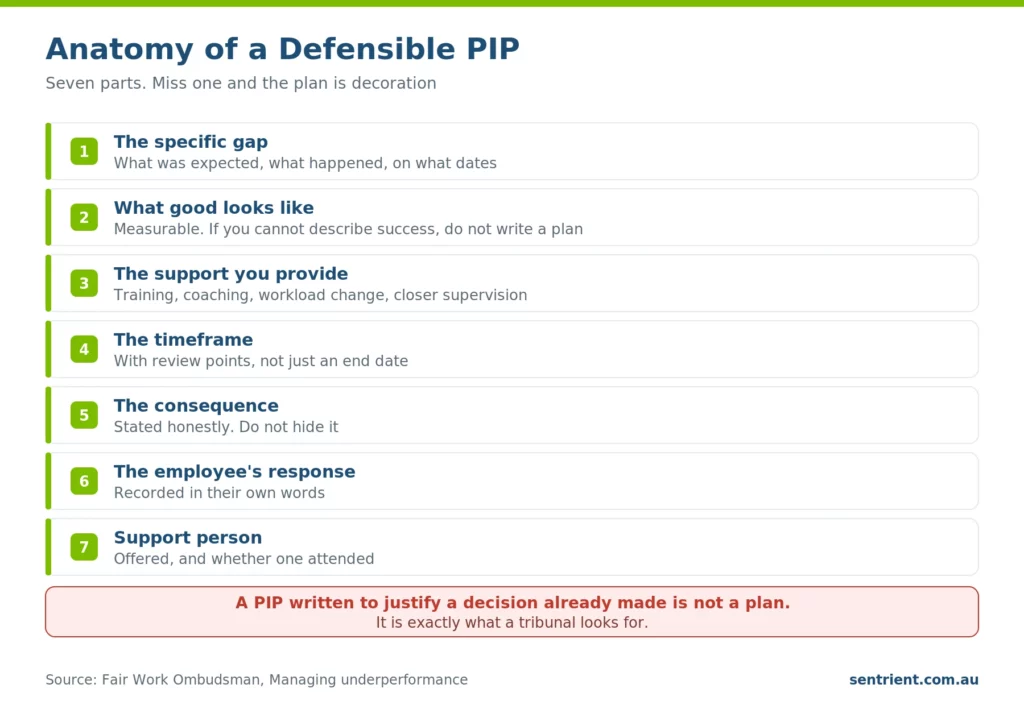
4. Underperformance meeting and performance improvement plan
- The specific gap: What was expected, what happened, on what dates
- What good looks like: Measurable. If you cannot describe success, you are not ready to write a plan
- The support you will provide: Training, coaching, a workload change, closer supervision
- The timeframe, with review points
- The consequence if the improvement is not achieved, stated honestly. Do not hide it
- The employee’s response, recorded in their words
- Support person offered, and whether one attended
The Fair Work Ombudsman publishes free templates for underperformance meetings, warning letters and performance improvement plans. They are a sensible baseline and they are linked in the sources below. If your internal template says less than theirs, use theirs.
What To Say, And What Not To Say
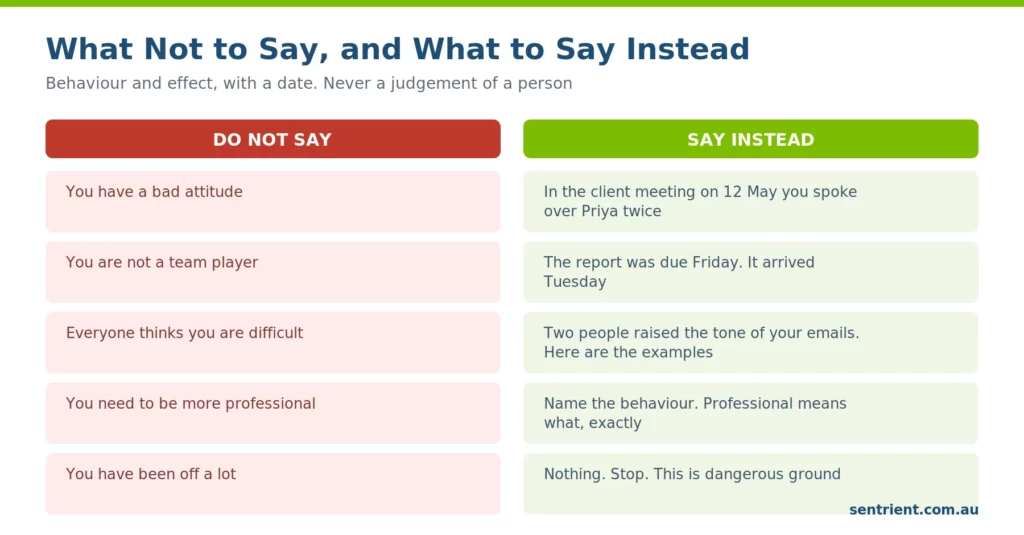
The test is simple. If you cannot say what happened, when, and what effect it had, you do not have feedback. You have an impression, and an impression will not survive scrutiny.
| Do not say | Say instead | Why |
|---|---|---|
| You have a bad attitude | In the client meeting on 12 May you spoke over Priya twice and she stopped contributing | Behaviour and effect, with a date. The first is a judgement of a person. The second is a fact about work |
| You are not a team player | The report was due Friday and the team could not finish theirs without it. It arrived Tuesday | Specific, checkable, and about the work |
| Everyone thinks you are difficult | Two people have raised the tone of your emails with me. Here are the examples | Never hide behind anonymous consensus. It is unfair and it is indefensible |
| You need to be more professional | Professional means what, exactly. Name the behaviour | If you cannot say what you mean, you are not ready to have the conversation |
| You have been off a lot | Nothing. Stop | Attendance affected by illness, disability, carer’s responsibilities or pregnancy is dangerous ground. Take advice before you go near it |
Linking Reviews To Pay And Promotion
Most Australian employers tie the annual review to the pay decision. That is normal, and it creates a problem worth naming.
The moment a review affects money, it stops being a development conversation. People stop disclosing weaknesses.
Managers inflate ratings for the people they want to keep and deflate them when the budget will not stretch. The honesty you needed for the development half of the conversation quietly leaves the room.
- Separate the conversations in time: Run the development discussion, then have the pay conversation a few weeks later. Not the same meeting
- Never use 360 feedback for pay decisions: Peers will not be honest about someone whose salary depends on their answer
- Calibrate before ratings are final, because a 4 from one manager and a 4 from another must mean the same thing if pay is riding on it
- Be able to explain the decision: If a person cannot see why they got what they got, they will assume the worst, and sometimes they will be right
- Watch for pay decisions that track protected attributes: If your ratings or increases correlate with gender, age, part-time status or who has recently taken parental leave, you have a problem that is bigger than performance management
If you cannot separate the two conversations, at least be honest that you are having a pay conversation, and do not pretend the development half was real.
Setting Standards That Mean The Same Thing To Everyone
A rating scale is worthless unless a 3 means the same thing in finance as it does on the floor. In most organisations it does not, and nobody checks.
- Define each rating in behaviour, not adjectives: Exceeds expectations means what, exactly, in this role
- Anchor to the position description, not to the manager’s personal standard
- Calibrate: Get managers in a room before ratings are final and compare. The first time you do this it will be uncomfortable, because the variation will be large
- Check the distribution: If one team is all 4s and another all 3s, one of those managers is wrong
- Do not force a curve: Ranking people against a quota is a different exercise and it damages trust badly. Calibration is about consistency, not quotas
Consistency across managers is not just fairness. It is a legal protection.
If two people performed the same and were treated differently, you will be asked why, and the answer needs to be better than which manager they happened to report to.
Bias: The Five That Do The Most Damage
- Recency. The last six weeks dominate a twelve month review. Keep contemporaneous notes or you will do this
- Halo and horns. One strong or weak trait colours everything else
- Similarity. Rating people like yourself more highly. The most common and least noticed
- Central tendency. Rating everyone a three to avoid difficult conversations. This is not fairness. It is avoidance, and it is unfair to your strong performers
- Leniency drift. Ratings creep upward year on year until nobody is below expectations, which makes the whole system useless when you finally need it
Two practical controls. Keep notes through the year rather than reconstructing at review time.
And calibrate across managers before ratings are final, because a four from one manager and a four from another should mean the same thing.
Common Problems And What Actually Fixes Them
| Problem | What actually fixes it |
|---|---|
| Managers avoid the conversation | Make it short and frequent. A quarterly check-in is a much lower bar than an annual verdict |
| Reviews are late, or skipped | Track completion, the same way you track training. What is not measured does not happen |
| Ratings mean different things in different teams | Calibrate across managers before ratings are final |
| Nobody remembers what happened in March | Contemporaneous notes. There is no other answer to this |
| The employee is blindsided | The manager failed. Nothing at an annual review should be new |
| Remote employees are reviewed on visibility rather than output | Define the output. Then measure the output |
| The high performer behaves badly and is untouched | Manage them. The whole organisation is watching this one and learning from it |
For Employees: How To Prepare, And What To Do If You Disagree
Most guides on this topic are written entirely for managers. Employees read them too, and they are searching for this.
Before the review
- Write down what you actually delivered, with dates and outcomes. Nobody else remembers your year, including your manager
- Be ready with examples of problems you solved, not just tasks you finished
- Know what you want next: a skill, a project, a step up, more flexibility. If you do not ask, the answer is no by default
- Bring the goals you were set last time and be honest about the ones you missed. Getting there first is far stronger than being told
If you get feedback you did not expect
- Do not argue in the room. Ask for the specific example: what happened, when, and what the effect was. If your manager cannot answer that, the feedback is an impression, and you can say so calmly
- Ask for it in writing
- You are entitled to put your own comments on the record. Do it. Your written response is part of the file, and it matters if this ever goes further
- If you disagree, say what you disagree with and why, factually. Then ask what specifically needs to change and what support you will get
If you think the review is unfair
- A review on its own is usually not something you can challenge. What happens next can be
- If you believe the review is influenced by a protected attribute such as disability, pregnancy, age or race, or because you exercised a workplace right such as taking leave or raising a complaint, that is a different matter and it is serious. Get advice
- Keep your own records, contemporaneously. Not to build a case, but because memory is not evidence and yours will fade too
Connecting Reviews To Development And Career
A review that ends with a rating and nothing else teaches people that the exercise is about judgement rather than growth, and after a couple of rounds they stop engaging with it.
- Every review should end with something the person gets, not just something they are told. A skill, a project, a mentor, a course, a change in scope
- Name the gap between where they are and where they want to be, and be honest about whether the organisation can close it. Pretending a promotion is coming when it is not is a slower way of losing them
- Tie development to the capability the role actually requires, rather than to a generic course catalogue
- Write it down and revisit it. A development plan nobody looks at again is a wish, and people notice
This is also where a training needs analysis and a review system meet. The gaps that surface in reviews should be feeding what you assign, and if they are not, one of the two systems is decorative.
Is Your Review System Actually Working?
Most organisations measure whether reviews were completed. That tells you almost nothing.
If ratings drift upward every year until nobody is below expectations, the system has quietly stopped working, and you will discover that at the worst possible moment: the first time you actually need the record.
| Measure this | Because |
|---|---|
| Completion rate, and how late | A review that happens in March for the year ending December is a formality, not a conversation |
| Rating distribution across managers | If one manager’s average is a 4.5 and another’s is a 3.1, the ratings do not mean anything and pay decisions built on them are indefensible |
| How many people were surprised | Ask. Surprise at an annual review is a management failure and it is measurable |
| Whether development actions actually happened | If the plans are written and never delivered, people learn that the review is theatre |
| Voluntary turnover in the 90 days after review season | A spike here is telling you something about how the reviews landed |
| Whether underperformance was addressed early or only at year end | Late-cycle PIPs are usually a sign a manager avoided the conversation for months, and they are legally weaker for it |
Special Situations
Reviews during a restructure or redundancy process
- Be very careful. A performance review conducted while redundancies are being planned will be read as building a case, whether or not it was
- If a role is genuinely redundant, that is about the role, not the person. Do not muddle the two, and never use a performance process to avoid a redundancy payment
- Get advice before you run performance processes during a restructure
Casual, part-time and fixed-term employees
- Part-time employees get the same review as anyone else: Pro-rata the goals, not the respect. Part-timers are among the most likely to report being overlooked at review time
- Casuals are often reviewed informally or not at all: If a regular casual has been with you for a year, they need feedback like anyone else, and a regular systematic casual may have unfair dismissal rights
- Fixed-term employees still need reviews. A contract ending is not a performance decision, and treating it as one causes problems
Contractors
- Do not performance-manage a genuine independent contractor the way you manage an employee. Setting their hours, controlling how they work, and running them through your review process are exactly the indicators used to decide that someone is actually an employee
- Manage the deliverable, not the person. If you find yourself wanting to run a PIP on a contractor, the relationship may not be what your contract says it is
New manager inheriting a team
- You cannot fairly review a period you did not observe. Ask the previous manager, read the record, and be honest with the person about what you saw and what you were told
- If there is no record, say so, and do not invent one
Remote employees
- Review the output, not the visibility. Remote workers are systematically penalised by managers who unconsciously equate presence with contribution
- If you cannot describe what good output looks like for a remote role, that is a job design problem, not a performance problem
What A System Can And Cannot Do
Honestly, because the temptation is to claim software fixes this.
- Software cannot have the conversation. It never will
- Software cannot make a manager brave. If they will not say the hard thing, no template helps
- Software cannot make a bad process fair. It will just document an unfair one more efficiently
What it does do is narrower, and it is the part that fails in most organisations.
- It makes sure the review actually happens, and shows you who is overdue
- It holds the record, in the employee’s words as well as the manager’s, with dates
- It keeps the process consistent across managers, which is itself a legal protection
- It survives turnover. When the manager leaves, the record does not leave with them
- It connects the review to the PIP, the training and the policy, so the whole story is in one place if it is ever examined
Where Sentrient Fits
Sentrient has a performance management system built for Australian workplaces, covering appraisal cycles, performance reviews, goals, one-on-one meetings, position descriptions, employee engagement surveys, learning and development plans, and performance improvement plans.
Reviews are scheduled and tracked so they actually happen, the record is held with dates and in the employee’s own words as well as the manager’s, and it connects to the training, the policies and the PIP, so the whole story sits in one place if it is ever examined.
Sentrient will not have the conversation for you, and it will not make an unfair process fair.
If the decision is already made before the plan is written, better software just documents that more efficiently.
What it does is make sure reviews happen, keep them consistent across managers, and hold the evidence that a person was told, supported and given a real chance.
Whether to end someone’s employment is a decision for you, and often one for legal advice.
Frequently Asked Questions
1. What is a performance review?
A performance review is a structured conversation between a manager and an employee about how the employee is performing, what needs to change, and what support they will receive. It usually covers achievements, gaps, goals and development. In Australia the written record of it also serves a legal purpose, because it is the evidence that a person was told about a problem and given a chance to fix it.
2. How many warnings do you have to give before dismissing someone for performance?
There is no general legal rule requiring three warnings, or even one. This is the most common myth in Australian performance management. What the Fair Work Commission actually considers is whether there was a valid reason, whether the person was told about it, whether they had a real opportunity to respond, and whether they were warned about unsatisfactory performance before being dismissed. In practice that usually means a warning, in writing, but the number is not fixed.
3. How often should performance reviews happen?
Annual reviews alone are not enough, because a year is far too long for someone to be underperforming without knowing. Most Australian employers now run a light quarterly or monthly check-in with a more formal annual review. The frequency matters less than whether feedback is timely, specific and recorded.
4. Does an employee have a right to a support person in a performance meeting?
An employee can request a support person at discussions relating to dismissal, and an unreasonable refusal is one of the matters the Fair Work Commission must take into account. Because a performance meeting can become a dismissal meeting, it is safer practice to allow a support person whenever the employee asks.
5. What is a performance improvement plan?
A performance improvement plan, or PIP, is a documented plan setting out the specific performance gap, what improvement is required in measurable terms, the support the employer will provide, the timeframe, and the consequence if the improvement is not achieved. Used honestly, it gives someone a genuine chance to improve. Used as paperwork to justify a decision already made, it is exactly what a tribunal looks for.
6. What is 360-degree feedback?
360-degree feedback gathers input on a person from their manager, their peers, their direct reports and sometimes external stakeholders, rather than from their manager alone. It is useful for development, and it is a poor basis for a pay or promotion decision, because the incentives to be honest change the moment the feedback affects money.
7. Can a bad performance review be challenged?
A review itself is not usually actionable, but the consequences of one can be. If a review is used to justify dismissal, the process behind it will be examined. If it is influenced by a protected attribute such as disability, pregnancy or age, or by the exercise of a workplace right, it can give rise to a discrimination or general protections claim.
8. What should you not say in a performance reviews?
Anything vague, anything about the person rather than the work, and anything that touches a protected attribute. Avoid attitude, not a team player, and needs to be more professional. Say what was done, when, what the effect was, and what needs to change instead.
Sources
- Fair Work Ombudsman, Managing underperformance best practice guide
- Fair Work Ombudsman, Managing performance and warnings
- Fair Work Ombudsman, Templates (performance improvement plan, warning letter, underperformance meeting plan)
- Fair Work Commission, What makes a dismissal unfair?
- Fair Work Ombudsman, Unfair dismissal
Disclaimer: General information for Australian workplaces, not legal advice. Performance management and dismissal are legally sensitive. Obligations differ by award, agreement and circumstance. Get advice on your situation from a qualified professional before ending anyone’s employment.
Read More
- Performance Reviews Software That’s Actually Built For Australian Compliances
- How To Choose Performance Review Software For Businesses In Australia
- How to Build a High-Performing Team Through Effective Performance Management
- Stop Wasting Time on Performance Reviews: Revolutionise Your Performance Management
- Top 100 Key Performance Review Questions You Should Ask Your Managers For Stronger Teams
- Top 100 Performance Review Questions You Should Ask Your Employees To Boost Engagement
- Performance Management Secrets: What Top Companies Don’t Want You to Know