
Quick Answer
What is employee offboarding? Employee offboarding is the structured process of moving an employee out of the business when their employment ends, whether they resign, retire or are dismissed. It covers written notice, handover and knowledge transfer, an exit interview, removing system access, recovering company property, final pay and super, and closing records. In Australia, the award, agreement or contract sets when final pay is due.
In this guide
- What Is Employee Offboarding?
- The Employee Offboarding Process: 8 Steps
- Why Employee Offboarding Matters: Benefits & Business Impact
- Key Components of the Offboarding Process
- Types of Employee Departures & Modern Challenges
- Best Practices & Technology Solutions
- Excellence in Knowledge Transfer
- Common Offboarding Mistakes to Avoid
- Measuring Offboarding Success & ROI
- Conclusion
- Frequently Asked Questions (FAQs)
A structured offboarding process shapes the last impression an employee takes away, and that impression travels. Many organisations excel at onboarding but neglect the final impression of departing employees.
Employee offboarding is the systematic process of transitioning employees out when they resign, retire, or are terminated. It encompasses knowledge transfer, asset recovery, relationship management, and security protocols.
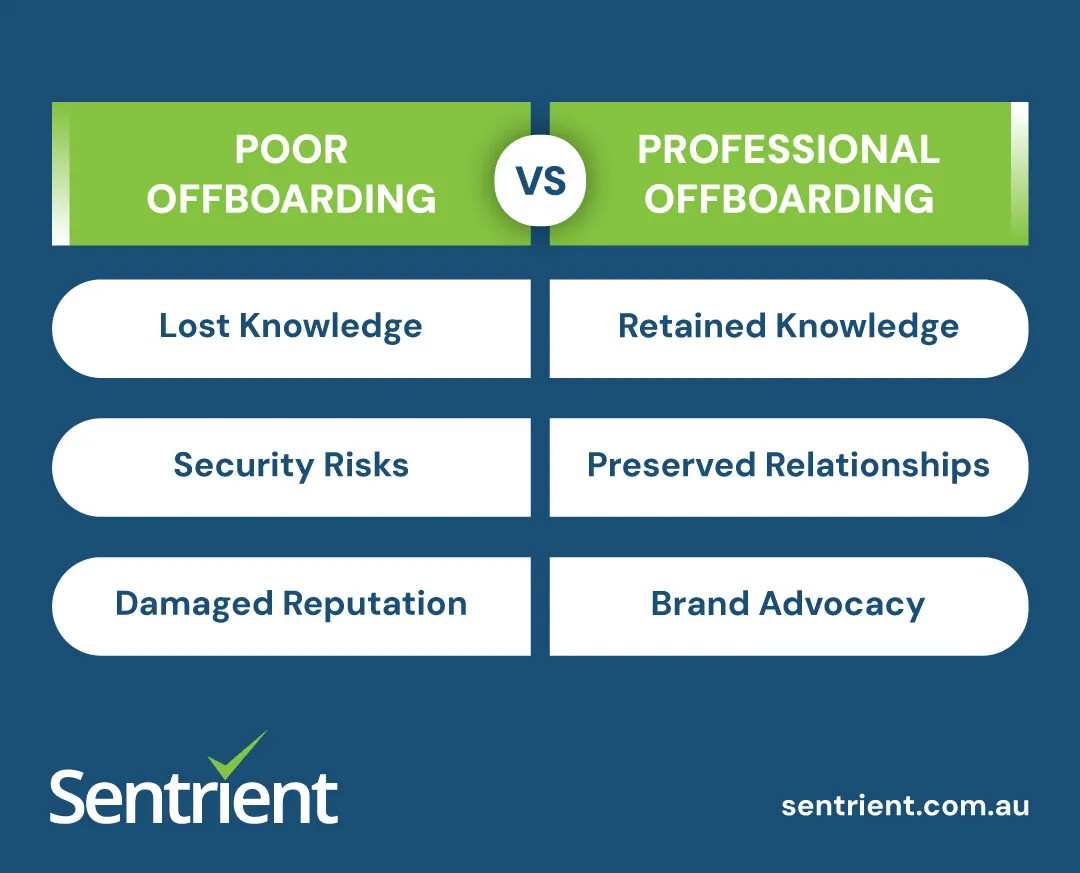
About 1.1 million Australians changed employer or business in the year to February 2025, according to the ABS. With that much movement, poor offboarding can lead to security risks, damage an employer’s brand reputation and add to turnover costs, which Gallup estimates at one-half to two times an employee’s annual salary.
Every departure is either an opportunity or a risk. Companies like Sentrient understand that strategic offboarding creates lasting value and builds brand ambassadors.
This guide provides frameworks that turn every exit into a strategic advantage.
What Is Employee Offboarding?
Employee offboarding is the structured process organisations use to transition employees out of the company when their employment ends, regardless of the reason. Unlike the informal “farewell and good luck” approach many businesses still use, professional offboarding involves systematic planning, clear procedures, and coordinated efforts across multiple departments.
The scope extends far beyond basic administrative tasks. True offboarding encompasses legal compliance, knowledge preservation, relationship management, security protocols, and strategic communication.
It begins the moment an employee announces their departure and continues well after their final day, sometimes extending weeks or months after their transition period.
Key Differences in Employee Exit Types
1. Offboarding vs Termination: Offboarding is a complete process management, whilst termination focuses primarily on ending employment relationships legally and administratively.
2. Offboarding vs Resignation Management: Resignation deals specifically with voluntary departures, whilst offboarding encompasses all departure scenarios with strategic elements like employer branding.
3. Offboarding vs Retirement Processing: Retirement involves succession planning, whilst offboarding adds relationship management and competitive intelligence protection.
Important Stakeholders in the Process
The modern offboarding process requires coordination across multiple departments:
- Human Resources: Leads process coordination, makes sure compliance and consistency
- IT Department: Manages system access and digital asset recovery
- Line Managers: Coordinate knowledge transfer and team communication
- Finance Team: Handles final compensation and benefit settlements
- Legal Department: Makes sure regulatory compliance and protects intellectual property
- Security Team: Manages access revocation and data protection protocols
Timeline Planning Considerations
Senior Executive Departures: Often need 3-6 months of structured offboarding, including complete succession planning and stakeholder transition management.
Mid-Level Employee Transitions: Typically need 2-4 weeks for effective knowledge transfer and project handovers to maintain operational continuity.
Entry-Level Position Changes: Benefit from 1-2 weeks of structured offboarding to maintain team morale and capture valuable insights about processes and culture.
Modern offboarding planning begins immediately when departure notice is given, not on the employee’s final day. This proactive approach makes sure nothing falls through the cracks whilst maximising opportunities to preserve institutional knowledge.
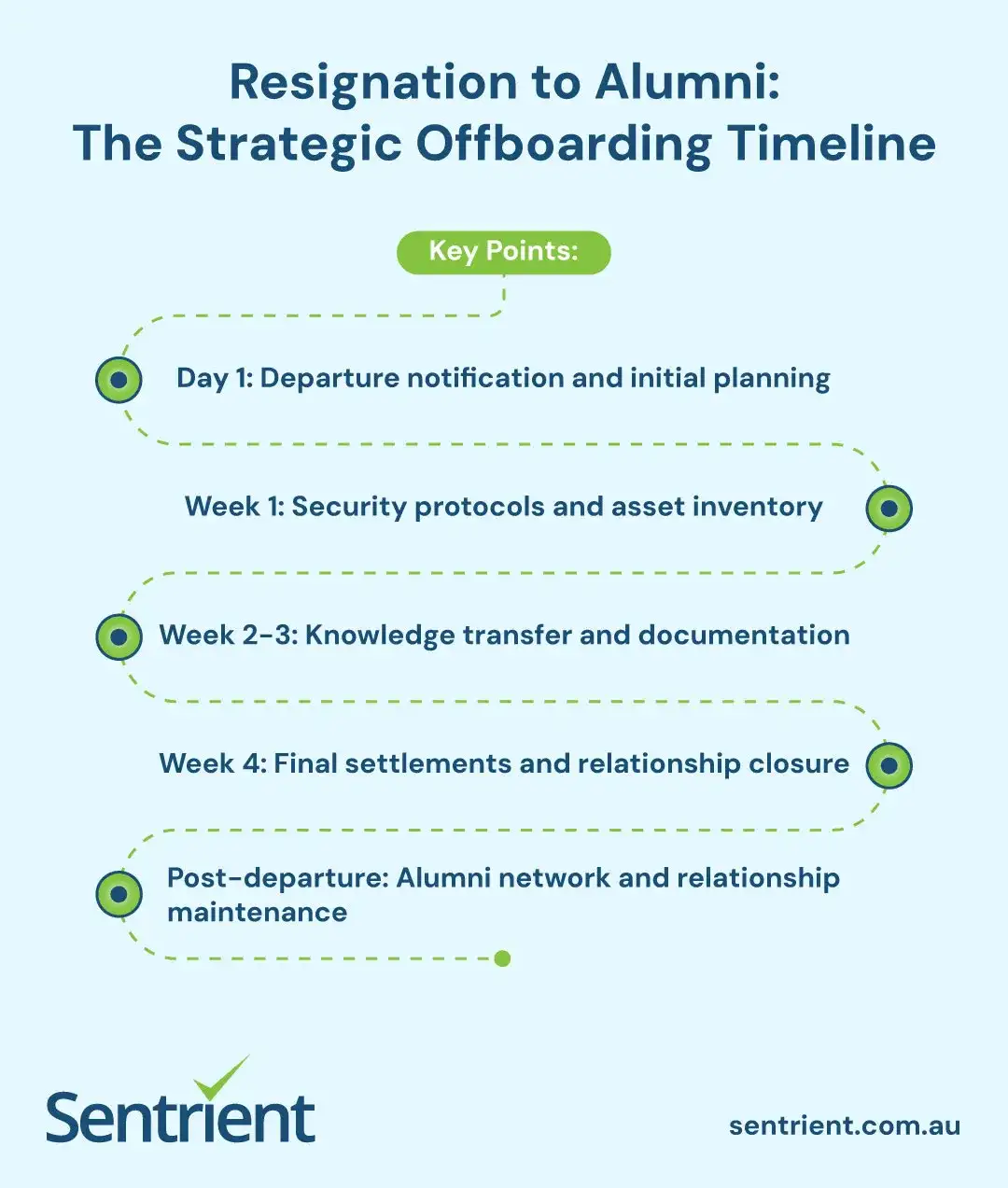
The Employee Offboarding Process: 8 Steps
Most offboarding processes follow the same order, whatever the reason for leaving. The detail changes with the role and the type of exit.
- Confirm the departure in writing: Record the resignation, or give written notice of the last day if the employer is ending employment, and check the notice period that applies.
- Plan the handover: Agree a timeline, name the people taking over each task and book the exit interview.
- Tell the right people: Brief the team, clients and stakeholders at the right time, respecting the employee’s privacy.
- Transfer knowledge: Document procedures, open work and key contacts, and hold handover sessions with successors.
- Hold the exit interview: Collect honest feedback on culture, management and the role.
- Remove access and recover assets: Close system and building access on the last day and collect devices, keys and cards.
- Pay final entitlements: Pay outstanding wages, unused annual leave and leave loading by the date the award, agreement or contract sets, and pay super on the final pay.
- Close the records: Update HR records, keep documents for the required period and invite the person to stay in touch.
For a timeline checklist and expert tips for each step, see our guide to offboarding best practices.
Why Employee Offboarding Matters: Benefits & Business Impact
1. Enhanced Employer Brand and Market Reputation
Your offboarding process directly impacts how former employees speak about your organisation in professional networks, social media, and industry forums. Well-managed departures create brand ambassadors who recommend your company to potential candidates and clients.
In a 2023 Harris Poll for Glassdoor, 83% of US job seekers said they were likely to research company reviews and ratings before deciding where to apply. That makes every former employee a potential influencer in your talent acquisition strategy.
Poor offboarding experiences can damage your reputation for years.
2. Protecting Company Assets and Intellectual Property
Systematic offboarding protects both physical and digital assets whilst safeguarding intellectual property. This includes recovering company equipment, revoking system access, securing client databases, and making sure proprietary information doesn’t leave with departing employees.
Structured asset recovery and timely access removal cut this risk. Human error caused 37% of the data breaches notified to the Office of the Australian Information Commissioner (OAIC) in the first half of 2025, and a missed account or device at exit is an easy error to make. Old logins are a real gap too. In a 2025 PasswordManager.com survey of 1,200 US workers, 40% said they had used a former employer’s password after leaving, and 15% said they still do.
Digital security becomes particularly critical when employees access cloud systems, client data, and proprietary software. Without proper offboarding protocols, former employees might retain access to sensitive systems for weeks or months after departure.
3. Maintaining Security, Compliance, and Data Protection
Australian employment, tax and privacy rules all apply when an employee leaves, and some industries add more, particularly industries like healthcare, finance, and government contracting.
Privacy obligations, including the TFN Rule for tax file number records, workplace health and safety laws and industry-specific standards all call for documented offboarding procedures to protect personal information and maintain audit trails.
Effective offboarding makes sure all legal obligations are met, reducing regulatory risks and potential penalties. This includes properly handling personal employee data, maintaining required documentation, and making sure compliance with workplace agreements.
4. Preserving Institutional Knowledge and Preventing Brain Drain
Knowledge transfer represents one of the most valuable, and often overlooked, aspects of strategic offboarding. When employees leave without proper knowledge documentation, organisations lose years of experience, client relationships, process improvements, and institutional memory.
Structured knowledge preservation involves documenting procedures, capturing client relationship insights, recording process improvements, and creating searchable knowledge repositories.
Panopto’s Workplace Knowledge and Productivity Report found that 42% of institutional knowledge is unique to the individual employee, and that a new hire can take up to 6 months to ramp up in a role. Systematic knowledge transfer shortens that ramp-up and keeps critical process knowledge in the business.
5. Creating Brand Ambassadors and Enabling Boomerang Employees
Well-managed offboarding transforms departing employees into long-term advocates for your organisation. These former employees become referral sources for future talent, potential clients for business development, and valuable industry connections.
Boomerang employees, those who return to former employers, represent an increasingly valuable talent pool. ADP Research found that boomerang hires made up 35% of new hires in its US payroll data in March 2025, up from 31% a year earlier. They return with new skills and outside experience, and they already know your systems and culture.
A positive exit makes that return far more likely than a poor one.
6. Impact on Remaining Team Morale and Productivity
How you handle employee departures significantly impacts the morale and engagement of remaining team members. Abrupt departures, lack of communication, and poor transition management create anxiety, increased workloads, and concerns about job security.
Transparent, respectful offboarding processes demonstrate organisational values in action, reassuring remaining employees about company culture and commitment to treating people well.
7. Legal and Regulatory Considerations
Australian employment law requires specific procedures for employee terminations, including notice periods, final payment calculations, and documentation requirements.
Fair Work legislation, superannuation obligations, and industry-specific regulations all mandate particular offboarding procedures to make sure compliance and avoid legal disputes.
Professional offboarding reduces legal risks by making sure all regulatory requirements are met, documentation is properly maintained, and employee rights are respected throughout the departure process.
Key Components of the Offboarding Process
1. Administrative Tasks and Documentation
Effective offboarding begins with complete administrative procedures making sure legal compliance. This includes processing final timesheets, calculating leave entitlements, updating personnel records, and coordinating accurate final payments.
Modern HRIS systems streamline these tasks through automated workflows and integrated checklists. Platforms specialising in Australian compliance make sure Fair Work obligations are met whilst reducing manual errors.
2. Knowledge Transfer and Documentation Strategies
Knowledge transfer represents the most strategically valuable component of professional offboarding. This involves systematically capturing institutional knowledge, documenting procedures, recording client insights, and creating searchable repositories.
Effective transfer includes structured handover sessions, collaborative documentation, video recordings, and mentoring relationships with successors. The goal is preserving explicit knowledge and tacit understanding that drives business success.
3. Asset Recovery and Digital Access Management
Complete asset management makes sure all company property is recovered whilst maintaining security protocols.
Physical Assets Include:
- Laptops and mobile devices
- Company vehicles and equipment
- Office keys and access cards
- Any assigned tools or resources
Digital Asset Management:
- Immediate system access revocation
- Digital file recovery and transfer
- Account ownership changes
- Complete security cleanup
Clear communication about recovery expectations and reasonable timelines maintain positive relationships whilst protecting company interests.
4. Final Compensation, Benefits, and Legal Requirements
Financial settlements require attention to legal requirements including final salary payments, leave entitlements, superannuation obligations, and bonus payments.
Compliance with Australian employment law requires specific procedures for payments, notice periods, and documentation. Professional guidance makes sure obligations are met whilst avoiding disputes.
5. Exit Interviews and Structured Feedback Collection
Exit interviews provide insights into organisational culture, management effectiveness, and operational improvements whilst demonstrating respect for departing employees’ experiences. Gallup found that 42% of employees who voluntarily left their organisation said their manager or organisation could have done something to prevent them leaving. A good exit interview tells you what that was.
Effective programs use multiple touchpoints, anonymous options, and structured questionnaires to capture honest workplace insights. These insights inform retention strategies and improvement initiatives.
6. Communication with Teams and Stakeholders
Strategic communication makes sure smooth transitions whilst maintaining team morale and client relationships. This includes appropriate departure announcements and transparent transition planning.
Communication strategies balance transparency with confidentiality, making sure teams understand plans whilst respecting departing employees’ privacy.
Types of Employee Departures & Modern Challenges
1. Voluntary Resignations and Career Transitions
Voluntary resignations represent the majority of employee departures and offer the greatest opportunity for positive offboarding experiences. These situations typically involve career advancement, industry changes, or personal circumstances that require thoughtful transition planning.
Career transition offboarding focuses on knowledge preservation, relationship continuity, and maintaining professional networks. Departing employees in these situations are often willing to invest time in complete handovers.
2. Involuntary Terminations and Performance-Related Exits
Involuntary terminations require more careful management to maintain legal compliance whilst protecting both organisational and individual interests. These situations demand clear documentation, consistent application of policies, and sensitivity to emotional dynamics.
Performance-related exits may involve longer transition periods with structured improvement plans, making offboarding a gradual process rather than an abrupt departure.
Professional management of these situations protects organisational reputation whilst respecting individual dignity throughout the process.
3. Retirement and Succession Planning
Retirement represents a unique offboarding opportunity that allows for extended knowledge transfer and succession development. These departures typically involve longer notice periods and complete documentation requirements.
Succession planning integration makes sure institutional knowledge is preserved whilst developing internal talent capabilities. Retired employees often remain available for consultation through advisory roles or project-based arrangements.
4. Remote and Hybrid Workforce Offboarding Complexities
Remote work has fundamentally altered offboarding requirements, creating new challenges for asset recovery, relationship management, and team communication.
Technology Considerations Include:
- Secure equipment return logistics
- Digital workspace cleanup procedures
- Virtual handover sessions coordination
- Distributed team impact management
Video conferencing, collaborative documentation platforms, and digital asset management systems become important tools for effective remote offboarding.
5. Managing Global and Distributed Teams
International employees and distributed teams require specialised offboarding approaches that account for different legal requirements, cultural considerations, and logistical challenges.
Time zone coordination, local compliance requirements, and cross-cultural communication add complexity to global offboarding management.
Compliance variations across jurisdictions require specialised knowledge and documentation. Professional services providers with international expertise become valuable partners for organisations managing global workforce transitions.
6. Crisis Offboarding Situations
Unexpected departures due to emergencies, sudden resignations, or crisis situations require rapid response protocols that balance urgency with thoroughness.
These situations test organisational resilience and require pre-planned procedures for knowledge preservation and transition management.
Crisis management protocols include emergency contact procedures, rapid access revocation capabilities, and contingency planning for critical role coverage.
Best Practices & Technology Solutions
1. Creating Standardised Checklists and Procedures
Consistent offboarding requires documented procedures and standardised checklists that make sure nothing is overlooked regardless of departure circumstances or personnel involved.
These frameworks provide structure whilst allowing flexibility for different roles, departments, and departure types.
Complete checklists include:
- Administrative task completion
- Security protocol implementation
- Knowledge transfer requirements
- Communication procedure execution
Digital checklists with automated workflows make sure accountability whilst providing audit trails for compliance purposes.
2. Early Planning and Proactive Communication Strategies
Effective offboarding begins immediately when departure notice is received, not on the employee’s final day. Early planning allows for thorough knowledge transfer, smooth project transitions, and complete relationship management.
Proactive communication involves stakeholder notification, transition timeline development, and expectation setting for all parties involved.
Clear communication reduces anxiety whilst making sure everyone understands their role in successful transition management.
3. Structured Knowledge Transfer Methodologies
Knowledge transfer requires systematic approaches that capture both explicit information and tacit understanding.
Modern knowledge management utilises:
- Video recordings of procedures
- Collaborative documentation sessions
- Searchable repository creation
- Interactive knowledge transfer meetings
These methods make sure understanding whilst building relationships between departing and continuing employees.
4. HRIS and Offboarding Management Platforms
Technology platforms designed specifically for HR management streamline offboarding through automated workflows, integrated checklists, and centralised documentation.
Systems like those offered by Sentrient provide complete frameworks that make sure consistency whilst reducing administrative burden.
Integration capabilities
connect offboarding processes with payroll systems, asset management databases, and communication platforms. This coordination eliminates manual data entry whilst providing complete audit trails.
5. Asset Management and Tracking Systems
Professional asset management makes sure all company property is accounted for throughout employee lifecycles. Digital tracking systems provide real-time visibility into equipment assignments, return status, and replacement requirements.
Automated asset recovery includes scheduled reminders, shipping logistics coordination, and condition assessment protocols.
Integration with offboarding workflows makes sure asset recovery is completed efficiently without impacting employee relationships.
6. Communication and Workflow Automation Tools
Automated communication systems make sure stakeholders receive timely updates throughout offboarding processes whilst maintaining professional consistency.
Workflow automation reduces manual coordination whilst providing accountability and progress tracking.
Multi-channel communication includes email notifications, dashboard updates, and mobile alerts that keep relevant personnel informed throughout transition periods.
Excellence in Knowledge Transfer
1. Identifying Critical Knowledge and Expertise
Effective knowledge transfer begins with systematic identification of critical information that must be preserved.
Critical Knowledge Areas:
- Technical expertise and procedures
- Client relationship insights
- Process improvements and shortcuts
- Institutional memory and context
- Informal knowledge networks
Knowledge mapping involves collaboration between departing employees, managers, and successors to identify explicit and tacit knowledge that requires documentation.
2. Documentation Strategies and Best Practices
Professional documentation goes beyond simple procedure manuals to include contextual information, relationship insights, and decision-making frameworks.
Multi-format documentation includes:
- Written procedures and guidelines
- Video demonstrations and walkthroughs
- Decision trees and flowcharts
- Contact databases and relationship maps
Searchable formats make sure information remains accessible long after transition completion.
3. Collaborative Learning and Peer-to-Peer Transfer
Knowledge transfer succeeds through collaborative approaches that involve multiple stakeholders in information sharing and relationship building.
Peer-to-peer learning creates redundancy whilst building team capabilities beyond individual dependencies.
Mentoring relationships extend beyond formal handover periods to provide ongoing consultation and support during transition periods.
4. Creating Sustainable Knowledge Repositories
Effective long-term knowledge preservation needs organised and accessible information.
Digital repositories with search capabilities, regular updates, and user-friendly interfaces make sure institutional knowledge remains valuable beyond individual employee tenures.
Knowledge management systems integrate with existing technology platforms to provide smooth access whilst maintaining security protocols.
5. Preventing Knowledge Silos and Information Loss
Proactive knowledge sharing prevents critical information from becoming isolated within individual roles or departments.
Cross-training, documentation requirements, and knowledge sharing incentives create resilient organisational capabilities.
Succession planning includes knowledge transfer requirements as standard components of role development. This proactive approach makes sure continuity whilst providing professional development opportunities.
Common Offboarding Mistakes to Avoid
1. Rushed or Incomplete Processes
Inadequate time allocation for complete offboarding leads to missed opportunities, incomplete knowledge transfer, and potential security vulnerabilities.
Rushing through procedures creates long-term problems that far exceed the short-term convenience of quick departures.
Time investment in thorough offboarding pays dividends through preserved knowledge, maintained relationships, and reduced replacement costs.
2. Poor Communication Between Departments
Lack of coordination between HR, IT, management, and other stakeholders creates gaps in offboarding coverage whilst potentially duplicating efforts or missing critical requirements.
Clear communication protocols make sure everyone understands their responsibilities and timelines.
Centralised coordination through HRIS platforms or dedicated offboarding management systems makes sure all stakeholders remain informed whilst maintaining accountability.
3. Inadequate Security and Access Management
Delayed access revocation or incomplete asset recovery creates security vulnerabilities that can persist long after employee departures.
Professional security protocols make sure immediate action whilst maintaining positive relationships throughout the process.
Automated access management reduces reliance on manual processes whilst providing audit trails for compliance purposes.
4. Neglecting Emotional and Interpersonal Aspects
Focusing solely on administrative requirements whilst ignoring emotional dynamics creates negative experiences that damage relationships and organisational reputation.
Professional offboarding balances operational needs with human considerations throughout the process.
Emotional intelligence in offboarding management recognises the personal impact of job transitions whilst maintaining professional boundaries.
5. Failing to Capture Institutional Knowledge
Lost knowledge represents one of the highest costs of employee turnover, yet many organisations fail to systematically preserve institutional memory during departures.
Proactive knowledge capture makes sure valuable insights and relationships continue benefiting the organisation.
Knowledge preservation
requires dedicated time and resources but provides long-term value through reduced training costs and maintained capabilities.
6. Legal Compliance Oversights
Incomplete understanding of employment law requirements can result in legal disputes, financial penalties, and damaged reputations.
Professional compliance management makes sure all regulatory obligations are met whilst protecting both organisational and individual interests.
Legal expertise may require professional consultation for complex situations or specialised industry requirements.
Measuring Offboarding Success & ROI
1. Key Performance Indicators and Metrics
Effective measurement requires specific metrics that demonstrate offboarding success and identify improvement opportunities.
Quantitative Metrics:
- Process completion rates
- Timeline adherence percentages
- Asset recovery success rates
- Cost-per-departure calculations
Qualitative Measures:
- Relationship quality assessments
- Knowledge preservation effectiveness
- Brand impact through stakeholder feedback
2. Employee Satisfaction and Net Promoter Scores
Departing employee satisfaction provides direct insight into offboarding quality whilst predicting future employer brand impact.
Net Promoter Scores specifically measure likelihood of recommending the organisation to others, indicating potential for positive word-of-mouth marketing.
Satisfaction surveys should be conducted immediately after departure and again after 3-6 months to capture both immediate experience and longer-term perspective.
3. Time-to-Productivity for Replacement Hires
Effective knowledge transfer directly impacts how quickly replacement employees reach full productivity.
Measuring this timeline provides concrete evidence of offboarding success whilst identifying areas for improvement in documentation and training processes.
Productivity benchmarks should account for role complexity and experience levels whilst tracking improvement over time.
4. Knowledge Retention Assessments
Systematic evaluation of preserved institutional knowledge makes sure offboarding processes effectively capture and transfer critical information.
These assessments should evaluate both explicit documentation and tacit understanding preservation.
Knowledge audits involve structured review of documentation quality, accessibility, and accuracy.
5. Cost-Benefit Analysis and ROI Calculations
Professional offboarding requires resource investment that should be justified through measurable returns.
Cost-benefit analysis should include direct expenses, opportunity costs, and long-term benefits from preserved relationships and knowledge.
ROI calculations must account for both quantifiable savings and strategic benefits that contribute to organisational success.
6. Continuous Improvement Frameworks
Regular review and refinement make sure offboarding processes remain effective and current with organisational needs.
Feedback loops, performance analysis, and stakeholder input drive ongoing enhancement whilst maintaining consistency and quality.
Improvement cycles should incorporate technological advances, regulatory changes, and best practice developments.
Conclusion
Strategic employee offboarding represents far more than administrative necessity, it’s a competitive advantage that strengthens employer brand, preserves institutional knowledge, and transforms departing employees into lasting advocates.
Companies that invest in complete offboarding processes see measurable returns through reduced replacement costs, maintained client relationships, and enhanced recruitment capabilities.
The transformation potential extends beyond individual departures to organisational resilience, cultural strength, and strategic capability building. When every employee departure becomes an opportunity for growth rather than just a loss to manage, organisations develop sustainable competitive advantages.
Modern technology solutions, like those provided by Sentrient’s integrated HR and compliance platform, make professional offboarding accessible to organisations of all sizes. Automated workflows, complete checklists, and integrated asset management eliminate complexity whilst making sure consistency.
Your next step involves honestly assessing your current offboarding practices and identifying specific opportunities for improvement. Whether you’re managing five employees or five hundred, strategic offboarding capabilities will strengthen your organisation.
Every departing employee represents either an opportunity gained or value lost.
Frequently Asked Questions (FAQs)
1. What is the ideal timeline for the offboarding process?
The ideal timeline varies by role complexity: 1-2 weeks for entry-level positions, 2-4 weeks for mid-level employees, and 3-6 months for senior executives. Begin offboarding activities immediately when departure notice is received for best results.
2. How do you handle offboarding for remote employees?
Remote offboarding requires secure equipment return procedures, virtual handover sessions, and digital workspace cleanup. Use video conferencing for knowledge transfer and make sure immediate access revocation with complete digital asset recovery.
3. What legal requirements must be considered during offboarding?
Australian employment law mandates specific notice periods, accurate final payments, superannuation obligations, and proper documentation. Industry-specific regulations may impose additional requirements for healthcare, finance, or government sectors.
4. How can small businesses implement effective offboarding with limited resources?
Start with standardised checklists, focus on compliance and security basics, then use cloud-based HR platforms like Sentrient for automated workflows. Prioritise high-impact activities like knowledge transfer and relationship management.
5. What should be included in an offboarding checklist?
Include administrative tasks (timesheets, payroll), security procedures (access revocation, asset recovery), knowledge transfer activities, communication requirements, and relationship management elements like exit interviews and feedback collection.
6. How do you measure the success of your offboarding process?
Use metrics like process completion rates, employee satisfaction scores, time-to-productivity for replacements, and cost-benefit analysis. Regular feedback collection and continuous improvement cycles make sure quality standards.
7. Can good offboarding help prevent legal issues?
Yes, professional offboarding reduces legal risks through consistent compliance, proper documentation, and respectful treatment. Structured procedures create audit trails whilst maintaining positive relationships even in difficult situations.
8. What are the best practices for exit interviews?
Use structured questionnaires with open discussion, conduct multiple touchpoints including follow-up surveys, offer anonymous options, and focus on management effectiveness, culture, and operational improvements for maximum insight value.
9. What does offboarding mean?
Offboarding means the formal process of separating an employee from an organisation when their employment ends. It is the opposite of onboarding. It covers the handover, access removal, return of property, final pay and a respectful goodbye.
10. Is offboarding required by law in Australia?
No single law is called offboarding, but many of its steps are legal duties. These include giving notice under the National Employment Standards, paying final entitlements on time, paying super on final pay and keeping employee records. A documented process helps you meet each one.
Sources
Australian Bureau of Statistics: Job mobility continues to decline into 2025
Gallup: This fixable problem costs U.S. businesses $1 trillion
OAIC: Notifiable data breach statistics, January to June 2025
Fair Work Ombudsman: Notice and final pay
ATO: TFN declaration payer obligations
Glassdoor: Employer branding statistics (Harris Poll, June 2023)
PasswordManager.com: 4 in 10 workers use former employer passwords (July 2025 survey)
Panopto: Workplace Knowledge and Productivity Report
ADP Research: Boomerang hiring makes a comeback
Gallup: Employee turnover is preventable yet often ignored
Last reviewed: October 2026









