
Quick Answer
GRC management software brings governance, risk and compliance work into one system. The six key benefits of implementing it are better operational efficiency, better-quality information, smoother stakeholder relationships, a clear organisational hierarchy, lower costs and faster reporting. They do not all arrive at once, and most depend on how the system is set up, so plan for each benefit during implementation rather than after it.
In this guide
More organisations are now realising and implementing the latest technologies and automation tools to reduce the costs of business processes.
The process of governance, risk, and compliance management is not exempt from this requirement either.
Digital systems are replacing manual labour across industries. According to the Deloitte Global Risk Management Survey (12th edition), 46% of the participating institutions reported the use of cloud computing, while 39% reported planning to use the same in future for risk management.
Is your organisation looking to deploy new technology for managing GRC procedures and activities?
Let us help you learn more about the benefits of using automation in the form of GRC management software.
What is the GRC management system?
Governance, risk, and compliance (GRC) management systems are automated tools that help organisations perform GRC-related tasks in an easy and timely manner.
It is an umbrella term for a platform that enables a varied set of business GRC processes and activities.
The main aim behind developing and deploying this system is for organisations to be able to take control of their GRC strategy implementation and avoid the consequences of non-compliance.
Why implement GRC management software?
A GRC management software helps solve complex organisational structures and communication breakdowns throughout an organisation.
Efficient implementation of GRC is adaptable and can help reduce downtime in business operations.
Regardless of the size of your business and industry type, GRC management software can help manage risks in line with business goals and stay compliant.
The cost of getting compliance wrong is rising. The Fair Work Ombudsman recovered $453 million in unpaid wages and entitlements for more than 181,000 workers in 2025-26, and nearly doubled its proactive investigations to more than 2,680. A GRC system will not fix pay errors by itself, but it gives you the obligations register, controls and evidence trail that make problems visible before a regulator finds them.
6 Key Benefits of implementing a GRC system
A GRC system can help your organisation in more than one way. Some of the most common benefits of implementing a GRC system include:
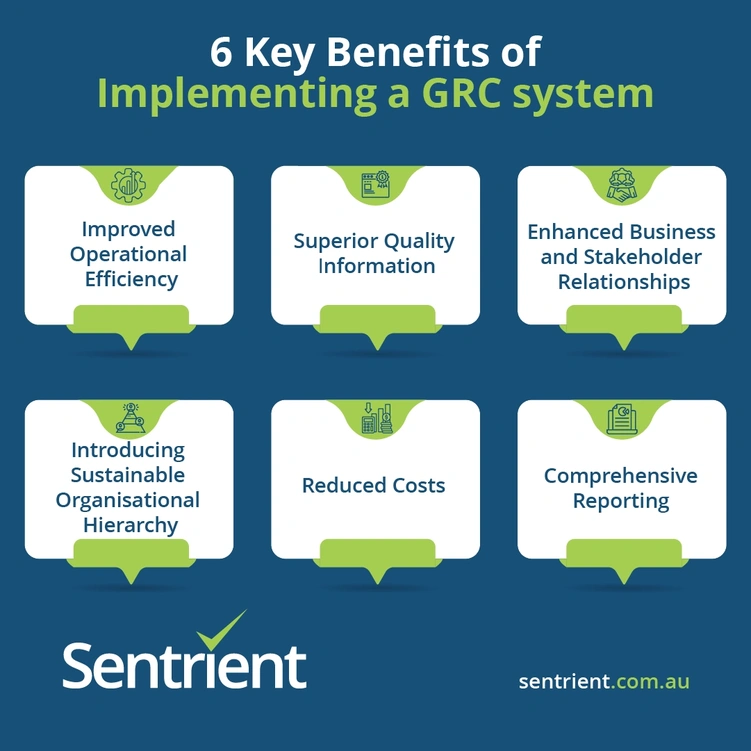
1. Improved operational efficiency
One of the biggest advantages of implementing a GRC solution is the ability to automate redundant and time-consuming business processes due to the continuous monitoring of controls, key risk indicators, and risk exposure.
This automation of common tasks results in more efficient ways to manage business operations and reduce the time and duplication of efforts required for GRC management across your organisation.
2. Superior quality information
The integrated approach to GRC management provided by automation enables your staff to have a complete view of the organisation.
It simplifies the methods of collecting and processing data into higher-quality information. This also helps management to make more effective and productive decisions.
3. Enhanced business and stakeholder relationships
A complete GRC tool implements authorised access control where information can be shared easily over cloud storage.
This control helps reduce stakeholder touchpoints and provides information necessary to understand the business unit profile and applicable risks and challenges.
4. Introducing sustainable organisational hierarchy
A clearly defined organisational hierarchy is the prerequisite to integrating GRC processes.
Defining and embedding the hierarchy inside a GRC tool helps enable various role-based access features and enhanced GRC management. It can also support evolving business hierarchies when required.
5. Reduced costs
Defining business rules, monitoring controls, and visualising the GRC roadmap for your organisation will result in implementing effective GRC activities.
Reduced costs are the first positive impact of efficient operations and management.
6. Complete reporting
GRC Management software helps employees and management draw out detailed reports with just a few clicks. It no longer takes hours or days to generate informative reports.
When each GRC software benefit shows up after implementation
The six benefits do not arrive at once. Some show up in the first months after go-live, others only after a full reporting cycle. Knowing which is which helps you set fair expectations with your board, and spot early if the rollout is off track.
| Benefit | When it usually shows up | What to set up during implementation so it arrives |
|---|---|---|
| 1. Operational efficiency | In the first few months, as manual chasing stops | Automated reminders and a named owner for every recurring obligation and control |
| 2. Better-quality information | After the first full reporting cycle | One register for obligations, risks and incidents, with the same fields everywhere |
| 3. Stakeholder relationships | Within the first quarter, as people stop asking for status updates | Role-based access, so managers and auditors can see what they need without asking |
| 4. Organisational hierarchy | At go-live, if it is mapped first | Your structure, sites and reporting lines loaded before launch |
| 5. Reduced costs | Usually within the first year, once old tools and manual hours fall away | A record of current hours and tool costs, taken before go-live |
| 6. Complete reporting | The first time a board or audit report is due | Report templates built at the start, not after the first deadline |
Record a few numbers before you switch on: hours spent preparing compliance reports, the number of overdue actions, and how long audit evidence takes to gather. Check them again at three and twelve months. That turns the benefits from a promise into evidence. For the rollout steps themselves, see our guide on how to implement a GRC system.
How does the GRC system work?
Organisations develop a GRC framework to support their strategy. This framework enables leadership and helps professionals see the effectiveness of their efforts and strategic decisions.
It encompasses all business sectors, and it is important to have connected GRC Management software across your organisation.
As seen above, the benefits of GRC Management software are numerous and result in both financial and productivity gains.
When selecting the best GRC software for your business, prioritise your GRC requirements and select the automation that helps you align them with business goals.
The Takeaway:
GRC management software benefits businesses in more than one way and simplifies the implementation of your GRC strategy.
If your organisation is looking to implement a GRC system, contact Sentrient today.
Our expertly crafted governance, risk, and compliance management software provides extensive features to help you perform GRC-related activities easily.
Frequently asked questions
1. What are the key benefits of implementing GRC management software?
The six key benefits are better operational efficiency, better-quality information, smoother stakeholder relationships, a clear organisational hierarchy, lower costs and faster, more complete reporting. Most come from replacing spreadsheets and inboxes with one system that holds obligations, risks, controls and evidence.
2. How long does it take to see the benefits of GRC software?
Efficiency gains often show up in the first few months after go-live. Cost and reporting benefits usually take a full reporting cycle or up to a year, because they depend on retiring old tools and building a track record in the new system.
3. Is GRC management software worth it for a small or mid-sized business?
It is worth it when obligations, risks and incidents sit in several spreadsheets or inboxes and nobody has a single view. Smaller organisations usually start with the obligations register, policies and incident reporting, then add risk and audit features as they grow.
4. What should you set up first when implementing GRC software?
Start with your organisational structure, the obligations that apply to you and who owns each one. Most of the six benefits depend on that foundation being right before go-live.
Sources
Deloitte, Global Risk Management Survey (12th edition)
Fair Work Ombudsman, 2025-26 recoveries media release (September 2026)
Last reviewed: October 2026
Read More About Governance, Risk Management, and Compliance:
- What Are The Benefits Of GRC Software And Its Importance For Australian Businesses?
- Understanding 5×5 Risk Assessment Matrix: A Complete Guide
- Responding To And Managing GRC Incidents Effectively
- Surviving Uncertainty – Develop An Efficient GRC Strategy
- Top 5 Tips To Create The Best GRC Policies For Your Organisation
- Comparing GRC Systems In Australia: Essential Factors To Consider Before Purchasing









