
Quick Answer
The benefits of equal employment opportunity (EEO) for an organisation are better recruitment, higher employee engagement, better customer service, protection for your people and business, and a stronger reputation. EEO means hiring, paying, training and promoting people on merit, without discrimination. In Australia, EEO is also a legal expectation: the Fair Work Act and federal and state anti-discrimination laws prohibit discrimination at work.
In this guide
We all thrive in a workplace that we love to come back to every day.
It is also becoming more commonly recognised that an organisation that embraces Equal Employment Opportunity and advocates for workers’ safety is more likely to win the confidence and trust of their people.
It is also important that an organisation follows the law, respects its people and protects them from unlawful treatment.
However, the importance and benefits of imposing Equal Employment Opportunity training and policies are not limited to the employees.
It has a broad scope of recognition for the employer as well. Read on for the five main benefits of equal employment opportunity for your organisation, and what Australian law expects of employers.
What Equal Employment Opportunity Means in Australia
EEO means people are recruited, paid, trained and promoted on merit, not on personal characteristics. Under the Fair Work Act, employers cannot take adverse action against an employee or job applicant because of protected attributes such as race, sex, age, disability, pregnancy, religion, family or carer’s responsibilities, gender identity or experiencing family and domestic violence. Federal laws covering sex, race, disability and age discrimination, and state and territory anti-discrimination laws, add further protections.
For a fuller explanation of the attributes protected by law, see our guide to what equal employment opportunity is. The rest of this article focuses on why EEO is good for your organisation.
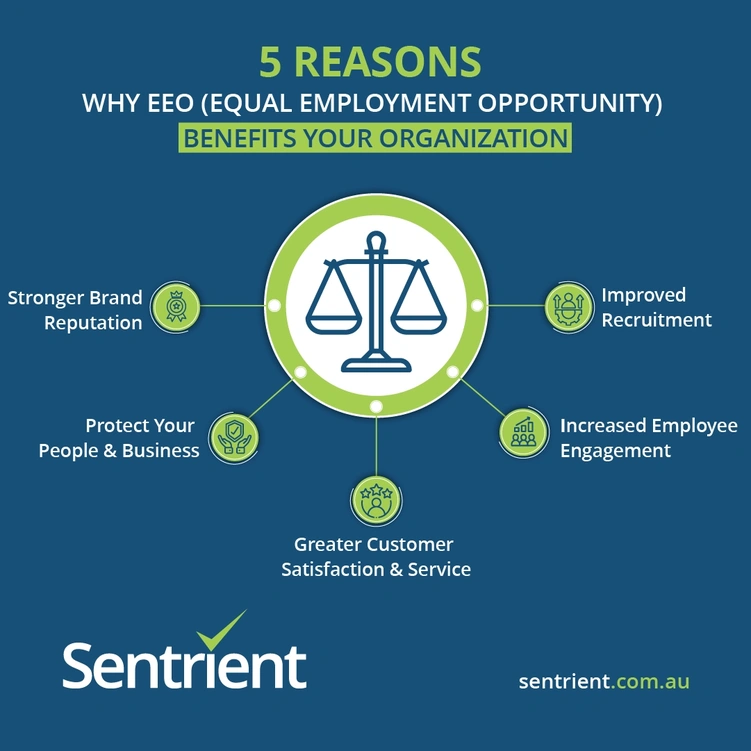
1. Improved Recruitment
Since it is a requirement enforced by the law to consider all applications equally regardless of their background, race, culture, religion, language, etc., the organisation can focus on evaluating the talent, skill set, and abilities of applicants who can efficiently contribute and make significant value-addition to the organisation.
Many organisations overlook the demand of the vacant position and fail to recruit the right candidate by hiring an individual who seemingly fits the role without any evaluation or assessments done to measure one’s qualifications.
Hence, on the lines of the Equal Employment Opportunity policy, the companies can spread word of mouth of their transparent and ethical recruitment process, attract potential applicants, make unbiased hiring decisions to employ qualified candidates, and build a proficient team with the right know-how and capacity to perform challenging tasks to add to the overall growth of the organisation.
2. Increased Employee Engagement
The Equal Employment Opportunity policies allow employees to interact openly and engage with each other without discriminating against peers based on their race, sex, religion, or hierarchical rank in the organisation.
It not only promotes respect toward fellow employees but also breeds an open, friendly culture with an opportunity to help and encourage co-worker performance and add up to diversity in the organisation.
Such policies, when implemented, create a healthy environment for the employees to quickly reach out to their subordinates as well as higher authorities and build an effective, transparent communication system within the organisation that scales up their productivity and broadens the scope of knowledge exchange.
Australian research backs this up. In Diversity Council Australia’s Inclusion@Work Index 2025-2026, workers with inclusive managers reported significantly higher levels of teamwork, extra effort, innovation and customer service. Men in organisations taking action on diversity and inclusion were also far more likely to be satisfied with their jobs (57%) than men in organisations that were not (31%).
3. Greater customer satisfaction and service
Customers and stakeholders hold the firm assurance of the organisation that if its employees perform well, they will contribute to the success of the organisation as it imposes sound guidelines to support a safe and hospitable workplace for everyone.
A work environment that is conducive to the all-round development of employees aids encouragement in them to work more efficiently, achieve more milestones in a short time, and produce excellent results that ultimately lead to serving customers with improved services, thereby increasing client retention and satisfaction.
4. Protect your people and your business
The Equal Employment Opportunity policy draws a baseline for employees to be aware of acceptable behaviour, which is critical considering the varying differences in lifestyles, attitudes, values, and socioeconomic strata.
It helps employees feel secure and that they’re being treated equally and fairly, increasing their level of dedication, loyalty, and satisfaction toward the employer.
Employers who issue clear, well-understood EEO policies, as well as educate their staff through training on EEO, can create an efficient system to mitigate legal liabilities associated with unlawful behaviour, derogatory remarks or acts, and unequal employment practices and take anticipatory measures to protect individuals and their rights.
The critical thing is that if discrimination takes place or is perceived to have taken place at work, our people know how to identify, report and resolve such issues. Also, it enables employees to raise allegations against disparate treatment, while the employer must take legal, fair and ethical actions to restrain further workplace conflict.
The legal and financial stakes are real. Under federal anti-discrimination laws, an employer can be held liable for discrimination or harassment by its employees unless it took all reasonable steps to prevent it. Workplace sexual harassment alone cost Australia an estimated $3.8 billion in 2018, according to the Australian Human Rights Commission.
5. Stronger brand reputation
Employees prefer working for organisations regarded well in the industry owing to their strong adherence to Equal Employment Opportunity policies.
The policies can either make or break the image of an organisation. However, if implemented effectively, the EEO policies add to the brand recognition of an organisation based on its actions toward its commitment to fair and equal workforce conduct.
Fair treatment also lifts morale and productivity. Research suggests a link with financial performance too: McKinsey’s 2023 Diversity Matters Even More report found companies in the top quartile for gender diversity on their executive teams were 39% more likely to outperform financially than those in the bottom quartile. That is a correlation rather than proof of cause, but it shows fair and inclusive organisations tend to perform well.
The 5 Benefits of Equal Employment Opportunity at a Glance
| Benefit | What it looks like in practice | Why it matters |
|---|---|---|
| Improved recruitment | Roles are filled on skills and merit, using structured interviews and clear criteria | A wider talent pool and fewer poor hires |
| Increased engagement | People feel treated fairly and can speak up | Higher effort, teamwork and retention |
| Better customer service | A diverse, motivated team serves a diverse customer base | Better service and client retention |
| Protect your people and business | Clear policies, training and a safe way to raise complaints | Lower legal and financial risk |
| Stronger reputation | Your organisation is known as a fair place to work | Easier hiring and stronger stakeholder trust |
Final Words: Why EEO Is Worth the Effort
There’s no doubt as to why organisations should issue Equal Employment Opportunity policies.
However, in devising and implementing one, companies should educate and train their workforce about the growing incidents of workplace conflict due to prejudices based on background, race, sex, culture, religion, language, etc., and how they can identify, report and resolve such incidents in the workplace.
It is the responsibility of an organisation to strive for a safe, fair and inclusive work environment for their workers where they can prosper and contribute intrinsically to the organisation’s growth.
That is why we see an increase in commitment from organisations of all sizes, from small and medium businesses to larger organisations, to train their staff and have policies in place for things such as work health and safety, privacy, workplace bullying, sexual harassment and equal employment opportunity.
That is because we now recognise the importance of both physical security and social protection for our people.
Frequently Asked Questions About the Benefits of Equal Employment Opportunity
1. What are the benefits of equal employment opportunity?
The main benefits are better recruitment decisions, higher employee engagement, better customer service, lower legal and financial risk, and a stronger reputation as an employer. Research also links diverse, inclusive workplaces with stronger performance.
2. Why is EEO good for business?
EEO helps you hire and promote the best people, keeps staff engaged and reduces the cost of discrimination complaints and turnover. McKinsey’s 2023 research found companies in the top quartile for executive gender diversity were 39% more likely to outperform financially than those in the bottom quartile.
3. Is equal employment opportunity a legal requirement in Australia?
Employers must not discriminate. The Fair Work Act prohibits adverse action because of protected attributes, and federal, state and territory anti-discrimination laws also apply. Non-public sector employers with 100 or more employees must also report to the Workplace Gender Equality Agency each year.
4. What is the difference between EEO and diversity and inclusion?
EEO is about fair treatment and removing discrimination, so everyone has the same chance based on merit. Diversity and inclusion goes further, actively building a workforce with different backgrounds and a culture where everyone feels they belong. EEO is the legal foundation that diversity and inclusion builds on.
5. How can a small business support equal employment opportunity?
Start with a written EEO policy, train managers and staff, use clear selection criteria and structured interviews when hiring, set pay and promotion rules that are applied consistently, and give people a safe, simple way to raise complaints.
Sources
Fair Work Ombudsman, Protection from discrimination at work
McKinsey and Company, Diversity Matters Even More: The case for holistic impact (2023)
Diversity Council Australia, Inclusion@Work Index 2025-2026
Australian Human Rights Commission, The financial cost of workplace sexual harassment (2022)
Last reviewed: October 2026
This article is general information, not legal advice. Check your specific obligations with a qualified adviser.
Read More About Equal Employment Opportunity:
- How Does Equal Employment Opportunity (EEO) Affect The Workplace?
- Why Is It Important To Have Equal Opportunities In The Workplace?
- Disability is a Personal Attribute Protected by Law
- Learn How Age is a Personal Attribute Protected by Law for Providing EEO
- What Is Equal Employment Opportunity and The Personal Attributes Protected By It?









