Quick Answer:
A compliance management system, or CMS, is the structure an organisation uses to meet its obligations and prove that it did. Australia has a published definition: AS ISO 37301:2023, which identically adopts ISO 37301:2021 and covers establishing, developing, implementing, evaluating, maintaining and improving one. The distinction that matters is that compliance management is the work, and a compliance management system is the structure that makes the work repeatable and provable. One is an activity. The other is what survives a change of staff.
In this guide
- Compliance Management vs a Compliance Management System
- What AS ISO 37301 Says a Compliance Management System Is
- The Elements of a Compliance Management System
- Why the Three-Element Model You Have Read About Is American
- Why It Matters in Australia, Specifically
- What a CMS Is Not
- How to Build a CMS
- Do You Need ISO 37301 Certification?
- Where to Go Next
- Frequently Asked Questions About a CMS
Most explanations of this term are written for an American reader or by a software vendor describing its own product. Neither tells an Australian organisation what the phrase actually means here, or which definition a regulator or auditor would recognise.
This page does. It covers the published Australian definition, the distinction between the work and the structure, what belongs inside one, and where the widely repeated three-element model comes from and why it does not apply here.
This article is general information for Australian organisations, not legal advice. Obligations differ by entity type, size, sector and state. Confirm what applies to you with a qualified professional. Correct as at September 2026.
Compliance Management vs a Compliance Management System
These two phrases get used interchangeably and they are not the same thing. Getting the difference right is the point of this page, because almost every other question about a CMS resolves once you have it.
| Compliance management | A CMS | |
|---|---|---|
| What it is | The work of meeting your obligations | The structure that makes that work repeatable, assignable and provable |
| The question it answers | What and why | How, by whom, and how do we know |
| What it looks like | Reviewing a policy, running training, investigating an incident, preparing for an audit | Named owners, defined processes, records, review cycles and reporting that hold those activities together |
| Where it lives | In people’s work | In a defined framework, usually supported by software but not the same thing as software |
| What happens when a key person leaves | It leaves with them | It keeps running |
| What a regulator asks for | Evidence you did the thing | Evidence the thing happens reliably, not once |
The distinction in one sentence
You can do compliance management without a CMS – plenty of organisations do, using spreadsheets, email and the memory of one experienced person. It works right up until that person takes leave, an auditor asks a question about a period nobody documented, or the organisation gets big enough that nobody can hold it all. The system is what makes it survive those three things.
What AS ISO 37301 Says a Compliance Management System Is
Australia has a published answer to this question, which is why it is worth quoting rather than inventing a definition.
AS ISO 37301:2023, Compliance management systems – Requirements with guidance for use, is the current Australian Standard. It identically adopts ISO 37301:2021, was published on 17 February 2023, runs to 40 pages, and carries Amendment 1:2024. It supersedes AS ISO 19600:2015.
| What the standard establishes | Why it matters |
|---|---|
| It specifies requirements and provides guidelines for a CMS | It is not a description of good practice. It sets out what one has to contain to be called one |
| It covers establishing, developing, implementing, evaluating, maintaining and improving | A CMS is a lifecycle, not a build. Five of those six verbs happen after go-live |
| It applies to all types of organisation regardless of type, size or nature of activity | There is no size threshold. A 30-person organisation has a CMS or it does not, the same as a listed company |
| It applies across public, private and non-profit sectors | The definition does not change for schools, charities, government bodies or companies |
| It is an identical adoption of the international standard | An Australian organisation working to ISO 37301 and one working to AS ISO 37301 are working to the same document |
That last point is the one worth holding onto. When a vendor, consultant or auditor refers to ISO 37301, they are referring to the same requirements that sit behind the Australian Standard.
The Elements of a Compliance Management System
Whatever framework you follow, a CMS has to answer six questions. If any one of them has no answer, that is the gap.
| The element | The question it answers | What it looks like when it is missing |
|---|---|---|
| Obligations register | What are we actually required to do? | Nobody can produce a list. Obligations are known individually by whoever happens to handle them |
| Ownership | Who is accountable for each one? | “Compliance” owns everything, which means nobody owns anything specific |
| Controls and processes | What do we do to meet them? | The activity happens but is not defined, so it happens differently each time |
| Records | How do we prove we did it? | The work was done and cannot be evidenced, which in an audit is the same as not doing it |
| Monitoring and review | How do we know it is still working? | Controls are checked after an incident and not before one |
| Reporting and escalation | Who finds out, and how fast? | Leadership learns about a problem at the same time as everybody else |
The element most often missing
The obligations register. Most organisations have policies, training and records before they have a list of what they are actually required to do. That order is backwards, and it is why organisations discover obligations during an audit rather than before one. If you build one thing first, build the list.
Why the Three-Element Model You Have Read About Is American
Search this subject and you will repeatedly find a CMS described as three elements: the board of directors, the compliance program, and the compliance audit. It is a sound model and it is worth understanding. It is also not Australian.
| The three-element model | AS ISO 37301 | |
|---|---|---|
| Where it comes from | United States banking supervision, published in examination guidance by federal regulators | An international standard, identically adopted as an Australian Standard |
| Who it was written for | Supervised financial institutions | All organisations, any size, any sector |
| What it is | How an examiner assesses a bank’s compliance function | Requirements for building and running a compliance management system |
| Use it for | A useful way to think about oversight, program and assurance as three layers | The definition to work to if you are in Australia and want one a regulator or auditor recognises |
The three layers translate perfectly well: a board or governing body that provides oversight, a program that does the work, and an audit function that checks it. Australian organisations can use that as a mental model. The point is to know which document you are citing when somebody asks where your framework comes from.
If your board is looking for the questions it should be asking about any of this, that is a governance conversation rather than a systems one, and it is covered in the keys to effective GRC management.
Why It Matters in Australia, Specifically
The general case for a CMS is that it prevents penalties and saves time. True, and unhelpfully generic. The Australian case is more specific: several recent changes moved the test from what you intended to what you can produce, and shortened the time you get to produce it.
| Obligation area | What has to be evidenced | Where it comes from |
|---|---|---|
| Work health and safety | That hazards were identified and controlled, including psychosocial ones, and that officers exercised due diligence | WHS duties · psychosocial hazards |
| Employment and pay | Accurate pay and hours records. Intentional underpayment has been a criminal offence since 1 January 2025 | record-keeping · criminal prosecution |
| Privacy | What personal information you hold and why, and a breach response that starts on awareness | Privacy Act · NDB scheme |
| Sustainability reporting | Climate-related information that an auditor can trace, for entities in scope | ASIC sustainability reporting |
Each of those asks for the same thing in a different subject: a record that existed before the question was asked. That is what a CMS produces, and it is the reason the term stopped being corporate vocabulary and became operational.
The volume is the part that makes a system rather than a filing habit necessary. Safe Work Australia and the OAIC publish the numbers:
146,700
serious workers’ compensation claims in Australia in 2023–24, more than 400 a day (Safe Work Australia, Key WHS Statistics 2025)
1,113
data breach notifications made to the Australian Information Commissioner across 2024 (OAIC)
This is why a CMS is important in practical rather than abstract terms, and the benefits follow from it rather than standing on their own:
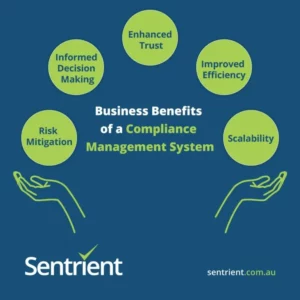
- Risk mitigation: Problems are found while they are still small, because somebody is looking on a schedule rather than after an event.
- Informed decision making: Decisions rest on current compliance data rather than on instinct or on whoever remembers most.
- Enhanced trust: Customers, staff, insurers, regulators and investors can be shown evidence rather than assurances, which is a materially different conversation.
- Improved efficiency: Duplicated effort disappears once there is a single source of truth, and the hours spent assembling information for audits drop sharply.
- Scalability: New sites, states, entities or obligations attach to the existing framework instead of triggering a rebuild. This is what separates a small-business approach from an enterprise one, and it is the point at which most organisations outgrow spreadsheets.

What a Compliance Management System Is Not
Four terms get used as if they were the same thing. They are related and they are not interchangeable, and knowing which one you mean saves a great deal of confusion in a vendor conversation.
| Term | What it actually refers to | Read more |
|---|---|---|
| Compliance management system | The framework: obligations, owners, controls, records, review and reporting. Can exist on paper | This page |
| Compliance management software | The tool that holds the framework and does the tracking. A system can exist without it; at scale it rarely works well without it | What compliance management software does |
| GRC system | Broader again. Joins governance, risk and compliance so an incident updates a risk and a risk informs a governance decision | What is GRC? |
| Compliance program | The set of activities inside the system: policies, training, monitoring, investigations | Components of workplace compliance training |
The mistake this causes
Buying software and assuming you now have a CMS. You have the tool. Whether you have the system depends on whether the obligations are listed, the owners are named and the review cycle exists – none of which the software decides for you. That is also why implementations stall: the missing piece was never technical.
How to Build a Compliance Management System
Six steps to build a CMS. The order matters more than the speed, and the first one is the one most often skipped.
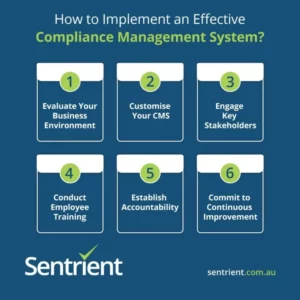
- Map your obligation environment: Identify every regulation, standard and contractual requirement that applies to your industry, your states and your operations, and assess honestly what you already do about each. This is the step that produces the obligations register, and everything afterwards depends on it.
- Shape it to your organisation: Size, sector, geography and risk profile decide what needs depth and what needs a light touch. A manufacturer’s system is weighted differently to a professional services firm’s. Decide what to automate and what to integrate with what you already run.
- Bring stakeholders in early: Leadership, department heads and the people who will use it daily. Each group needs to hear the case in its own terms, and each will identify problems you would otherwise find after go-live.
- Train for roles, not for the software: People need to understand their compliance responsibilities as well as which buttons to press. Tailor it by role, because obligations differ by role.
- Make accountability explicit: Named owners against named obligations, clear reporting lines, and a small set of measures – training completion, overdue actions, time to produce evidence, audit findings closed on time.
- Review on a cycle and keep improving: Regulations change and so does the organisation. Set a review rhythm, use audit results and user feedback, and record what was reviewed – including in the periods when nothing went wrong.
Steps five and six are where most systems quietly fail. A framework with no owners is a document, and a framework nobody reviews stops reflecting reality within about a year. The detailed rollout sequence is in how to implement a GRC system, and what commonly goes wrong is in overcoming GRC implementation challenges.
Do You Need ISO 37301 Certification?
This comes up as soon as the standard does, and the answer for most Australian organisations is no – but the standard is still worth using.
| Working to the standard | Certifying to the standard | |
|---|---|---|
| What it involves | Using AS ISO 37301 as the reference for what your system should contain | An accredited third party audits your system and issues certification |
| What it costs | The price of the standard and the work of aligning to it | Audit fees, surveillance audits and the internal effort of preparing for them |
| Who it suits | Most organisations, most of the time | Organisations where a customer, tender or regulator asks for it, or where certification is itself a commercial asset |
| What it proves | Nothing externally, but your system is built to a recognised definition | That an independent party assessed the system against the requirements |
The honest position
Certification demonstrates that your system meets the requirements. It does not demonstrate that your organisation is compliant, and the two are not the same. Build the system because it makes obligations visible and evidence producible. Certify it if somebody who matters to your business is asking for the certificate.
Where to Go Next on Compliance Systems
| If you are asking | Go to |
|---|---|
| What does the software actually do that a spreadsheet cannot | What is compliance management software and why do you need it |
| Which features matter when comparing products | How to choose the right compliance management software |
| Which named systems should we look at | Top compliance management systems in Australia |
| What is GRC, and how is it broader than compliance | What is GRC? Governance, risk and compliance explained |
| How do we run the rollout | How to implement a GRC system |
| What is changing in Australian compliance right now | GRC trends 2026 |
| What would a system look like | Sentrient’s workplace compliance system · compliance management software |
Start with the list, not the software
If you take one thing from this page: write down every obligation that applies to you and put a name against each one. That single document turns compliance management into a CMS, and it costs nothing but an afternoon.
Sentrient’s workplace compliance system holds the policies, training, incidents and records that sit underneath it. Book a free demo.
Frequently Asked Questions About Compliance Management Systems
1. What Is a Compliance Management System in Simple Terms?
It is the structure an organisation uses to meet its obligations and prove that it did: a list of what you are required to do, a named owner for each, defined processes, records that evidence them, a review cycle and reporting. It is not the same as the software that holds it. The test of whether you have one is whether compliance keeps running when a key person is on leave.
2. What Is the Difference Between Compliance Management and a CMS?
Compliance management is the work: reviewing policies, running training, investigating incidents, preparing for audits. A compliance management system is the structure that makes that work repeatable, assignable and provable. Compliance management answers what and why. A CMS answers how, by whom, and how do we know.
3. Is There an Australian Standard for a CMS?
Yes. AS ISO 37301:2023, Compliance management systems – Requirements with guidance for use, is the current Australian Standard. It identically adopts ISO 37301:2021, was published on 17 February 2023 and carries Amendment 1:2024. It supersedes AS ISO 19600:2015 and applies to organisations of any type, size or sector, including public and non-profit.
4. What Are the Elements of a CMS?
Six, whatever framework you follow: an obligations register, named ownership of each obligation, defined controls and processes, records that evidence them, monitoring and review, and reporting with escalation. The obligations register is the one most often missing, because most organisations build policies and training before they list what they are required to do.
5. Is the Board, Program and Audit Model the Right Framework in Australia?
It is a useful way to think about oversight, program and assurance as three layers, but it comes from United States banking supervision and was written for supervised financial institutions. In Australia the recognised reference is AS ISO 37301. Use the three layers as a mental model if they help; cite the Australian Standard when somebody asks what your framework is based on.
6. Does a Small Business Need a CMS?
AS ISO 37301 applies to organisations regardless of size, so there is no threshold below which the concept stops applying. What changes is the weight of it. A small organisation may run a perfectly adequate CMS on a shared obligations register, named owners and a quarterly review. The trigger for something more is usually multiple sites, anything with expiry dates, or one person being the system.
7. Do We Need ISO 37301 Certification?
Usually not. Certification suits organisations where a customer, tender or regulator asks for it, or where the certificate is itself a commercial asset. Everyone else gets most of the value by working to the standard without certifying. Certification demonstrates your system meets the requirements; it does not demonstrate that your organisation is compliant, and the two are different claims.
8. Is a CMS the Same as Compliance Management Software?
No. The system is the framework: obligations, owners, controls, records, review, reporting. The software is the tool that holds it and does the tracking. You can have a system without software, and you can buy software and still not have a system if the obligations are unlisted and the owners are unnamed. Buying the tool and assuming the framework came with it is the most common expensive mistake in this area.
Disclaimer: This article is general information for Australian organisations, not legal advice. Obligations differ by entity type, size, sector and state, and standards are revised. Confirm what applies to you with a qualified professional. Correct as at September 2026.
Sources
Standards Australia – AS ISO 37301:2023 Compliance management systems
ISO – ISO 37301:2021 Compliance management systems
Safe Work Australia – Duties under WHS laws
Safe Work Australia – Psychosocial hazards
Fair Work Ombudsman – Record-keeping
Fair Work Ombudsman – Criminal prosecution and criminal underpayment offences
OAIC – The Privacy Act
OAIC – Notifiable Data Breaches scheme
OAIC – Notifiable Data Breaches Report: July to December 2024
Safe Work Australia – Key Work Health and Safety Statistics Australia 2025
ASIC – Sustainability reporting